The Pink Caravan that is saving lives
The Pink Caravan tours the far-flung reaches of the emirates trying to save lives
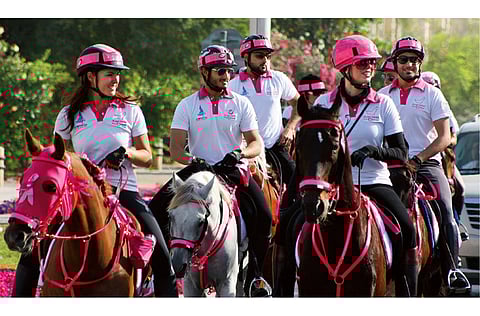
We all face moments of truth throughout our lives, whether it’s a school exam result, a driving test, a job interview, a marriage proposal, or a pregnancy test. The moments just keep on coming, and the results come in the form of phone calls, letters, emails or invitations for a second interview.
Somehow, none of this is any preparation for a recall after a breast cancer health check. Our health and our life suddenly seem fragile. Fear takes over, and many people choose to put the problem aside for another time.
It is this fear that the team at Friends of Cancer Patients (FOCP) wants us to focus on this month. The findings from two years of screening people all over the UAE during its travels with the Pink Caravan, show that for every 900 patients screened, 40 need follow-up tests, but only ten of them return for the tests.
Dr Sawsan Abdul Salam Al Madhi, FOCP’s secretary general, says, “The fear has nothing to do with how smart we are. The first step of going for a breast exam is a big thing. It is a relief when nothing is found, but now we are starting to look at the psychology of patients who do not return for another check.
“Unfortunately we have no vaccination or miracle pill for breast cancer. One in eight ladies will develop breast cancer in their lifetime, and this is a fact we all have to deal with. On the other hand, an early diagnosis and quick treatment shows a very high recovery rate of 98 per cent.”
For the past two years, the Pink Caravan has covered hundreds of kilometres, visiting far-reaching corners of the UAE. It consists of a mobile medical unit with specialist staff, accompanied in style by riders on horses decked in pink saddle cloths and pink bridles. It has been a huge success so far, and it is set to carry on for two more years at least.
The caravan started out as FOCP’s tenth anniversary push to take awareness to people’s front doors. “Some women may have a two-hour drive to the nearest place for a check-up,” Dr Sawsan explains. “We needed to reach out to them.” So far the team has screened a total of 15,000 people. Interestingly, as young men get the message that they too can get breast cancer, they are also queuing for check-ups – in fact 3,000 have done so far.
Breast cancer has a slightly different pattern in the UAE, where patients tend to get it about ten years earlier than in other countries.
There is no definitive research on this yet, but it is thought that lifestyle choices, such as an unhealthy diet and lack of exercise, may be factors. For women under the age of 40, an ultrasound is recommended rather than a mammogram, as their breast tissue is very dense and this affects image quality.
The team has to find a delicate and sensitive balance, so that if the dreaded recall comes, it is as early as possible. They need to get younger women into the habit of self-examination, stressing the importance of regular check-ups without scaring them. Women over 40 are advised to have a mammogram every two years.
Huda Abdul Kader Mohammed is FOCP’s medical awareness executive, and it is her task to get these messages across, so that people in the UAE can get the treatment that they need. “We keep our talks short, but our main aim is to make girls as aware of their breasts as they are of their hands,” she says. “We get them to close their eyes and describe what they think their hands look like. Everyone can do that, but when we ask them to describe their breasts, they are quiet. Some may have been told by their mothers not to look at their breasts, so we have to encourage them that it is alright to do so. If they know their breasts, they can be alert if changes occur.”
It is true that about nine out of ten recalls in the UAE will need no further action, but that doesn’t help a woman petrified by the thought of being the one in ten that does. Dr Sawsan says, “We have been speaking about breast cancer for the past 12 years, and the voice is becoming louder and louder. “Perhaps it is now time to find a way of putting breast cancer into a new context. Early treatment can save your life, and it can be cured. Even so, we do link cancer with death, and it will take a lot of education to change this mindset around the word.”
Between April 1-17 this year, the Pink Caravan stopped at 49 locations, from Khorfakkan to Manama, Jumeirah to Masafi. The response so far has been better than expected. “We thought we would have to knock on doors to persuade people to come for an examination, but they are coming to us as we arrive,” says Dr Sawsan. So perhaps the fear factor comes later in the process, although with few statistics to go by, that is hard to prove.
In the UK, where the National Health Service Breast Screening Programme has run since 1988, 1.3 million women are screened, and about 10,000 cases of breast cancer are detected each year. One in four women invited to a screening don’t go.
The Programme reports, “There is a delicate balance between reducing recall rates so far that small cancers are not missed, and calling back too many women, which may reduce re-attendance.” In many cases, the anxiety is mixed with practical considerations, as a woman may be fearful of abandoning her family duties if she needs treatment.
The FOCP’s programmes and research manager Lize De Jonge says simply, “Please don’t live with the ‘what if’ by not going back for your second examination if you get recalled. The fear will only grow.” And according to Dr Sawsan, cultural differences don’t really come into this. “Fear is universal, every culture is the same. We may express ourselves differently, but every woman will feel the same fear.
“Our job is to speak clearly, get our points across with no jargon, and speak in a woman’s own language,” says Dr Sawsan, who also wants to start a GCC cancer registry, so practitioners can call on data to see trends and patterns, set priorities and form policies.
Confronting your fear ultimately comes down to individual courage and moral support, no matter how many statistics are available. Huda speaks to women facing their fears all the time. She says, “It is very important to pass on information with the right attitude, and to be a good listener.” If you’re worried about breast cancer and wondering what to do, ask yourself, ‘Am I prepared to take that risk?’
For support and information, you can call Friends Of Cancer Patients on 06 5065542, 8am-4pm, visit its website at: www.focp.ae or join its facebook page. Or contact the support group, Brest Friends, at www.brestfriends.org or email info@brestfriends.org.
‘I hoped the lump would go away’
When Patricia Southcombe discovered a lump in her right breast last November, she went for a mammogram at Al Zahra Hospital in Sharjah straight away. The next day, she was recalled for an ultrasound, but this time she did nothing – she didn’t even tell her artist husband, Christopher.
“I was wishing the lump would go away, but it didn’t,” she says. “I was petrified. It was hell not talking to my husband about it, but I really was frightened. Every day I would check the lump, then check the other breast. It was the fear of being told it was cancer.” One month later, she finally told Christopher what had been going on; the next day he took her back to Al Zahra, where an ultrasound scan and a biopsy revealed she had cancer. Patricia, 69, flew home to England, where she had a mastectomy.
She spent 18 weeks in England, staying with her sister who had also gone through breast cancer. Patricia and her husband have lived abroad for 30 years, and in Sharjah for the past 17 years.
Husband Christopher says, “If wives are concerned what their husbands will think, I say that the body doesn’t matter, it’s what is inside that makes the person. We need to treat women as exactly the same person they were before. Love is the most powerful force, and I love Patricia as much now, if not more than before.”
Patricia adds, “If it is cancer, you must act. I went numb when it happened to me, and even now it makes me cry. Inside we all feel the same at this time, petrified. But it has to be faced, you cannot shut it out.”


![Global experts will examine how health data, genomics and digital tools could transform medicine during the Future Health Summit 2026. [Illustrative image]](http://media.assettype.com/gulfnews%2Fimport%2F2023%2F07%2F19%2FOPN-AI-HEALTHCARE_1896e7cdbff_large.jpg?w=320&auto=format%2Ccompress&fit=max)
