Oil spell
The varieties of oils available make life easy and difficult.
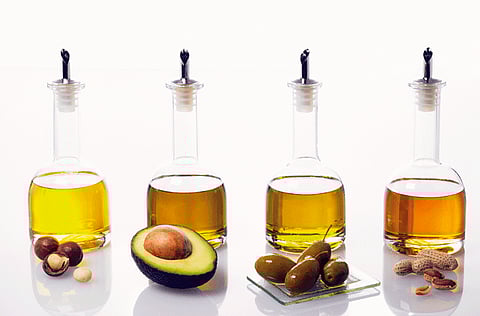
"It is easy on the lips, tough on the hips." When Lovely Ranganath, nutrition consultant, HealthTrendz, quotes this oft-repeated phrase, it's less sloganeering and more of a mission statement on the issue of fried foods. Of course we all love fried foods. Science has established that fat provides a ‘mouth feel' that releases a sense of feel-goodness in the body. Creamy ice creams, fresh-from-the-deep-fat-fryer goodies, luscious cream-filled puffs... just biting into a pillow of fat can make you feel life is a wonderful thing.
But as is the case with many other things in life, a few moments of pleasure can lead to much heartburn later on. In the case of fatty foods, this is a literal truth. Before we get down to the real issue of why all oils are not well, the fact of oil being a healthy source of energy is indisputable. What is disputable is the kind of oil, its use and abuse. Deep-frying, for instance, is a sure-fire way to damage otherwise healthy oils. When subjected to high temperatures, oils get oxidised, promoting free radicals which as has been said countless times by health experts are the villains in our fight to stay healthy.
Why oils are good for you
Oils can be extracted from seeds, vegetables and plants. Some of them are known to be the richest sources of omega-3 and omega-6 fatty acids. And this is why it is important to know how to choose the right oils that boost your health. There are many oils that are health promoters.
"Almond oil, for example," says Ranganath, "is a rich source of monounsaturated. A high-heat cooking oil, it has a clean flavour too that is pleasing to the palate. The same is true for apricot kernel and avocado oils, which, again, are excellent sources of monounsaturated fats. You can use them for deep-frying. You may also use them to sauté food on high heat.
"Canola oil is another good all-purpose oil as it has a medium-high smoke point (the temperature at which cooking fat begins to break down and smoke). Other good oils are corn oil, grapeseed oil, peanut oil, safflower, sunflower, sesame, soy and walnut oils, all of which make for ideal cooking mediums.
"Flaxseed [also known as linseed], hemp, pumpkin, sunflower, safflower, sesame and maize oils are also excellent sources of omega-3 and omega-6 fatty acids as are walnut, soybeans and wheatgerm oils that are rich in Omega-6 fatty acids."
The heroes and the villains
Now that the grocery list of healthy cooking oils has been drawn up, let's get down to Lesson 101 in one of the most important areas of fat - saturated fats or trans-fats. While saturated fats raise total blood cholesterol as well as the bad cholesterol (LDL), trans-fats raise LDL and lower good cholesterol (HDL). On the other hand, good fats are divided into two categories: monounsaturated fats and polyunsaturated fats.
The former lower total cholesterol as well as LDL and boost HDL (high density lipids that clear arteries of fat). Polyunsaturated fats, like the omega-3 fatty acids, lower total cholesterol and LDL. This is why using cooking oils rich in monounsaturated and polyunsaturated fats is a yes-yes and oils high in saturated fats and trans-fats a no-no.
"The heroes in the world of cooking oils," says Ranganath, "are canola, flaxseed, peanut, olive, safflower, sunflower and corn oils. The villains are vegetable shortening, hard margarine, butter, palm oil, palm kernel oil and [yes] coconut oil, as they are high in trans-fats and saturated fats."
What about the nomenclature of oils? If a brand of oil is labelled ‘pure', it is because it contains only one type of oil, says Ranganath. But vegetable oils are blended from various sources. They are mostly odourless and have a neutral flavour. They are extracted from a variety of plants through the cold press process or using chemical solvents. They are known to be cholesterol-free because they do not contain any animal products.
Canola oil is processed from rapeseeds. It is great for use as an all-purpose cooking oil as it contains no cholesterol and has a high percentage of monounsaturated fats. It also has a high smoke point.
"Don't be carried away by the term ‘light oil' because it is only referring to the colour and fragrance, not the calories or fat content," she says. One of the most important considerations with oils is an individual oil's smoking point. Some oils tolerate high temperatures without affecting its health properties while others are better off being heated to lesser temperatures. Still others, like olive oil, for instance, are best when eaten raw, as dressing on salads.
Good oils for deep-frying: Corn, safflower, sunflower, soy or canola oils. Why? Because they have a higher smoke point. It is best not to fry with olive oil as its smoke point is lower.
Whatever oil and method you choose to prepare your food based on the above suggestions, what's not to be ignored is the message that use oils sparingly in your daily diet. "At all times, keep your fat intake between 20 to 35 per cent of the total number of calories you consume daily. Go easy on portion-size because at the end of the day, all oils are high in calories and fat content. This will help keep your heart healthy as well."
Flavoured oils and the fuss
An interesting and increasingly popular choice, flavoured oils, also known as infused oils, are made by extracting aromatic oils from flavouring agents like garlic and lemon and then emulsifying them with a high-grade oil. This infusion is then placed in a centrifuge to get rid of any impurities. By using aromatics in oils, the flavour of food is enhanced.
A wide range of flavoured oils with olive and canola oils as the base are available in most major supermarkets in the UAE. Popular ones include lemon, basil, garlic and mixed herbs. These oils can be used as a dip for breads or as a light-heat cooking medium or as flavouring agents in barbecue and other marinades, salad dressings, sauces and in main course recipes."
More categories
In the case of olive oil, in particular, the types can leave a consumer quite confused. "Extra-virgin, virgin and pure oils (in olive oil) are decided on the levels of the acidity of the oil," says Ranganath. "Normally, one should prefer to use oils with the least amount of processing time involved [in its extraction] that ensures a very low acid content."
In case of olive oils, when it is 100 per cent unadulterated, unheated and the result of the first cold-press, it is called ‘virgin olive oil' It may, however, vary in quality depending on the percentage of oleic acid in it. Ideally it contains about 3 per cent of the acid. But the ‘extra-virgin olive oil' contains approximately 1 per cent of oleic acid. On the other hand, ‘pure olive oil' is extracted from the leftover pulp of the first cold-press. In this case, heat and few chemicals are used to extract it. This is why this type of oil is lighter in flavour and heaper than ‘virgin' and ‘extra-virgin' olive oils.
***
With such a dizzying variety to choose from, buying an oil may seem like rocket science but it is not. A few basic guidelines are all that need to be kept in mind:
1) What kind of food do you want to prepare? If it is a deep-fried item, choose an oil that has a very high smoke point (almond oil and apricot kernel oil both at 495°F; avocado oil at 450°F). Do not fry in olive oil as it has a low smoke point at 375°F.
2) Do you want a light touch of oil for drizzling over salads, dips or a smear over bread? Good oils: olive oil, tea oil (available in stores selling specialty organic products), sesame oil.
3) Do you wish to shallow fry, light-cook in oil at medium temperatures? Choose from canola, corn and sunflower oil.
Above all, remember, the world of oils is divided into the good and the not-so-good as explained in the article. The good guys are rich in polyunsaturated and monounsaturated fats. The bad guys are rich in saturated and trans-fats.
Pick the former and walk past the latter in the supermarket aisles. Enjoy eating feel-good foods made in healthy oils. But, as is the case with everything in life, moderation is the most fail-proof way to enjoy life.
The essence of omega fats
These fats contain linoleic acid, which is derived from the omega-3 fat family. It is converted by the body into gamma-linolenic acid (GLA). GLA has two fats.
Some GLA is converted into arachidonic acid, which is used to build the brain, along with the omega-3 fat docosahexaenoic acid (DHA). GLA is also converted into di-homo gamma linolenic acid (DGLA) and from there into prostaglandins (hormone-like active substances).
Prostaglandins by themselves cannot be supplemented as they have a very short lifespan. This is why we have to rely on omega-6 fatty acids. The ones made from these omega-6 oils are called Series 1 Prostaglandins. They keep the blood thin and prevent clots and blockages, lower blood pressure and perform a host of functions to maintain and improve body functions.
On the other hand, there is the alpha-linolenic acid (ALA) from the omega-3 fat family. It gives us the metabolically active EPA (eicosapentaenoic acid) and DHA (from which Series 3 Prostaglandins are made). This is essential for proper brain function or else it might affect vision, learning ability, coordination and mood. They also help to reduce the stickiness of the blood. Additionally, they help control blood cholesterol and fat levels, help improve immune function and metabolism, help reduce inflammation and maintain water balance.
Information courtesy Lovely Ranganath


