Keep calm and quit
Sometimes quitting can be the best way to move life forward, says Sharon Parsons
Even when she eventually qualified as a junior doctor and began work at a large city hospital in London, Aisha, now 34, found herself frequently miserable and dissatisfied. “Despite that, it didn’t occur to me that I could do something else – I knew it was a prestigious career and I felt guilty that I didn’t enjoy it more. Then one day when I was complaining yet again to a friend, she simply said, ‘Well, if you really hate your job so much, why don’t you quit and do something else?’ It was like an epiphany – I realised I could actually do just that.
“Telling my family I was going to walk away from a medical career was so hard – but ultimately all I felt was relief. I knew I wanted to do something more creative, and while it hasn’t always been plain sailing, six years on, I’ve carved out a career as a journalist specialising in health – ironically – and I’m so much happier. I only wish I’d had the courage to quit earlier.”
It’s undeniably true that in today’s success-driven society, giving up on something that isn’t working – be it a job, a relationship or any other kind of commitment – is far from easy. From childhood, we’re taught that staying the course no matter what shows strength of character, fortitude and loyalty, whereas walking away means quite the opposite.
“So often we regard quitting as a terrible weakness,” says British health author and psychotherapist Dr Andrew Reeves. “We’re especially hard on ourselves, believing that giving up on something equals failure. Unsurprisingly, we’re also worried about what other people will think: we define ourselves by our jobs and status, and the peer pressure to maintain these outward signs of achievement can be incredibly forceful.”
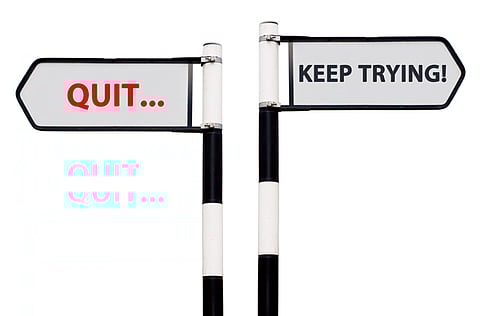
Caught at a crossroads
Obviously, nobody would advocate throwing in the towel without a lot of careful thought. Our reasons for wanting to quit could just be down to a blip – a tough period at work or a rough patch in a marriage, for instance. Riding the storm, and putting in the time and effort necessary may well get things back on an even keel.
“If you’re not sure what to do, put some boundaries in place,” suggests Dr Reeves. “Ask yourself what is currently acceptable in your situation – and what isn’t. Being able to consider that puts you in a much stronger position about whether to stay, go or just to try to make necessary changes to improve your circumstances. That in itself is immensely empowering.”
There is also, it must be said, a huge difference between quitting mindfully and running away if something is difficult: some challenges need to be endured in order to reap the rewards down the line. This could mean anything from learning to drive to mastering technology, or putting in hard graft for a much-deserved promotion. “In these circumstances, appreciating that there’s no other way and staying the course is to be commended – especially when the prize is an obvious one,” says British health and well-being consultant Liz Tucker.
Keeping your options open
Sometimes, unrealistic expectations may mean we’re forced to quit. Sara*, a marketing executive and a busy mother of three, was determined to fulfil a long-held ambition – namely, to learn French – and enrolled on an intensive six-month correspondence course. “At first it was great,” she says. “I carved out specific study times during the week, and kept on top of the mountain of work I was expected to do. Friends and family were impressed by my dedication.”
Indeed, this approach can prove a successful middle ground in many situations. “You might feel you have no other option but to give something up at a particular moment in time, but the door doesn’t have to shut completely,” Dr Wyne points out. “You can always go back and try again when you’re better placed to do so.”
Finally, have faith in yourself: while the cost of walking away can be high, doing it well also shows tremendous self-respect and awareness, not to mention courage. “Perhaps it’s time we stopped using the word ‘quitting’ altogether,” says Liz Tucker. “It can be much more liberating to think of our actions in terms of ‘moving on’ – and embracing the changes and opportunities that come with that.”
HANG IN THERE?
Thinking of throwing in the towel? Here’s how to make the right decision:
- Be honest “Ask yourself if you’re really giving up on something because you want to begin a new stage in your life, or if it’s more about running away from a difficult situation that should be faced,” advises Dr Tara Wyne of The LightHouse Arabia. “Knowing yourself is key.”
- Keep a diary Record both the good and the bad aspects of a situation over a period of time before you make a final decision. It helps keep things in perspective by providing an accurate in-the-moment account of what’s happening.
- Weigh it up “Do a happiness percentage check. If you feel unhappy for more than 70 per cent of the time – and you can’t see a way to rectify the situation – it’s fairly obvious things have to change,” says psychotherapist Dr Andrew Reeves.
- Plan your move Don’t quit in the heat of the moment – take your time to ensure that you have a clear and realistic strategy for moving forward. It will help immeasurably to have a structured plan in place, especially during wobbly moments.
- Be positive A study carried out by Northwestern University in Chicago found that changing your mindset from focusing on what you might lose to what you might gain through walking away is extremely motivating, and makes the process seem far more manageable.
*Names have been changed


