A helping hand to hope
Determination to lead a normal life drove a mother to opt for revolutionary surgery
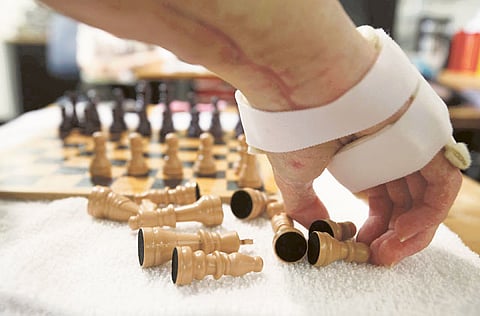
When Emily Fennell walks into a store or the hair salon, people often ask, "What happened to your hand?" She gets a kick out of their reaction when she casually replies, "I had a hand transplant."
"They say, ‘Can they really do that?'" she said, glancing down at the soft brace that covers her right forearm and wrist, slender fingers and neatly trimmed fingernails peeking from the bottom. Yes, they can. Fennell strolls around Los Angeles's Westwood section as living proof. On March 5, Fennell became the first person to undergo a hand transplant in California and the 13th in America to have the revolutionary surgery. At the time, the 26-year-old single mother from Yuba City wished to remain anonymous. Now, a few weeks after the 14-hour operation at Ronald Reagan UCLA Medical Centre, she is talking about her journey.
It was a car accident almost five years ago that took her right hand. "It's crazy how good it looks," she said at her occupational therapy session one morning at UCLA, where she spends about eight hours a day working on learning how to move her new hand and fingers. "I knew the match wouldn't be perfect, but if you didn't know what happened, you'd think I just had some kind of orthopaedic surgery."
On June 11, 2006, Fennell was a passenger in the front seat of a car that was clipped by another vehicle and rolled over. The sunroof was open. Fennell's hand went through the space and was caught between the car and the road. The mangled hand had to be amputated. "About a week after the accident, my mum said, ‘You can be the kind of person who says ‘Woe is me' and gives up, or you can say, ‘I'm moving on.' I chose that one," she said. She learnt to use her left hand to write, dress, drive a car and work in an office typing 40 words per minute. When she received a prosthetic arm six months after the accident, she had already mastered many tasks with her left hand and, after months of trying, concluded that the prosthesis wasn't helping. But she wanted to be able to do more for herself and her daughter, now six. She heard about hand transplants from a friend who was also an amputee and immediately began researching the surgery. She was evaluated at UCLA and accepted into its newly formed transplant programme to wait for a suitable donor hand to become available.
Doctors told her the biggest risk comes from the side-effects of lifelong use of strong immunosuppressant medications, which can cause high blood pressure, kidney or liver damage, elevated cancer risks and lower resistance to infections. These have rendered hand transplants more controversial than other forms of transplant because, unlike a heart or a kidney transplant, receiving a new hand is not a life-and-death matter. "I decided the benefits were worth those risks," Fennel said.
The rehabilitation process has a long way to go but she has made the ordeal look simple, said Dr Kodi Azari, surgical director of UCLA's hand transplant programme. Doctors, nurses and therapists scrutinise her every move, make copious notes and have only recently began to relax a little, he said.
At the therapy session, Azari watches as his patient places cylinder blocks into a pegboard, one of a variety of drills aimed at teaching dexterity to the new hand. With the brace off, one can see Fennell's scar — it loops halfway down her forearm, then sweeps back up and around. The donor hand was not attached in a straight line encircling Fennell's wrist like a bracelet. Instead, a circuitous incision was made to prevent a roll of scar tissue from forming at the wrist, which could impair movement. The therapy continues with ever smaller items that Fennel is challenged to grasp.
Therapist Renee Portenier asks her to try to pick up a nickel-sized disc between her thumb and index finger. All the muscles and tendons in her right forearm are weak from years of inactivity and must be strengthened before she can begin to truly take command of her new hand. Sitting quietly, her left hand in her lap, Fennel tries to grip the piece. She raises and swivels her shoulder to lift and rotate the hand above the disc and bring it straight down to touch it. Her fingers tremble but she manages to close her forefinger and thumb on the disc and lift it. She has no sensation yet in the transplanted hand. The nerves grow about one millimetre a day from the connections the surgeons made to her arm and it will be several months before sensations develop.
Like any 26-year-old, Fennell is eager to get on with her life. Once home from UCLA, she will have regular occupational therapy. Improvements can be expected for several years and she should eventually obtain about 60 per cent of the function of a normal hand. The transplanted hand will always be weaker. But Fennell has a mental list of future milestones to celebrate as her hand becomes serviceable. Pull her hair into a ponytail. Cut up meat with a fork and knife. Hug her daughter "with both hands". "You know," she said. "Little things."


