Where redemption lies
An intense tale of 1950s’ America, and how humanity survives against all odds
Home
By Toni Morrison,
Knopf, 160 pages, $24
The meaning of home is often connected with comfort, relationships, family and friends that give meaning to our lives. It is also related to memory. Toni Morrison’s latest novel, a brief but intense tale set in the early 1950s, suggests that sometimes home is the best and only place you can go.
“Home” opens with Frank Money, a Korean War veteran, escaping from a mental hospital. The deaths of his two friends — whom he had known “before they were toilet-trained” — and acts of violence that he has committed, particularly the shooting of a small Korean girl, have scarred him as much as growing up in Lotus, Georgia, a town where “there was no future, only long stretches of killing time”.
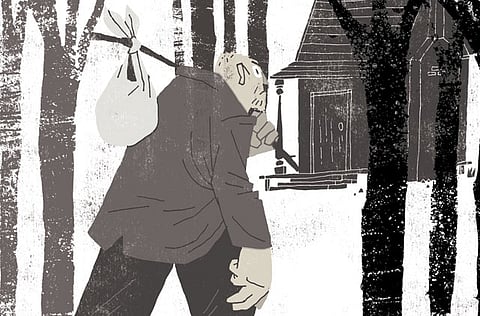
Driven by a letter he receives from a doctor’s housekeeper about his younger sister Cee — “Come fast. She be dead if you tarry” — Frank sets out to rescue his beloved sister, and himself in the process. Penniless and apparently defeated, Frank, who doesn’t even have shoes to walk in, has no place to take Cee but back to Lotus and the home he has hated all his life. A brief stay with a mean grandmother proved to have a lasting effect on both of them; Frank and Cee grew up to only depend on each other.
During his journey back home, Frank is helped by people, with train fare, food and clothes, but he is also frisked by cops and jumped by gangsters. Struggling with a fractured masculinity, Frank brings his grievously injured sister to Lotus, and Cee is taken over by “those women with seen-it-all eyes” who have faced down poverty and prejudice and loss all their lives.
They handle Cee’s sickness as though it were an affront, an illegal, invading braggart who needed whipping. The women repair what an educated bandit doctor had plundered. They bring Cee back, and teach her quilting, a skill “they had been taught by their mothers during the period that rich people called the Depression and they called life”.
“Home” is the sort of novel for which it is best not to give too much plot away — Morrison has a fine way of building tension, leaving gaps that the reader must fill with speculation until the truth is revealed at the moment that provides most dramatic satisfaction.
One of America’s greatest living novelists, a Nobel laureate who was awarded the prize in 1993, Morrison has earned her place as a literary icon. As expected from a writer of her stature, Morrison touches on the injustice of poverty, made worse by race and gender, yet her characters never lose their humanity — “Home” is riddled with memorable characters and their emotional insights.
Tightly composed, fast and fluid in its storytelling, unflinching conversations in Morrison’s deeply moving novella are short, direct and have the capacity to leave a reader awestruck. The narration is split between Frank, Cee and Frank’s lover, Lily. It hops from present to past, and from interior to exterior perspectives — all packed in just 145 pages.
The notion of home returns many times: One example is where Lily, the seamstress, is denied the house she wants because the owners will sell only to whites.
Earlier, Lenore, Frank and Cee’s unloving step-grandmother, resents the intrusion of children into her own sanctuary, and her contempt for Cee stems from the girl being born “on the road”.
“Decent women, she said, delivered babies at home, in a bed attended to by good Christian women who knew what to do. ... Being born in the street — or the gutter, as she usually put it — was prelude to a sinful, worthless life.”
Cee herself seeks some kind of shelter, though her choices prove to be wrong. Made timid by her grandmother’s bullying, she marries a good-looking man, with big-city accent, who married her because she has access to an automobile. She finds what she thinks is a perfect place to work and live, only to be subjected to an arrogant doctor’s experiments, which puts her life in jeopardy.
Morrison is anything but predictable. Long claimed by feminists as one of their own, albeit one who refused to stick to the script, the novella is filled with such precise images that lift the scene out of a stock situation. Morrison’s prose has an easy grace that ensures that the pages slip by without undue difficulty.
With both siblings experiencing a rite-of-passage, we see Cee’s transformation is dealt with relatively briskly. She speaks, by the end, as a woman whose consciousness has been raised. Branded early as an unlovable, barely tolerated “gutter” child by Lenore, Cee wants to be the one who rescued her own self — gutted, infertile, but not beaten. She could know the truth, accept it, and keep on quilting.
In the meantime, Frank, too, discovers a community, fresh and ancient, safe and demanding, in Lotus that was unknown to him as a child and a profound courage he had thought he could never possess again. He buries his guilt and shame, finds the healing and strength to move on.
Both discover that home is not exactly the way they remember it, but some things never change; the way time functioned in Lotus is subject to anybody’s interpretation; children still laughed, ran, shouted their names; and women sang in their backyards.
It is no paradise, but there is redemption.


