Visions of towering strength
Banking and finance have until recently been a relatively secondary activity in the context of Malaysia's ever-evolving economy, but especially in the Islamic element have become part of a primary policy objective of strategic economic renewal
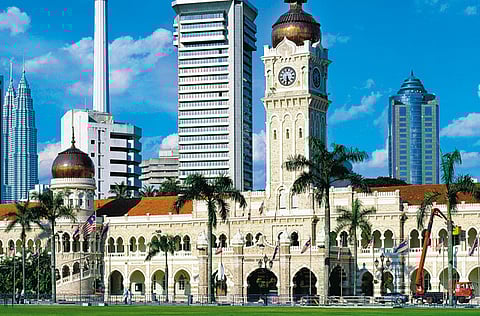
While some of the more well-established financial centres have been emerging only slowly and steadily from the shock of the international credit crunch, one financial centre could be said to have had a relatively good crisis.
Indeed Malaysia has seen significant growth in this pivotal sector, and is looking to consolidate its position as a diversified and efficient hub for the region.
The financial industry had already been advancing prior to the downturn, with its contribution to the country's GDP rising to 11 per cent in 2008 from around 9 per cent in 2000.
Over the past three years it has expanded at the rate of 8.8 per cent a year, overtaking the pace of real GDP growth.
The Islamic banking and takaful segment has been a major factor, growing at 19 per cent and 25 per cent respectively in the past five years to 122 billion Malaysian ringgit (Dh139.6 billion) and 6.6 billion ringgit.
More is to come. Development of Malaysia's Islamic financial sector is seen as a national strategic priority, and the full authority of the state is behind expansion plans. Last year the prime minister announced liberalisation to create opportunities for another seven foreign banks by 2012. In addition, up to two new takaful licences were issued.
These measures follow on from Bank Negara — the Malaysia Central Bank — fast-tracking such licences in 2006 and 2007 to Al Rajhi Bank of Saudi Arabia, Kuwait Finance House, and Qatar Islamic Bank. Two years ago approval was granted for the acquisition of a stake by Dubai International Group in the flagship Bank Islam Malaysia Berhad, the first Islamic bank to be authorised in Malaysia, in 1983.
According to the Banker magazine's 2009 survey of the top 500 Islamic financial institutions, Malaysia ranks third behind Iran and Saudi Arabia in terms of Sharia-compliant banking assets, with $86 billion (Dh315.8 billion). In terms of the number of Islamic banks, the survey ranks Malaysia third with 53 institutions, behind Bahrain and Kuwait.
About 45 per cent of all sukuk, the most well-established Islamic financial product, issued in the first seven months of last year took place in Kuala Lumpur, according to Standard & Poor's, raising $9.3 billion and putting Malaysia first in the global league table for issuance, far ahead of Saudi Arabia's 22 per cent. Bank Negara has stated that Malaysia's total outstanding sukuk — both public and private — amount to $66 billion, or 62 per cent of global outstanding issuance.
The state-owned oil company Petronas reinforced the country's standing in the Islamic sector by issuing a $1.5 billion global sukuk — the world's largest — in August 2009 as part of a $4.5 billion debt offering.
But the focus is not on banking alone. Islamic fund management is well established, with 149 Islamic funds domiciled and managed in Malaysia by late last year, according to PriceWaterhouseCoopers, compared with 131 in Saudi Arabia. Meanwhile, an Islamic commodities market is under development.
The reasons behind Malaysia's success in developing this market are manifold, but not least is the wholehearted support of the government, keen to develop the country's service industries. In 2006 the Malaysia International Islamic Financial Centre (MIFC) initiative was launched to promote aspirations in this field.
It has been a collaborative effort between regulators, officials from relevant government agencies, and participants from the banking, takaful and capital market sectors.
In addition the government created a tax-friendly regime for the sector, which includes stamp duty exemption of 20 per cent on Islamic financing instruments.
However, more significant is the issue of regulation. Malaysia's approach, which has been described as being more pragmatic than in other countries, has provided a high degree of legal certainty for issuers and investors, as well as an environment favourable to innovation. Whereas, by comparison, there are competing schools of Sharia interpretation in the Gulf, Malaysia recognises only one source of religious legitimacy — rulings by its own Sharia Advisory Council.
Malaysia is taking a broad perspective, looking to develop links with other financial centres, in both developed and developing markets. Agreements have been signed with Bahrain, Dubai and Qatar to collaborate on developing Islamic finance, including mutual recognition of common standards. Malaysia is also collaborating with non-Muslim countries interested in developing their Islamic finance businesses — such as the UK, France and South Korea.
While Malaysia will still have to compete with the better-known and increasingly competitive centres of Singapore and Hong Kong, and lately Indonesia, its strong operating framework based on sound governance and risk management systems, in addition to a broad offering of Islamic financial products constantly being enhanced by sophisticated innovation, should enable it to maintain its leading position as Asia's Islamic finance hub.
Transforming the economy
The Malaysian economy has been actually undergoing a period of transformation for several decades, shifting from a natural commodity platform to becoming a manufacturing-based economy, and more latterly applying a growing focus on moving up the value-added chain, notably in electronics. Its next intended phase is into the higher-income, knowledge-based realm, taking it away from lower-cost competition in the region.
One constant throughout this period has been the prominence of international trade. Exports represent more than 110 per cent of the country's GDP, and this dependence on overseas sales negatively impacted the Malaysian economy as foreign demand fell away in the recent global crunch.
Nonetheless, the economy was underpinned by a well-regulated financial sector, sustained growth in private consumption and increased public spending, which limited the downside in 2009.
Recent performance has been encouraging. Latest industrial production data suggest the first-quarter growth will be well into double-digits year-on-year, and full-year GDP is now heading for 7 per cent or more, while inflation remains low and pressures appear benign.
Yet, like other Asian exporters, Malaysia is looking now to build upon domestic demand, particularly through expanding its service sector.
During the early stages of its economic development Malaysia was heavily dependent on its commodity exports — as early as the 19th century it was providing 55 per cent of the world's tin. Agriculture came increasingly to the fore, in particular the cultivation of rubber-yielding trees, satisfying the demand from new industries, notably the car industry. Plantations switched to a new crop, oil palms, a product used primarily in foodstuffs, and by the 1960s Malaysia was supplying 20 per cent of world demand for this commodity. The product range was extended by a rapid increase in the export of hardwood timber to markets mainly in East Asia and Australasia.
A major addition to the country's list of primary products came with the discovery of large deposits of oil and natural gas in the 1970s. It is these offshore assets that have underpinned the country's economy in the past few decades.
According to BP's Statistical Yearbook, Malaysia produced 34 million tonnes of oil in 2008, amounting to roughly 1 per cent of global production, and 62.5 billion cubic metres of natural gas, roughly 2 per cent of total output. Efficiently managed, Petronas, the state-owned oil company — through a combination of taxes, dividends and royalties — is the single largest contributor to the government budget, accounting for a staggering 45 per cent of the central government's revenues.
In common with other Asian countries, from the late 1980s through to the Asian crisis of 1997 the Malaysian economy grew apace, recording growth of around 9 per cent per annum as it diversified into manufacturing, particularly of electronic components.
Benefiting from foreign direct investment (FDI) from international brands such as Sanyo, Toshiba, Matsushita and Philips, Malaysia is one of the world's largest exporters of electronics. The industry currently accounts for nearly 30 per cent of the country's manufacturing output and just over 55 per cent of exports. The ratio of commodities to manufacturing, once 94:6, was reversed by year 2000 to 20:80.
The same dynamism with which manufacturing was built is already producing results in new areas such as banking and finance. The country has developed itself not just into a regional hub for Islamic finance, but on a scale challenging the Middle East centres.
Other sectors showing growth potential are information and communications technology, medical tourism, education and training, management services, logistics and oil and gas services. As in other sectors, government is playing an active role through easing restrictions on foreign investors and the employment of foreign specialists and professionals in order to attract increased levels of FDI.
Hardly surprisingly, FDI fell significantly in 2009, but Malaysia, despite increased competition from other Asean countries, notably Vietnam, hopes to see levels pick up again. One means to do so is relentless efforts to expand and improve infrastructure. The country boasts a well-developed transport system, both road and rail, which link up key growth centres to ports and airports. With 95 per cent of Malaysia's trade carried out by sea, seven state-of-the-art ports offer some of the top facilities in Asia. Industries are chiefly situated in over 200 industrial estates or parks and 14 Free Industrial Zones extended throughout the country, which are continually being replenished by new sites.
Prime minister Najib Razak has set a target of 70 per cent of GDP by way of services in the future, up from 54 per cent currently. The recent announcement of a change of strategic economic model — to ally traditional high savings rates with greater investment in a supply-sided reform programme, and cut budget deficits via privatisations — has been dubbed Najibnomics by Clare Chin, head of research at stockbrokers CLSA Securities Malaysia. Speaking to Financial Review in Kuala Lumpur, she said "cyclical recovery is the easy part; it's the structural story now" which needs to take over, confirming that natural scepticism of reforms is gradually being overcome.
Malaysia seems to be not only back on track in the short term, but, by government commitment and the prospect of public-private partnerships, to be laying the ground for an even stronger long-term future.
- The writer is a freelance journalist.


