The subtext of time
One person loves life, another wants hers to end immediately. They meet Dor, who has had a taste of eternal life
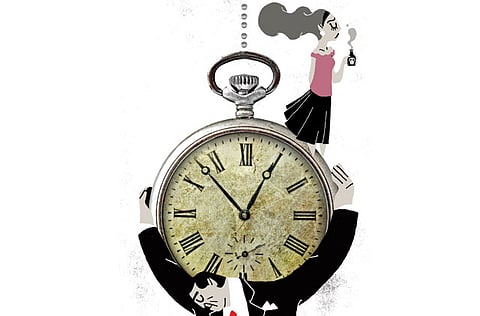
Accuracy improved at a startling rate. Although it took until the 16th century for the minute hand to be invented, by the 17th century, the pendulum clock was accurate to within a minute a day. Less than a hundred years later, it was within a second.
Time became an industry. People now wake up to clanging alarms. Business adheres to “hours of operation”.
Mitch Albom’s new book explores an idea that is so simple, yet infinitely complex: time. There is always a quest for more minutes, more hours, faster progress to accomplish more each day. The simple joy of living is gone.
“Timekeeper” also investigates the shared human experiences. We all love and lose our loved ones. Whatever our gender, economics or outlooks, we are all essentially alone and wondering what life is about. Birds are not late. Deer do not fear of time running out. Man alone measures time, and not make the most of it.
Albom imagines Father Time, Dor, who is banished to a cave for centuries for trying to measure God’s greatest gift, which is time. For 6,000 years, Dor is sentenced to eternal life, granted immunity from the passing moments — the planet grows older but he doesn’t use a breath. He hears the cries of all humanity throughout the generations — cries about time and their desire to dominate it. He is given a chance to redeem himself by teaching Sarah Lemon and Victor Delamonte — two people belonging to two different worlds, one high school and fast food, the other boardrooms and white tablecloths — about the true meaning of time.
Sarah is a bright student who gets perfect grades, and has a promising future. She falls in love with an out-of-her-league boy, but humiliation of Ethan’s rejection, the shame caused by his friends and the shock of seeing her secrets exposed on Facebook, have her future shattered to such an extent that the thought of poisoning herself gives her relief.
On the other hand, after a successful life and a long marriage, the world’s 14th richest man, Victor, is on dialysis to help him live few more months. Victor wants to buy himself more time on Earth — even willing his lifeless body frozen in a cryonics lab to return when there is a cure for his cancer.
Sarah wants less time. Victor wants eternity. The contrast is pure: agonising but calm, understated yet vivid, and totally believable.
Dor steps into the lives of Sarah and Victor, but the complexity of their worlds baffles him. Dor comes from a time when if you wished to speak with someone, you walked to see them. This time is different. The tools of this era — phones, computers — enable people to move at a blurring pace. Yet despite all they have accomplished, they are never at peace. They constantly check their devices to see what time it is — the very thing Dor had tried to determine with a stick, a stone and a shadow.
Father Time is charged with the mission of helping them both realise that control over time is more of a curse than a blessing. It had taken Dor all these centuries to comprehend the last thing the old man said to him: “Everything man does today to be efficient, to fill the hour. It does not satisfy. It only makes him hungry to do more. Man wants to own his existence. But no one owns time.”
Dor himself learns how controlling time is no gift.
In the last few chapters, Dor freezes time, takes his subjects into the future and shows them how the decisions they have made affect those whom they now realise they love the most.
Albom is an impressive shape-shifter, and each world — world before time was invented and the present-day time-hungry world — feels complete and convincing.
What works in “Timekeeper” is the admirable simplicity of Albom’s prose — beneath its outward straightforwardness lies a hauntingly complex exploration of the recurring patterns that life inevitable follows, of how once we begin to chime the hour, we lose the ability to be satisfied.
It is part of the fun of reading this novel that much of it reminds you of other stories, in prose and film. You are on familiar but never stale territory, and you read on with the growing conviction that you can live for 200 years and blow every one of them or you can have 20 years and live every one of them to the hilt. It is a timely tale, gripping and well-told. “There is a reason God limits our days,” Dor says at a critical time of self-discovery. “To make each one precious.”
Each short chapter is broken up with bold-type subheadings, letting readers skim the narrative quickly, in outline form. It stops and starts and throws up more questions. But in the end it does what any good novel should — it unsettles, it moves, and it forces us to question our life in a fast-paced, wonderful world.


