The short film route to fame
Amna Ehtesham Khaishgi will be rubbing shoulders with Hollywood's finest
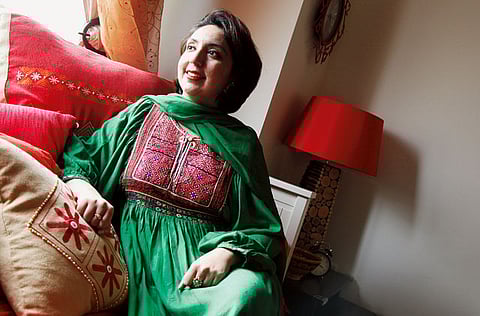
Head bowed over her work, Amma Ji Hajra Begum is busy sewing in her tailoring shop in the famous Meena Bazar, in Karachi, Pakistan. Her embroidery is exquisite and she squints as she inspects the detailed pattern, before staring straight into the camera.
Amma Ji, who has been running her store for the last 45 years, isn't just a widow who has kept her five children fed and educated thanks to her sewing skills, after her husband died when she was just 22. She is also one of the stars of Kingdom of Women, a nine-minute short film shot by Dubai-based Amna Ehtesham Khaishgi, which is being shown at the short film corner at the 2012 Cannes Film Festival.
Panning in on her weathered and worn face, Amma Ji smiles. "I want to die beside this sewing machine," she tells her customers.
In that frame she pays homage to the women-only Bazar, the place that helped hold her family together, and which fascinated movie maker Amna.
"My short film is a tribute to these uneducated, sometimes rural women, with no financial or social support system to really count on, who find an inner strength to stand up and make something of their lives,'' says Amna, whose previous short film Touch Wood was also screened at Cannes two years ago.
She is the only Pakistani shortfilmaker to receive that honour, while her other film, Leap of Faith (2010) was screened in the Emirates Film Competition at the Abu Dhabi Film Festival to rave reviews.
"I have never been to Cannes and I'm looking forward to it,'' Amna tells Friday, on the eve of her departure. "I'm proud that I'm showcasing one of the most amazing places in Pakistan and the most amazing group of people I found making a living there.''
Set up to help women in need
The celebrated Meena Bazar, located in the heart of the city, may appear to be an old and rather insignificant building. However, the circular structure is a major landmark much visited by the city's residents as it offers products and services at hugely discounted prices. "It was set up in the 1950s to help poor and helpless women - particularly widows - to eke out a living,'' says Amna.
On the first floor of the building are more than a hundred small, box-shaped, open shops that sell a plethora of beauty products, household goods and other items for women. There are also scores of beauty salons offering henna treatments as well as tailoring shops.
"The authorities laid a few ground rules when they set up the bazar - the shops would be registered in the names of the women, only women would be allowed to buy and sell goods, and no male below the age of six would be allowed to shop there. This was to prevent any potential problems that could arise in a women-only shopping area,'' says Amna, 35.
At the entrance to the stairs is an elderly security guard with a long stick by his side to shoo away troublemakers and ensure that the ‘no male above six' rule is implemented strictly.
A magnet for people interested in people
"The all-women market in Karachi is a dynamic, exciting and amazing place,'' Amna says. Her film shows in close up the intricate relationships women have with each other, and the haggling that takes place between them and their customers. "The hustle and bustle of the place, the excitement in the air, the sheer array of stuff that was available there all contributed to make the place a magnet for people, including me,'' says Amna, who first decided to make a film about it two years ago.
She researched the bazar in libraries and met women veterans from the area before setting off with her camera last June, to do her recce. "I spent several days there meeting and talking to some of the women in the bazar, getting them to open up to me and then towards the end of June started shooting,'' she says.
"We spent about 15 days absorbing as much as we could and shot around 12 hours of footage, which I then whittled down to nine minutes. The film offers subtle vignettes of the lives of some of these self-sustaining women, far-removed from sophisticated corporate women and yet, much more mature and committed to the idea of helping their families, no matter what.''
No stranger to the limelight, Amna has completed several courses in TV production and filmmaking including a Reuters course on TV production and a documentary production course conducted by the Documentary Filmmakers Group, London.
Her short films tell riveting stories about ordinary people and life from an ordinary woman's perspective.
Touch Wood, for instance, produced by Abu Dhabi Film Commission under a programme called New Voices, recounts the life of a carpenter in Abu Dhabi who has been living in the UAE for 40 years and witnessed the success story of this country. He speaks of his hopes and dreams, as well as meeting with the late Shaikh Zayed Bin Sultan Al Nahyan, the UAE's founding father.
Amna's 25-minute movie, Leap of Faith, was produced by the Abu Dhabi Film Commission (ADFC) and told the story of four Europeans who embrace Islam.
"Making short films can be a true test of one's ability, as the director has just three to around 25 minutes to tell a good story and make a significant impact," Amna says. "There's no luxury of time like with full-length feature films. We need to cut to the chase, and make sure the end product is poignant or funny or soul-stirring in a matter of minutes."
Storytelling is never compromised
Admitting that it's often not easy to raise funds for short films, Amna says she produced Kingdom of Women on her own, although she was fortunate to have the support of the ADFC to help with the post production.
"I put in a huge chunk of my savings in this film as I did not want to seek funds from corporates because that would have meant having to compromise my ideas and the way I want to tell a story,'' she says. "I've really struggled to raise funds taking up several small jobs and saving every single dirham so I could realise my dream of making quality films.
"In the initial days, I remember my husband Ehtesham (Shahid, an Indian journalist) and I used to survive on a few shawermas a day so we could save up money to fund the short films,'' she says.
"But I am proud that it's all worth it as the films are being recognised. I've received some lovely words of praise and encouragement from people such as eminent Lebanese filmmaker Mahmoud Kaabour and the director of the ADFC, David Shepherd.''
So many stories to tell
Amna believes there are so many untold stories about the expat community. "The country has great potential for becoming the cynosure of regional cinema and leading to some amazing untold stories," she says.
The former magazine journalist moved here in 2003, which she says was a turning point for her as it gave her several opportunities to grow.
Amna worked as an assistant producer at ARY TV here, working her way up to Vice President Production. She then moved to GEO TV heading documentaries and international productions in Dubai before deciding to go solo and be an independent writer and filmmaker.
Even though she is no doubt rubbing shoulders with Hollywood's finest at Cannes, which began on May 16 and runs until Sunday, Amna has her feet firmly on the ground. With a Master's in International Relations from Karachi University, she is currently working on a doctorate on ‘The Role of Nationalist Cinema on Indo-Pak Relations'.
Now an independent journalist, Amna is also working on a script for a full-length feature film. "It would be on the lines of a Hollywood or Bollywood commercial entertainer,'' she says.
"It is on blue collar workers in the region and will be a positive story of how the UAE has helped give a life to thousands of such expatriate workers.
"Yes, it's going to be a commercial film, but it will be an intelligent commercial film. I am keeping my fingers crossed. Hopefully, that too will make its way to Cannes.''


