More than one way to tap the market
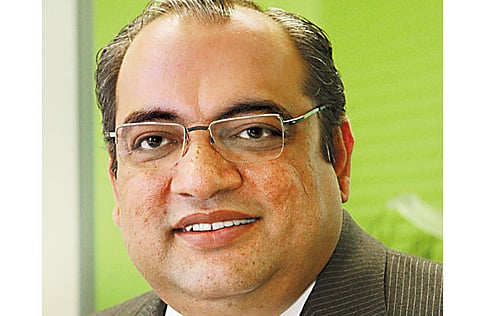
Arup Mukhopadhyay, tells Financial Review that the retail segment is a strategic growth engine.
Are banks in the UAE, including Abu Dhabi Commercial Bank (ADCB), looking at more retail business for asset growth?
Retail is definitely an identified strategic growth area for ADCB. And it is not necessarily for asset growth, but it's essentially a strategic growth engine as a business segment.
But has it not come into focus given the financial crisis and corporate business side of the banks being under pressure?
That's a fair point. It's only natural that given the general difficulty in the market that was witnessed last year and the ensuing weakness, asset growth or balance sheet growth is going to be limited, definitely on the institutional side or the wholesale banking side. So ADCB is really looking at two strong growth engines: one is, of course, retail, and the other is SMEs.
Within the retail business, what are your focal points?
One is the credit card business and the other is the mass affluent business, which is represented by our two segmented offerings of Privilege and Excellency. We are also pretty passionate about a new area we are trying to develop, which is in the education segment, not just in loans but education by itself. I think graduate and postgraduate education matures and grows, and the UAE is making a lot of investment in this field. We want to be a contributor and participant in that process.
What about retail deposits?
We basically doubled our deposit base on the retail side in five years. Our average CAGR (compound annual growth rate) is about 20 per cent in the past five years. The way to grow retail deposits is to grow customers. In the Privilege segment, these are customers who are not yet high net worth, but are definitely potentially high-net-worth customers, with a relationship balance of anything between $50,000 (Dh183,660) and $150,000. Our Excellency offering is for those who have a relationship balance of more than $150,000 with us. It has been a multi-pronged approach to grow our mass affluent business. It has grown about 40 per cent in the last year or so. We have focused on growing the customer propositions, enhancing service. Our online banking platform has been voted by Global Finance as the best online engine in the UAE.
Have you expanded in regard of branches?
We are not necessarily a branch-intensive company; we have 49 branches. But we would arguably be a very large consumer franchise, [as] we invest in our branch network in new areas of growth. We concentrate on building a state-of-the-art, online banking platform as well as a mobile banking platform. Seventy-five per cent of our customers are registered on our mobile banking. Forty per cent plus of our customers are on our online banking, which are very high for this region in terms of penetration levels. Twenty per cent of our loan volumes typically will be over the phone.
We believe this [multi-channel strategy] is the right one to follow, leveraging both people and technology. We also have other areas where we have invested in alternate distributions. For example, we have a very successful co-brand with the Lulu Hypermarkets chain and a presence [there]. Today it's a mature co-brand with more than 40,000 customers and growing strongly.
Which retail segments have been the most profitable and how much have they grown?
Credit cards have been one of our biggest successes. Five years back ADCB did not have a very big credit card business, in fact it was insignificant. Our business has grown ten times in the past five years, and today we are a significant player in the market, [with] a 7 per cent share. We don't look at share of cards because that's not relevant. That is subject to regulatory approval. When the acquisition and integration happens with the Royal Bank of Scotland (RBS), our share of the market will actually double. We have a large personal loans business, which is extremely profitable. We also built a mortgage business, also profitable.
But what about impairment provisions on the retail portfolio?
We were reasonably prudent in growing our asset business even during the good times. At the height of the recession last year, our net impairment charge in the retail portfolio was actually under 4 per cent. If you add the high-net-worth lending business, which is completely different, then the net impairment charge actually comes down to 2 per cent.
On mortgage finance, we have stuck to our principles. We never did 97 per cent LTVs (loan-to-value ratio) or 100 per cent LTVs. We have always lent first to the profile and then to the collateral. Eighty per cent of our mortgage customer base earn salaries of more than Dh20,000 per month. Seventy per cent of our portfolios are on completed properties. These are factors that have contributed to keeping the credit loss down even in the most difficult period that we have seen. [That's] apart from the various proactive steps that [we] take on the credit management side in terms of policy measures, in terms of process measures, in terms of collection efficiencies.
Going forward, what are the kind of provisions you have to keep aside at the retail end for the next few quarters?
Two or three points are germane. First to note is that when the analysts are talking [in this area], they are talking about the bank as a whole and the market as a whole, including the entire business with corporate banking, investment banking, etc. Second, in retail banking we have a pretty conservative provisioning policy. In fact more than 95 per cent of my delinquent book is actually provisioned for, which is not necessary. The problem is that there is not a uniform guideline in how you should look at provisions. So I don't know if the other banks follow the same, prudent provisioning norms.
The third point is I wish I had a crystal ball; I don't know [the future]. But all indications, learning from the general market as well as our own portfolio, are that probably the worst is behind us. The job losses and salary cuts actually happened in the first quarter of last year. We saw our worst figures in the third quarter of 2009. Post-recession, all our graphs are pointing in the right direction. I would still be hesitant to say that market is in recovery, but I can confidently say that it has stabilised, and is tending to look better.
How about the RBS portfolio in this respect?
It is not a worry. While I can't get into specifics, I can make two generic statements. One, when we did our due diligence, we did not see anything in that portfolio that would not be expected in the period that market went through in the past two years. The trends in the portfolio in terms of pre-crisis, during and post-crisis were very similar to what we had seen in our own portfolio. That gave us confidence that there are no gremlins in that asset book.
So what are your plans to grow?
There are a couple of things that our CEO has spoken about. One, in the medium term [of] the next couple of years we intend to be a UAE-focused business, which is our core business, and why this particular opportunity [the RBS purchase] is an extremely good one. While we would always be agile and open to opportunities, currently we are not taking any inorganic opportunities outside of the UAE.
Coming to growing organically, it is not only about branches. We believe in the multi-pronged strategy. We will add branches in new areas that we are not represented in, expanding the ATM network, [and] continue to invest in our online and mobile banking platforms. We would continue to invest in people and training as well as growing the distribution in the identified areas of growth. We have been agile to opportunities. We have just launched the Etihad co-brand, a focused programme.
What are the kinds of risks out there, and how will ADCB cope with them?
I am no economic expert, [but] I don't see a ‘double-dip'. The worst that can happen in the retail segment is that we have an economic downturn again and the corporate sector is forced to cut costs and initiatives and retrench staff. Our business depends on salaried people. When people lose their jobs, that's when our business gets hit. What we can try to do or afford to do is to manage such risk proactively. So we are keeping a tab on the economy.
We talk to, through our corporate business, a lot of institutions to get an idea of what's happening. In my opinion, it's going to be a period of slow growth. So we are, if I may use a clichéd phrase, cautiously optimistic about the future. Fundamentally this country is quite strong. It's a matter of time before it rebounds.
What is your view about a credit bureau, the Emcredit in Dubai?
There is no question that this market requires a credit bureau, and the faster we have it the better. However, I would like to add that a credit bureau has to be under the auspices of the regulator that regulates the bank. That is when this process would become ideal.
We have actually participated with Emcredit — we have subscribed to a couple of their products. But I strongly believe that we need a central credit bureau under the auspices of the Central Bank. I would expect a national credit bureau with laid-down guidelines from the banking regulator on what to share and what level of data, etc., to make the process more watertight.


