Filipino lawmakers approve family planning
Catholic and pro-life groups are lobbying in courts to question the law’s constitutionality
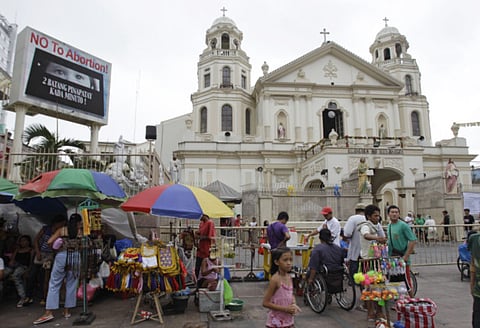
The Responsible Parenthood and Reproductive Health Act of 2012 (RA 10354) is controversial to say the least, having passed through several amendments, sparking heated debates and prayer rallies, and creating a great divide between those who believe that such a law is instrumental to a progressive nation and those who argue that certain provisions go against traditional family values and religious conscience.
Divisiveness was apparent not only in the congress or the senate but within families and communities as well. Frustrations grew, tempers flared. When it was all over, the Roman Catholic Church retreated with a warning that reconciliation with the government will not be possible as long as the law is in effect.
Filipinos have in the past years have been witness to some of the most dramatic national events. In the past decade alone, the nation watched on as former president Joseph Ejercito Estrada was ousted and sentenced for plunder, and years later, as his successor Gloria Macapagal-Arroyo was tried and arrested for electoral fraud. The House of Representatives impeached a chief justice in 2012 and an ombudsman in 2011, both appointed to office by Arroyo.
The nation found itself divided once again when provincial representatives pushed for the resumption of deliberations on a bill that was vehemently opposed by leaders of the Roman Catholic Church from the outset.
Major provisions
The newly approved measures stipulate that “all effective and natural modern methods of family planning that are medically safe and legal” will be promoted “without bias”. Under the law, abortion is recognised as illegal but women are given a right to receive care for post-abortion complications and counselling in a “humane, non-judgmental and compassionate manner”.
Government health centres and hospitals nationwide would be subsidised for birth control facilities for the benefit of those who cannot afford them. A “multidimensional approach” integrates certain components of family planning and responsible parenthood into all anti-poverty programmes initiated by the government.
The law also states that sex education would be taught in public schools across the country from the fifth grade to the fourth year in high school. Employers will also be mandated to partner with health-care providers in providing reproductive health services to their female employees. Bigger companies that employ more than 200 workers must make available family planning services and reproductive health services to workers.
The Responsible Parenthood and Reproductive Health Act stipulates that the national government and local governments will ensure that reproductive health-care services, including prenatal care and family planning services, are available to all. Failure to comply will result in fines or imprisonment.
Defeating the ‘Catholic vote’
Surveys showed that a majority of Filipinos wanted the bill passed but since the Roman Catholic Church remains a highly influential institution in the country, its approval was far from certain.
Versions of the bill have been filed earlier — the first one was the Integrated Population and Development Act of 1999 — but it wasn’t until the 14th congress that things started getting serious. When the latest version, known as the Reproductive Health Bill (RH Bill), finally reached the stage in the legislative process when the House of Representatives could debate it in plenary, the nation started to pay close attention to the proceedings.
Supporters and opponents of the bill took to the streets and netizens engaged in heated arguments via social media sites. Bishops rallied their parishioners to oppose the bill and to withdraw electoral support for politicians who endorse it, amid criticism from citizens of them meddling with affairs of the state.
In August 2012, the parliament agreed to terminate debates and begin a vote, heeding an appeal by President Benigno Aquino III. The period of amendments began four months later, despite critics applying parliamentary tactics to further delay deliberations.
The house voted “yes” to the bill, 113-104 in the first reading.
With three session weeks left before Congress is set to go on a holiday break, the president took the nation by surprise when he certified RA 10354 as urgent. He had always been evasive about his stance on signing the RH bill ever since his presidential campaign. The third and final reading in the house went in favour of the bill, 133-79.
The Senate voted in favour of the RH Bill, 13-8, but not before amendments proposed by Senate President Juan Ponce Enrile, who is not in favour of the law, were turned down.
To make things more interesting, a controversy involving Majority Leader Vicente Sotto III drew public attention away from the bill for a short while. In a senate speech explaining his opposing vote, the senator prompted strong reactions from netizens who accused him of using copyrighted material by three US-based bloggers without properly crediting them. The bloggers have since filed complaints before the Philippine Senate Ethics Committee.
Finally on December 21, 2012, after 14 years of deliberations that seemed to be going nowhere, President Aquino signed the Republic Act No 10354, otherwise known as the “Responsible Parenthood and Reproductive Health Act of 2012” into law, two years into his term as the chief executive.
Fertility rate stands out in Asia
The Philippines recorded a fertility rate of 3.15 in 2011. The figure is higher than many of its Asian neighbours who are implementing measures to deal with low fertility rates. Catholics arguing against the bill warned that the country might face the same problem of a rapidly ageing population if contraceptives are made available to the public.
The Philippines is now ranked the 43rd-largest economy in the world by the International Monetary Fund, and Goldman Sachs predicts that it will be the 14th-largest by 2050. Last December, a World Bank official stated that the country is once again a “rising tiger” and no longer the “sick man” of Asia. Despite the figures, poverty remains one of the biggest problems of the Southeast Asian nation.
The population has grown approximately 45 per cent between 1990 and 2008. As of 2012, the Philippines is the world’s 12th most populous country in the world. And while economic outlook is generally on a rising trend, 45 per cent of Filipinos still consider themselves “poor”, according to the 2012 Survey Review by the Social Weather Station. Close to half of the population of 94 million earns a daily income of less than $2.
Gilden Urjillas, 45, from Caloocan City has had seven children, two of whom died in infancy. One was born prematurely and the other died of pneumonia a year after birth.
“She was hooked up to oxygen tanks but then we had to cut them off as we could not afford treatment any longer,” Urjillas recounts. Her family sought help from charitable foundations to be able to pay hospital bills. Urjillas offers laundry services to several customers, although she is unemployed at the moment because she is busy taking care of her youngest child, who is just four months old. Her husband works odd jobs to provide for the family and to send the younger children to school.
She admits that raising her children is beyond her family’s means but says she accepted her unplanned pregnancies wholeheartedly. A devout Catholic who is an active member of a church organisation, Urjillas says she has only used natural birth control methods.
“A child, as they say, is a blessing. If you are given a blessing, you do not refuse,” she says. Two deaths in the family had been quite tough to deal with but according to Urjillas, the birth of their youngest child, albeit unexpected, has helped her and her family recover from the pain.
Church opposition
Now that the law has been passed, Catholic and pro-life groups are lobbying in courts, questioning the law’s constitutionality. As of now, eight petitions have been filed in court calling for the law to be repealed. In its en banc session early in February, the high court did not issue a temporary restraining order but consolidated the petitions.
In the course of events since the bill was presented in 11th congress to its final enactment in December, the Roman Catholic Church had been very vocal about its opposition. At one point, President Aquino said he might even be facing excommunication from the church.
“I am resolved to enact into law the principles of responsible parenthood. I am aware there are those who oppose this but it is my duty as our country’s leader to reach out to all sectors … even if there are those who have said that I should be excommunicated. Ultimately, I need to make a stand. I need to follow my conscience, and I need to do what is right,” he said in April 2012.
Church leaders argue that public access to contraceptives will only lead to young people engaging in premarital sex. “The youth are being made to believe that sex before marriage is acceptable, provided you know how to avoid pregnancy. Is this moral? Those who corrupt the minds of children will invoke divine wrath on themselves,” the Catholic Bishops’ Conference of the Philippines (CBCP) stated in a pastoral letter.
The Roman Catholic Church equates contraception with abortion, which is illegal in the country. “These artificial means are fatal to human life, either preventing it from fruition or actually destroying it,” the CBCP said in a statement prior to the voting on the bill in the congress.
By promoting the use of “artificial contraceptives” to Filipinos who reject them, according to the statement, the proposed measure infringes on religious freedom. The organisation even went as far to declare that President Aquino’s support of the bill is a declaration of an “open war” against the Roman Catholic Church.
Faculty members from two of the Philippines’s top Catholic universities, De La Salle University and Ateneo de Manila, openly endorsed the bill. Officially, the aforementioned universities confirmed that they are one with the Roman Catholic Church in its firm stance against the bill, postulating that industrialisation, not population control, is the answer to poverty, citing China as an example.
Religious groups that supported the bill include Iglesia ni Cristo (INC), Seventh-Day Adventists, Philippine Council of Evangelical Churches, United Methodist Church, Episcopal Church of the Philippines, the National Council of Churches in the Philippines, Convention of Philippine Baptist Churches, and Catholics for Reproductive Health.
“ … parents have a moral obligation to plan the number of their children and keep it under control. The Bible states that a parent who does not provide for the needs of his own household is worse than an unbeliever,” INC executive minister Eduardo Manalo said in a statement. INC is one of the largest Christian denominations in Asia with Filipino adherents numbering around 27 million.
The Muslim Mindanao region also issued a religious edict supporting family planning methods that are safe, legal, and in accordance with the Sharia.
Public opinion
Around 81 per cent of the national population is Roman Catholic. However, the National Survey report released by Pulse Asia in October 2010, showed that 69 per cent of Filipinos look favourably upon the bill’s intent to provide information about and access to natural and modern family planning methods as well as to recognise the rights of couples and women to choose a method that suits their needs and does not go against their religious beliefs.
But lawmakers and organisations against the bill cite separate studies, which show completely contradicting results. They claim that nationwide surveys such as those by Pulse Asia and SWS are commissioned by foreign political lobby groups to create a bandwagon effect.
Supporters of the law believe that it paves the way for introducing a better quality of life for Filipino families. Those who oppose insist that the government would be better off focusing on improving health care in general through better facilities in health centres and hospitals. They question the safety of using contraceptives. But proponents say that the risks of pregnancy complications far outweigh those of using artificial birth control methods.
Implementation
RA 10354 officially took effect on January 17 this year. In February, the government set apart ₱21 billion pesos (Dh1.9 billion) for the Department of Health, from which funding for family planning, maternal and infant health, and responsible parenthood programmes would come. Advocates admit they have their work cut out.
“There are major tasks ahead, which hopefully will not be as excruciating and arduous as (the law’s) passage,” Albay’s representative Edcel Lagman, the bill’s principal author, says. “Appropriations would be a continuing battleground starting with the 16th congress … We must assure that in the May elections, the RH advocates get the people’s mandate so that adequate allocation will be given to the law.”
Naomi Ruth Ganhinhin is a writer based in Manila, Philippines


