Polo: The nomadic tribe
An exploration of the game of honour, played on the highest ground in the world
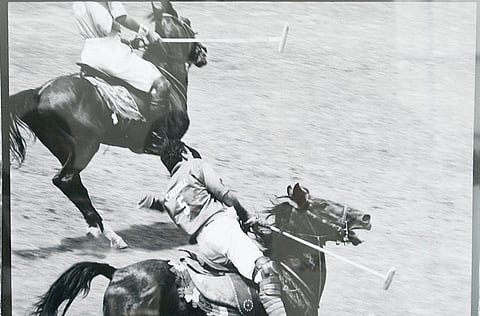
Every year, teams of skilled horse riders take on an incredible challenge. A challenge that is not for money or any kind of prize: except honour. The honour of a valley.
The Shandur Festival is the home of this battle of honour, played between polo teams from Chitral and Gilgit, on the world's highest polo field at almost 4,000 metres in the extreme north of Pakistan.
From Mongolia to Argentina, Pakistan to the United Kingdom, one French photographer has been following a tribe of "crazy" polo players for some time.
The players, Aline Coquelle told Weekend Review on a recent visit to Dubai, are like a "nomadic tribe", playing "the king of sports and the sport of kings".
"Every player trains to reach one dream — make his valley vibrate by winning the supreme trophy of Shandur. To be the kings," Coquelle writes in her narrative photographic book Polo: the Nomadic Tribe.
"It's a voyage of obsession, to find a legend — that of the cavaliers of the Hindu Kush front, who affront each other as close to the sky from the Earth as they can, for their own dignity, on a land that fell to obscure ostracism and confrontation."
Coquelle's descriptive narrative, which accompanies her fascinating photography, takes the perception that polo is a game played by gentlemen far away.
Coquelle has been travelling with polo families, trainers, breeders and horse breakers, who have formed a tribe, whose journeys never stop.
The tribe comprises a cosmopolitan mix of people, she says, with Indian, Arab and Argentine players on the team.
The Shandur Festival is perhaps one of the most impressive of events, as Coquelle herself describes and captures through her lens: "The mountains, glaciers and lakes are as impressive as the horizon. The shadows of riders, a flock of yaks, a nomadic camp of tents of different shapes and sizes as far as the eye can see — it's all stunning. We are a tribe of happy, crazy ones, sharing in the beauty of the stunning environment."
The Parisian photographer graduated with a degree in History of Art and anthropology, and has taken on photo assignments for publications such as Vogue, Conde Nast Traveller and Vanity Fair.
Rituals after the tournament are like a "crude ballet", Coquelle writes, "all games finish with dancing, singing and hot tea is served under the canvas tents, chicken and mutton are grilled… But the absolute must is the care given to the horses, as an apology for having pushed them so hard, a ritual of devotion between a man and his mount."
Her work has taken her far, to East Africa, India, Argentina and Guatemala, for example.
"For me, life is like an offering: My time is homage to life, a vehicle for experiencing sensations and creations that I share and transmit through images."
She travels, because "it is part of my culture and my sense of being", she said.
Coquelle's images capture the essence of polo — the calm before a match, the thrill of the chase, the violence of clashes, horses snorting the hot misty breath of exertion, and the style of those who prefer to watch.
"Photographing such contrasts throughout the world has afforded me a unique opportunity for reflection," she said of her work in Pakistan. "I hope to transmit the light and shadows of places such as Pakistan, [which is a] victim of violent exile."
The country, she continued, is fighting for its peace through their sport — through sport they show how confrontation can also be for peace. "I discovered a passionate and peaceful people; the photos always show this," she said.
Coquelle has published two books, Palm Springs and The Cartier Polo Games, (2005 and 2006, respectively), and contributions to other collective works.
Her forthcoming work Gandhi's Angels focuses on the ten years she spent with Gandhi's disciples in the ashrams in the east of Maharashtra, India.
However, for now, Coquelle is content to carry on her travels with the "crazy" nomadic tribe of polo players.
"They are following the sun, their occupation. I will follow this, passionate [tribe of] horsemen," she said, hoping that "people can discover this tribe".
With translation by Emmanuelle Landais, Staff Reporter.


