Mirroring geometric abstractions
Some of Monir Shahroudy Farmanfarmaian’s works since the 1990s are on display for the first time at Third Line’s new space in Alserkal Avenue
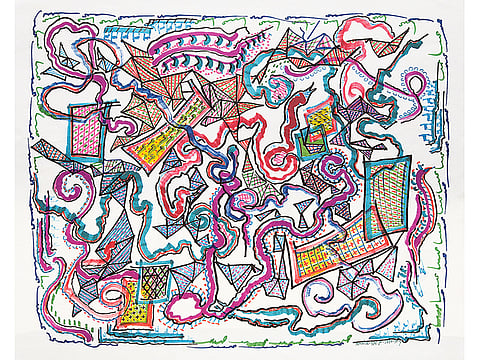
The Third Line is celebrating its move to a new and larger space in Alserkal Avenue with an exhibition of works by renowned Iranian artist Monir Shahroudy Farmanfarmaian. The exhibition titled “Infinite Geometry” showcases the 92-year-old artist’s ongoing experiments with geometric abstraction and a wide variety of materials through her well-known mirror works as well as drawings on paper, hand woven carpets and silver jewellery. The artworks range from pieces created in the 1990s to recent works, all of which have never been exhibited before.
Born in Qazvin, Iran, in 1924, Farmanfarmaian studied art at Cornell University and the Parsons School of Design in the United States. She began her career as a fashion illustrator in New York, where her friends included Andy Warhol and Milton Avery. After returning to Iran in 1957, she got interested in collecting and preserving Iranian arts and crafts and exploring local artistic and architectural traditions.
In the 1970s she was deeply inspired by the traditional Islamic geometric mirror work (aineh-kari) seen in the shrines and mosques of Iran, and began working with master craftsmen to produce her own contemporary interpretations of these ancient designs. The Iranian revolution in 1978 forced her to live as an exile in New York again. During this period she expressed her feelings through text-based drawings and “memory boxes”. She returned to Tehran in 2004 and has continued her experimentation with mirror works as well as new materials and media.
Farmanfarmaian is best known for her mirror works, in which she uses traditional reverse glass painting, mirror mosaics and principles of Islamic geometry to create dazzling, contemporary wall-based panels. Her recent works in the show indicate that her desire to experiment, innovate and explore remains as strong as ever.
In her meditative 2014 “Maze” series, Farmanfarmaian has used mirrors and reverse glass painting on plaster and wood to create labyrinths in various geometric shapes with floral patterns in the centre. The works reference Islamic architecture, philosophy and the concept of the central garden, inviting viewers to discover unknown inner worlds. Other mirror works on display include two spectacular pieces from 2015 that capture the effect of sunrise and sunset through the skilful play of light, reflection, surface texture, colour and form.
Her drawings on paper also combine the cosmic patterning of traditional Islamic geometry with the rhythms of modern Western abstraction. While in the past she has incorporated mirrors, reverse-painted glass and handwritten words into her drawings, she has used glitter to add light and texture to her most recent felt-tip marker and pen drawings. The tightly calculated geometrical compositions, with a multitude of roulette curves, are quite like her recent mirror works, and they are infused with a spirit and energy that belies her age. Through her jewellery, the artist explores geometric forms, textures and play of light in silver and precious stones.
A special feature of the show is a series of felt marker, pen and pencil on paper drawings from 1993, and a set of hand woven carpets based on some of these drawings. The drawings were created while she was living as an exile in New York, and are different from anything she has done since then.
Done spontaneously, the colourful, freehand, whimsical drawings are a subconscious expression of her emotions at a time when she was far away from her homeland and had lost her husband. More than a decade later in 2009, she worked with Iranian weavers in Tabriz and Bijar to transpose the drawings on to wool and hand-dyed silk carpets, complete with her signature.
Exhibited for the first time ever, Farmanfarmaian’s carpets reflect her eternal quest for new media and materials to express herself, and her love for collaborating with traditional craftspeople.
In 2015, the Solomon R. Guggenheim Museum in New York presented a solo exhibition, “Monir Shahroudy Farmanfarmaian: Infinite Possibility”, which looked at the evolution of her visual and conceptual language in a career spanning more than five decades. For art lovers in the UAE, The Third Line’s carefully curated inaugural show in its new space offers a unique opportunity to enjoy the breadth and depth of the work of one of the best known artists from the region.
Jyoti Kalsi is an arts-enthusiast based in Dubai.
“Infinite Geometry” will run at The Third Line, Alserkal Avenue, until January 30.
Wednesdays at the Warehouse
Warehouse 421, the newest arts and cultural destination in Abu Dhabi, has launched a curated programme of creative activities and events. The programme, titled “Wednesdays at the Warehouse”, will be held every alternate Wednesday evening from January 20 until April 27 at the former warehouse turned art space in Mina Zayed district. It includes art workshops, film screenings, panel discussions and exhibitions that are free and open to everyone. It has been organised in collaboration with alumni from the Salama bint Hamdan Al Nahyan Emerging Artists Fellowship, Cinema Akil, the independent cinema platform, and Lest We Forget.
Those interested in participating can register online. For more details and registration, visit www.warehouse421.ae
Quoz Arts Fest
Alserkal Avenue will host the fourth edition of Quoz Arts Fest on January 22 and 23, from 10am to 10pm. The event is a celebration of the arts community in the art quarter of Al Quoz and includes programming by arts organisations and businesses across the neighbourhood, exploring the intersection of visual art, design, film, music, dance and food. At the heart of the event is a programme of music performances, workshops, film screenings, live art and interactive installations presented by Alserkal Avenue that engage audiences of all ages. The event is free and open to the public.
Do it [in Arabic]
Sharjah Art Foundation (SAF) will launch the “do it [in Arabic]” project with an Open Day at Bait Al Shamsi in Al Shuweiheen on January 23, from 10am to 5pm. The event features creative workshops, activations, performances and other thought-provoking activities that are free and open to all.
The project, which runs from January 23 until April 23, is co-curated by Hoor Al Qasimi, director of SAF and Hans Ulrich Obrist, co-director of Serpentine Gallery, London. It is a new iteration of the ongoing “do it” publication and exhibition project originally founded and curated by Obrist in 1993.
Through this project, more than 60 artists from across the region were commissioned to write instructions for creating works of art. These include well-known names such as Etel Adnan, Manal Al Dowayan, Lara Baladi, Abdulnasser Gharem, Hazem Harb, Mona Hatoum, Susan Hefuna, Mohammed Kazem, Ahmed Mater, Hrair Sarkissian, Hassan Sharif and Camille Zakharia.
The instructions are published in the “do it” bilingual publication, along with previously published instructions, and essays that contextualise the project. The general public is invited to view artworks made from these instructions, and to make new works by following the instructions available.
SAF is collaborating with schools, universities and communities across the UAE such as Ajman Centre for Rehabilitation, American University of Sharjah, Al Tamkeen Centre, Emirates Fine Arts Society, Sharjah City for Humanitarian Services, Sharjah International Book Fair, and University of Sharjah to engage the wider community. It also plans to take the project across the region, starting with Darat Al Funun in Amman, Jordan in September.
For more information, write to info@sharjahart.org.
–Jyoti Kalsi


