Cut to the chase
Pecha Kucha Nights foster informal discussion of creative endeavours in a format that emphasises succinct presentation
An American artist who uses light bulbs, fluorescent lights and LEDs to create his installations. A Turkish photographer who hangs out near airports to get the perfect picture of an aeroplane. A Leban-ese schoolgirl who has a passion for writing poetry. An Arab-Russian office worker who draws comic strips about life in Dubai. A Hungarian computer programmer who develops innovative interactive projects. An Austrian artist who visits construction sites to document the making of iconic structures in the UAE. A British social worker who helps children through art. And a Kuwaiti teddy bear, who writes a daily blog. Where in Dubai would you meet all these interesting people? At a Pecha Kucha night, of course. Pecha Kucha nights are informal, fun gatherings where creative people get together and share their work, their ideas, their thoughts or even their holiday pictures.
Pecha Kucha (pronounced peh-chak-cha) is derived from the Japanese term for the sound of conversation or chit-chat. The first Pecha Kucha Night was held in Tokyo in 2003 at the design gallery of Klein Dytham Architecture to provide an opportunity for young designers to meet, network and show their work in public.
What set this event apart from other similar gatherings was the 20x20 presentation format devised by Astrid Klein and Mark Dytham.
The two co-owners of Klein Dytham architecture knew that architects talk too much. In fact, given a PowerPoint and a microphone, any creative person tends to talk on and on. So, their format allowed each presenter to showcase just 20 images, each shown for exactly 20 seconds. The presenters got their six minutes and 40 seconds of fame and the audience got to see over ten presentations in an evening, with plenty of time afterwards for debate and discussion. The format has become so popular that Pecha Kucha Nights are now held in over 230 cities around the world. Pecha Kucha venues include places such as cafés, restaurants, clubs, studios, universities, private homes, the beach and even a quarry.
And the short, informal format encourages all kinds of people to share their ideas, ranging from an art graduate speaking about his first professional project to a grandmother showcasing her elaborate wedding cake creations and a teenager talking about his music collection.
With Dubai's cultural scene developing rapidly, it was inevitable that Pecha Kucha would come to the city. Pecha Kucha Dubai is jointly organised by The Third Line gallery, design gallery Traffic and fashion and lifestyle boutique S*uce. The event is held at The Third Line gallery every three or four months and entrance is free and open to all. The first event was held in December 2007 and received an enthusiastic response. Pecha Kucha Nights have now become one of the biggest interactive art events in Dubai, attracting an eclectic audience and presenters from diverse fields.
As always, the sixth edition of Pecha Kucha Dubai, held at the Third Line gallery on February 3 drew a full house, with people arriving long before the 8.20pm start time. And as usual, the nine presentations were varied and interesting.
The first presenter was Turkish photographer Ozant Kamaci, who has moved to the city just six months ago. In his presentation with a touch of humour, Kamaci described how he spent several months outside Heathrow airport just to get that perfect picture of an aircraft seemingly stuck in a tree.
"I quit my corporate job to study photography in London; and now I teach photography in Dubai. I have never been to a Pecha Kucha event before but I love the concept because art is something that grows when ideas are shared and discussed. I am really happy that my presentation generated a good discussion," he said.
Genoveva Kriechbaum's story was similar. The multimedia artist from Vienna spent four years following her passion, which was to photograph every stage of the construction of the Shaikh Zayed Mosque in Abu Dhabi.
Her presentation, Concrete Memories, took the audience on a visual tour of the grand structure in the making and was peppered with interesting details garnered from the architects, interior designers and others on site.
"This was a personal project and I never planned to exhibit these photographs. But I now realise that these pictures are a valuable legacy because they show this magnificent structure as it will never be seen again and hence I must share them with all lovers of art and history," Kriechbaum said.
Interestingly, after this project, the artist has found her niche as a publisher of books about the "making of" projects such as power plants and oil pipelines.
"I am not good at public speaking but I am happy to be here because a Pecha Kucha Night is an amazing platform to share my work with people from all walks of life," she said.
Peter Saghegy and Attila Malarik came to Pecha Kucha night with a different aim. The artists from Hungary, who work in 3-D, wanted to showcase the innovative interactive applications they have developed and were hoping to find artists interested in collaborating with the company they work for.
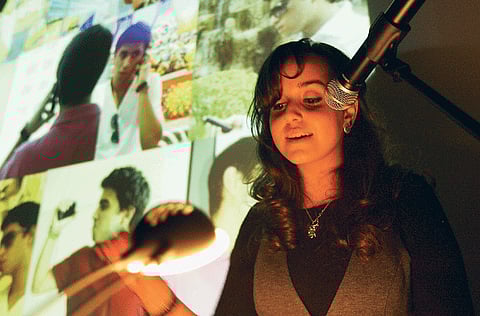
Maya Kaboor brought a refreshing flavour to the evening with her humorous poem about a teenage romance, illustrated with pictures of her friends.
The 15-year-old Lebanese schoolgirl enjoys writing poetry and short stories and is working on a romantic novel.
"My brother made a presentation at Pecha Kucha last year and that motivated me to do the same. I have shared my poems and stories online with people around the world and this was a great way to introduce myself to the creative community in Dubai," Kaboor said.
Like Kaboor, Raed Tulefat has also found a worldwide audience for his webcomic, titled Dubaihippie, through which he presents snippets of life in Dubai. Tulefat, who is of Bahraini and Russian origin, works in an office and art is his hobby.
He used the Pecha Kucha platform to encourage more people to read comics and to create comics about the Arab world.
"Comics are underrated and not respected in the Middle East. I wanted to convey the message that comics are a great tool for storytelling and they should be appreciated as an art form and a medium of communication that should be developed in this region," he said.
Several charity organisations used the forum to create awareness about their social projects.
Sonia Brewin, director of START, an art-based programme by Art Dubai and Al Madad Foundation, made a heartwarming presentation about her team's recent visit to an orphanage in Bethlehem. Antonia Carver, director of Bidoun Projects, and Alia Al Sabia talked about the process of cataloguing the Bidoun Archive's collection of books from and about the Middle East.
Joanna Lambert, a consultant working in the field of sustainable innovation, shared her experiences of developing a European project on providing healthy diet to elderly people and workers living in isolated industrial areas.
The most unusual presenter of the evening was a cuddly teddy bear named Teddy B. The cute bear is the alter ego of a young Kuwaiti architect, who posts a daily photoblog of her experiences in Kuwait city.
"I lived abroad for six years. So when I came back, I decided to use Teddy B as an alter ego and a buffer to help me settle back into my society. Together we discovered the city and its people and everyday I took pictures of him in different places and situations and posted them on my blog.
"I started the blog as a personal project but surprisingly we found many followers. So I now use the blog to comment on socio-cultural issues and support charitable causes. I want to remain anonymous till day 365 of the blog.
"But I was happy to bring Teddy B here today because I want feedback on this project from the creative community in Dubai," said the young lady, who remained in the background, while the spotlight was on Teddy B.
Pecha Kucha organisers try to have a good mix of presentations. Rami Farook, founder/director of Traffic said: "The kind and number of applications we get indicate that there is a rich pool of talent in the UAE. We try to pick ideas that have a strong concept and will entertain and educate. We have had some innovative presenters such as a poet who presented his work to the accompaniment of live music."
Commenting on the 20x20 format, Farook said: "It is challenging but it also makes the presentations exciting. The short-and-sweet format keeps the momentum going. In fact, it is the perfect format for emerging artists or hobby artists, who may not have much work to show. We are happy that Pecha Kucha has helped many budding artists be recognised and new partnerships be formed."
Perhaps one of Pecha Kucha Dubai's best success stories is James Clar. The young American artist works with light, combining technology and art to create innovative illuminated installations. But in Dubai he found himself stuck in a job that provided no scope for creativity. Feeling that his work did not fit here, he had made up his mind to go back to New York, when he heard that Pecha Kucha had come to Dubai.
"I knew about Pecha Kucha and had presented my work in Tokyo. So I thought I would give it one last shot by presenting my work at Pecha Kucha Dubai.
"The response and support was amazing. I realised that there is a growing movement here that wants to push the envelope in terms of creativity. And best of all, I met Rami Farook, who invited me to be an artist in residence at Traffic. Now, I have my studio there. "Together with like-minded people, I am working hard to establish Dubai as a city that welcomes and fosters progressive ideas," said Clar. "And I always try to attend the Pecha Kucha nights here because that is the best way to keep track of what the creative people here are up to."
It is not just artists who look forward to Pecha Kucha nights. The event attracts people from all walks of life such as financial consultant Mohammad Ismail and lawyer Rachel Smith. Ismail, who is Somali, is a regular at the event.
"I think it is fun to hang out with people who do something different from what I do. Many people complain that Dubai has no culture but here you get a chance to hear different views and creative ideas. You can always be sure to see some interesting presentations that provide food for thought," he said.
Smith agreed. "I do not have the patience to listen to long lectures about art but I love the 20x20 format, especially the auto-forward, which forces the presenter to move on to the next slide after 20 seconds. Listening to these creative ideas is exhilarating and a good change from my legal work," she said.
But Italian artist Paolomaria had a different view. "This is like fast food. There is no time to reflect on each idea. And with so many presentations in one evening, I cannot even remember any of them properly," he said. However there is no denying that Pecha Kucha has a big following in Dubai and is set to get bigger.
Financial disctrict adds more zest to Dubai’s vibrant culture scene
One does not expect a financial district to be associated with art and culture. But the Gate Village, located in the heart of the Dubai International Financial Centre (DIFC), is fast emerging as a significant hub of Dubai’s art scene. The Gate Village houses several art galleries, fashion boutiques and restaurants and they have all come together to create a unique event called Art Nights @ Gate Village, which combines elements of art, film, design, fashion and cuisine in a variety of indoor and outdoor events. Launched in January, Art Nights will be held on the last Wednesday of every month. It has been initiated by DIFC Art and Culture, which is a part of DIFC Lifestyle Group and endorsed by Dubai Culture.
“Our aim is to engage the community in Dubai with art and culture and to create a platform for tapping synergies between various artistic disciplines. With its mix of galleries, boutiques and fine-dining options, the Gate Village offers the perfect space for creative interaction and cross-pollination between these disciplines. And events such as these are a great way to enrich the cultural life of the financial district,” says Maitha Al Falasi, acting director, Art and Culture, DIFC Lifestyle Group. Ahmad Humaid Al Tayer, governor of DIFC, adds: “Thanks to the dramatic growth in its art and culture scene, today Dubai is a bridge linking the East and the West not only in the economic and banking sector but also in the sphere of art and culture. DIFC strongly believes that art can play a major role in stimulating new ideas and perspectives in business and hence we will continue to support a growing role for art within the financial services industry and community.”
The inaugural Art Nights held on January 27 was a heady mix, including innovative design, cutting-edge fashion, great food, good music and interesting live performances. It attracted an eclectic group of artists, collectors, art aficionados, fashionistas, bankers, business leaders, corporate honchos and socialites from around the UAE. The highlight of the evening was the opening of a show titled From Matisse to Warhol: Works on Paper by Modern Masters, at the Farjam Collection gallery. The exhibition showcased works by great masters of the 20th century, such as Dali, Picasso and Chagall, and included several pieces that have never been displayed in public before. Art lovers also enjoyed the displays at Opera, Artspace and The Empty Quarter galleries, while Cuadro Gallery enticed visitors with the screening of an art film titled Universe of Keith Haring, which gives a rare insight into the life and work of the iconic contemporary artist. Adding a special artistic touch to the evening were live performances by Dubai-based artistes UBIK and Oliver Abi Rached.
Next door at the luxury fashion store Villa Moda, Dubai-based designers Meher Mirchandani and Riddhima Whabi marked the occasion by launching the spring/summer 2010 collection of their label, Meher and Riddhima with a trunk show. “Our designs are inspired by art and architecture and our garments are an amalgamation of creativity and luxury. So our work fits in well with the theme of Art Nights. We are happy to be part of this event because it has given us the opportunity to showcase our creativity and also to introduce our work and our label to a section of the community that does not usually come to fashion events,” said Mirchandani.
The British brand Andrew Martin contributed to the event with a display of its quirky and stylish design objects such as a wooden sculpture of a horse, a metal robot and an antique car. Dubai Culture also participated in the event by creating a site-specific lounge to create awareness about the Shaikh Mohammad Bin Rashid Al Maktoum Patrons of the Arts Award. This is the first initiative of its kind in the Arab world to recognise those who have made financial or other contributions to the growth of the cultural sector in Dubai.
After visiting the galleries and stores, people wandered into the outdoor area and stayed on to discuss the art, enjoy the lovely weather, the lively music played by the DJ and the array of gastronomic delights offered by Zuma restaurant and its Japanese master chef. “Art Nights is a wonderful concept and the number of people here today indicates that it has been well received. I believe that the amazing art on display and Meher and Riddhima’s vibrant, colourful collection are a reflection of Dubai’s upbeat mood and attitude. I hate it when people put Dubai down. But this event and the energy we can feel here tonight clearly says that you cannot put Dubai down. We will always bounce back,” said Padma Corum, a long-time Dubai resident, event organiser and art and fashion lover.
Jyoti Kalsi is a UAE-based art enthusiast.


