
The science of blisters: Why they form and how to stop them
Why blisters form, and how smarter socks, fit and friction control can help.
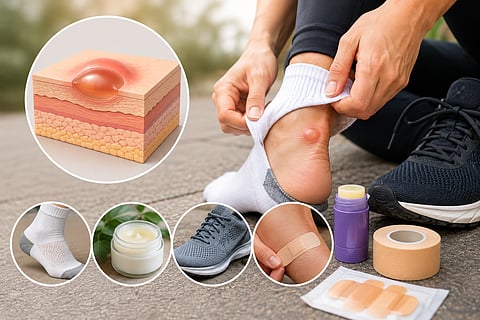
A foot blister is more complicated than a shoe simply rubbing away the skin. A 2024 review in the Journal of Athletic Training describes a friction blister as a tear within the epidermis caused by repeated shear deformation. In other words, the surface of the foot and the shoe do not need to slide dramatically against each other. Small, repeated movements can deform layers of skin until they separate and fluid fills the resulting space. That distinction helps explain why a new pair of school shoes can cause trouble on an ordinary day, while runners may notice the same problem after kilometres in otherwise comfortable trainers.
What causes blisters, and who should think about them?
Pressure, repeated movement and friction all influence the amount of shear experienced by the skin. Moisture matters too because it changes the frictional properties of skin and materials around it. The practical goal is therefore not to make a foot completely friction free, but to reduce repeated shear at vulnerable areas such as the heel and toes.
That is relevant when breaking in school shoes, starting a running programme or spending long periods walking in closed footwear. Warm conditions can also make moisture management more important, a useful consideration for active people in the UAE.
Research does not support every familiar blister remedy equally. The 2024 review found limited clinical evidence for many commonly used strategies, including lubricants and optimised shoe fit, despite their plausible mechanical rationale.
What to look for
Start with fit. Shoes should hold the foot securely without obvious pressure points, while socks should sit smoothly rather than bunching. Low friction sock interfaces can reduce shear forces, according to biomechanical research, although fibre type alone does not guarantee blister prevention.
Treat “blister proof” language cautiously. No sock, balm, plaster or insole can guarantee that a blister will not form. Instead, look for designs that address a specific factor: sock movement and moisture, rubbing between surfaces, or local cushioning.
Balega Blister Resist socks
For running and long walks, Balega approaches the problem through sock construction. Its Blister Resist range combines Drynamix synthetic yarn with mohair and merino wool, while the manufacturer uses seamless construction, cushioning and a deep heel pocket to limit bunching and movement.
Balega lists its No Show version as 34 per cent nylon, 32 per cent recycled polyester, 13 per cent mohair wool and 13 per cent merino wool, alongside smaller amounts of acrylic and elastane. The important principle is the stable, moisture managing interface rather than the “Blister Resist” name itself.
Body Glide Original Anti Chafe Balm
A balm takes a different approach by creating a lubricating layer where repeated rubbing occurs. Body Glide Original is a solid stick intended for application directly to areas prone to friction. Its published ingredients include caprylic/capric triglyceride, cetearyl alcohol, ozokerite wax, glyceryl behenate, stearyl alcohol, allantoin and tocopherol.
For runners who repeatedly notice rubbing at a predictable spot, that makes the stick format convenient to apply before activity. The distinction is important, though: lubrication has a sensible mechanical purpose, but the clinical evidence for lubricants as a reliable method of preventing foot blisters remains insufficient.
Compeed Blister Plasters
Compeed is more relevant once a blister or obvious rubbing point needs cushioning than as an everyday substitute for correctly fitting footwear.
The brand's medium blister plaster uses hydrocolloid material containing moisture absorbing particles, with cushioning intended to redistribute pressure around the area. Compeed also specifies tapered edges designed to move with the skin and reduce further rubbing.
For general first aid use, follow the manufacturer's application instructions and use the product only as directed. Persistent, unusually painful or concerning foot problems should be assessed by a doctor rather than managed solely with a consumer foot care product.
Dr. Scholl's Air-Pillo Comfort Insoles
An insole changes the shoe foot interface rather than covering the skin itself. Dr. Scholl's Air Pillo uses two foam layers, including a soft upper layer and a shock absorbing lower layer, plus Cool Vents and Sure Grip foam intended to reduce wrinkling and bunching. The manufacturer describes the design as thin enough for a wide range of footwear and trim-to-fit.
It is best viewed as a cushioning and fit management option, particularly when an existing shoe has room for an insert. An insole cannot correct fundamentally poor shoe fit, and adding thickness to an already tight shoe may be counterproductive.
Verdict
Blister management makes more sense once the problem is understood as repeated shear rather than simple surface rubbing. Good shoe fit comes first, followed by choosing the intervention that matches the problem. For running and long periods on foot, the Balega Blister Resist socks are the strongest starting point here because their construction addresses sock movement, cushioning and moisture at the shoe foot interface without requiring application to the skin.
Gulf News earns a commission on purchases made through links in this article, at no extra cost to you. Our editorial team selects products independently.


