
Why rowing makes full-body home cardio so efficient
Rowing combines cardio and full-body muscle work with a joint friendly, low-impact stroke
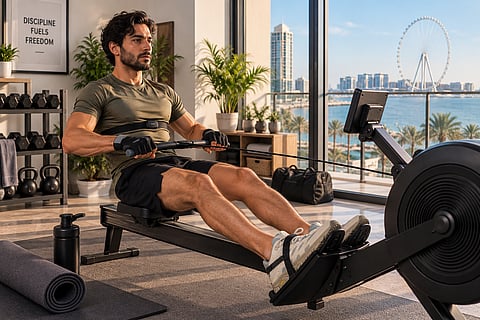
A rowing stroke looks like a pull, but most of the movement begins somewhere else. Concept2's technical breakdown starts the drive with the powerful muscles of the legs, followed by hip movement and then the arms. Across the complete stroke, the quads, glutes, hamstrings, abdominal muscles, back, shoulders and arms all have work to do. Electromyography research has similarly found that rowing depends on coordinated activity between muscle groups rather than one dominant muscle. That combination helps explain why an indoor rower can pack cardiovascular work and substantial whole body involvement into one machine.
What rowing does, and who it suits
Indoor rowing repeats four phases: catch, drive, finish and recovery. From the catch, push through the legs before opening the hips and drawing the handle towards the torso. Reverse that sequence on the way back, sending the arms away, hinging forward and then bending the knees.
The Children's Hospital of Philadelphia describes rowing as low impact exercise. Your feet remain supported and the seat slides rather than requiring repeated landings, so there is none of the foot strike associated with running. Low impact does not mean effortless, and poor technique can still overload muscles and joints.
For UAE homes, rowing has another practical advantage. It provides substantial indoor cardio when heat makes an outdoor session less attractive. Anyone with persistent pain or a medical condition that affects exercise should discuss suitable activity with a doctor.
What to look for in a home rowing setup
Prioritise a smooth stroke and enough resistance adjustment to let you progress without turning every session into a strength test. Check the machine's footprint, user weight rating and storage arrangement against your actual room. Magnetic resistance is useful where quieter operation matters. Technique matters more: drive with the legs first, keep the trunk controlled and let the arms finish the stroke rather than doing all the work.
Recommended rowing gear
MERACH Magnetic Rowing Machine
The MERACH is the foundation of this setup, using magnetic resistance for indoor rowing without the characteristic rush of an air flywheel. The specifications list an LCD display, a maximum recommended user weight of 160kg and dimensions of approximately 96 x 17 x 56.5cm. Its compact dimensions are particularly relevant where a home gym is really a corner of a bedroom or living room. The important feature is adjustable, controlled resistance, which lets beginners concentrate on sequencing the stroke before increasing the workload.
SKY-TOUCH 10mm Exercise Mat
A mat does not improve rowing technique, but it makes a home exercise area easier to manage. The SKY TOUCH model has the dimensions at 180 x 60cm and 10mm thick, with a textured, non slip design. For rowing, its useful role is beneath or alongside the machine, depending on the rower's footprint and your flooring. It also gives you a dedicated surface for mobility work, stretching or floor exercises before and after a session, without pretending that extra cushioning can compensate for poor rowing form.
BEAST RAGE Training Gloves
Training gloves can reduce direct friction between your palms and the handle during repeated strokes. The BEAST RAGE gloves uses a fingerless design with breathable microfiber mesh and non slip silicone padding across the palm. They weigh about 40g per pair and use a hook and loop closure, according to product specifications. That lightweight construction makes them a practical fit for rowing, where you want some palm coverage without adding much bulk around the handle. Keep your grip relaxed and wrists neutral, since gloves cannot compensate for an unnecessarily tight hold.
Polar H10 Heart Rate Sensor
For readers who train by intensity rather than simply counting minutes, the Polar H10 adds heart rate data without changing the rowing mechanics. Polar specifies electrical heart rate measurement from a chest strap, Bluetooth LE and ANT+ connectivity, recording mode and up to 400 hours of training battery life. The sensor is also WR30 rated. Those features make it useful for tracking effort across steady rows and harder intervals when paired with compatible equipment or an app. It is a training tool, not a diagnostic device, and its readings should not be interpreted as medical advice.
Verdict
Rowing earns its efficiency from coordination. The legs begin the drive, the hips and trunk transfer force, and the upper body completes the stroke while the cardiovascular system supports the repeated effort. For a home setup, start with a smooth, adjustable machine and learn that sequence before chasing resistance or stroke rate. The MERACH Magnetic Rowing Machine is the central recommendation here because it packages adjustable magnetic rowing into a relatively compact format, while the mat, gloves and heart rate sensor solve more specific setup and training needs.
Gulf News earns a commission on purchases made through links in this article, at no extra cost to you. Our editorial team selects products independently.


