Europe EV sales: Top 30 countries leading transition
Flow vs fleet: Critical mass of EVs pushes energy systems toward rapid "reset"
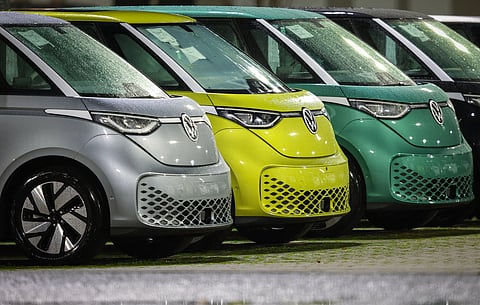
As oil prices skyrocketed due to war, the appeal of traditional internal combustion engine (ICE) vehicles began to melt away across Europe.
Battery electric vehicles (BEVs) saw a sharp rise in popularity, accounting for 18.2% of all new car registrations in the EU from January to February 2026 — an impressive jump from 15.2% in the same period the previous year.
Amid the fuel price shock, a massive surge in electric vehicle sales swept the continent.
In total, 312,369 new battery-electric cars were registered in 2025, reflecting growing consumer interest in cleaner mobility options as fuel costs climbed, according to the European Automobile Manufacturers' Association (ACEA).
As volatility in global oil markets drive fuel prices up, consumer shift away from ICE accelerates, and analysts expect EVs to rise further in March.
While overall new car registrations dipped slightly by 1.2% year-to-date, the EV segment bucked the trend with strong double-digit growth. And if current demand trends continue, this could mark a significant gain for EVs in Europe.
Sales flow vs fleet stock
What many still underestimate is not the technology — it’s the system dynamics: The interplay between sales (flow) and the EV fleet (stock).
In 2024, the world sold roughly 14 million electric vehicles, about 18% of new car sales globally.
That’s the flow. But the stock — the total number of EVs already on the road — has now crossed 40 million vehicles worldwide.
Each year’s sales don’t replace the system; they accumulate into it.
And once that stock reaches critical mass, the system begins to move under its own momentum.
Displacing demand
Even modest displacement at the margin matters: a single EV can avoid roughly 10–15 barrels of oil per year.
Multiply that across tens of millions of vehicles, and you’re looking at hundreds of millions of barrels annually quietly erased from demand.
This could pressure refining margins, distort investment signals, and amplify price volatility.
The volatility, in turn, accelerates the shift. High and unpredictable fuel costs push more consumers, fleets, and governments toward electrification.
Infrastructure built for a century of steady throughput — refineries, tankers, pipelines — struggles in a world of uneven demand and shrinking margins.
But EVs are not only clean: the eventual switch from ICE also leads to energy efficiency gains.
Oil demand doesn’t decline in a straight line — it destabilises.
Cleaner drive: Transition to replacement
Notable examples: France and Germany which led the charge with huge increases in EVs.
The combined market share of petrol and diesel cars, meanwhile, slipped further, underscoring how rising oil prices lead to an unintended consequence of accelerating the transition away from fossil fuel.
European drive are now drawn to the long-term savings and environmental benefits of electric cars as a result.
This wave of adoption signaleds brighter prospects for electrified transport.
Instaed of a gradual transition, it has ushered in a "replacement" ecosystem, shifting the balance towards greater stability and resilience, according to Abu Dhabi-based International Renewable Energy Agency (Irena).
Disruption in behaviour
Despite the hostility toward electric vehicles, solar, and batteries — this has led to a classic disruption behaviour, not because EVs fail, but because they work, and work at a far more efficient scale.
As incumbents defend legacy systems, the fact remains: oil runs on geopolitics — fragile supply chains, chokepoints, and coordinated production.
Electric systems, on the other hand, run on physics — declining costs, modular scaling, and local generation. One tightens under stress; the other expands.
What's next?
Experts increasingly describe the current moment as an "inflection point": as electric vehicles move from early adoption to mass penetration —especially in regions like Europe — oil demand doesn’t simply decline in a smooth, predictable curve.
Once EVs reach critical mass, they begin displacing not just marginal fuel demand, but core, high-frequency consumption — daily commuting, delivery fleets, and urban transport.
This erodes the most stable layer of oil demand.
What remains becomes more volatile: aviation, petrochemicals, and long-haul transport, i.e. sectors that are harder to electrify and more sensitive to economic cycles.
As falling demand weakens margins and discourages new fossil fuel investment, improving EV economics — lower battery costs, expanding charging networks, and policy support — accelerate adoption even further.
The transition, once self-sustaining, could then move faster than most forecasts expect.


