Birthday traditions from around the world
Different cultures have different rituals with many surprises.
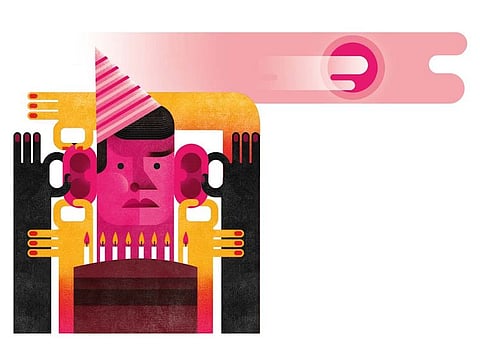
By making the earth turn, birthday rituals still reserve many surprises. From institutions, such as the recent celebration of the 5th Republic, to monuments and great personalities, birthdays continue to punctuate the public calendar, without forgetting the long list of our friends and family members. A practice which dates back down the ages where, with rituals and traditions, we concocted our relationship with time and death. Historians agree that the Egyptians were the precursors of these yearly celebrations. It was just necessary to know one’s date of birth and belong to a culture where the cult of the individual exists. Let us take a whirlwind tour of practices across the world, which is not quite as globalised as we may believe.
Ear lobes and backsides
Brazil and Hungary, although geographically and culturally far flung from one another, share the same ritual of pulling the ear of the person, and as many times as the number of years celebrated! In Hungary, the gesture is accompanied by a song of which the words celebrate the long life to be lived and encourage the ear lobes, after being much pulled throughout the years, to reach the ankles. In the UK, it is another part of the anatomy which is concerned for a similar ritual. It dictates that the backside of the person is hit against the ground as many times as the number of years alive. Each contact with the ground is followed by being thrust into the air! With age, the exercise can become rather dangerous. In Scotland, the number of “bumps” is accompanied with £1 notes.
Birthdays in the orient
In China, new-born children are only named one month after birth, during the celebration of Mun Yuet which means Full Moon. Once they have a first name, the babies are also symbolically harboured to the world, and they are offered a bracelet which mimics a padlock or an item of jewelry in the form of a chain. In a country for a long time regulated by the single child policy where success is important, the first birthday gives rise to a ceremony where several objects are presented to the baby. The choice will determine the future profession and character. The red belt which is tied around the baby is also a superstition which distances misfortune. After childhood, it is with a dish of Yin Mey (Longevity Noodles) that the birthday is celebrated. Take care not to make a faux pas, it is bad luck to offer a watch, alarm clock or pendulum as a gift.
A sweep of the broom
In certain German Lander, tradition marks out thirty-year-old men who are still single. On the day of their birthday, they must sweep a broom in front of the town hall or church. Tradition dictates that they can only stop when a woman kisses them. A pragmatic way of showing their effectiveness and capacity to keep house.
A buttery nose
In Canada, celebration of a birthday is accompanied by a small race which ends in the person’s nose being smeared with butter. The allegory is rather nice. Once the nose is greased, all of the misfortune and disasters of the year ahead will not be able to take hold and will slide away.
Cinnamon, pepper and flags
In the Kingdom of Denmark, it is easy to guess who is celebrating a birthday. A fl ag flies above the doorway of the home. At work, it is placed in front of their computer. A patriotic reminder in a country where the fl ag is deployed for almost every occasion. Another ancestral tradition dates back to the 17th century whilst the Danish were sailing the seas to trade in spices. Cinnamon, for which they had an unrivalled taste, was used to mark a special birthday. At 25 years old, singletons were bombarded with cinnamon in the street. It is not rare to see “Pebersvend” (cinnamon girls) tied to lampposts and showered with the spice. The tradition grows harsher at 30 years old, when cinnamon is replaced for pepper. Improvised sculptures of pepper pots cut into oil drums are placed at the door of those who are naysayers to marriage.
Rituals and figures
The democratisation of birthdays and widespread celebration of their passing in Western culture have led to many practices being wiped out, which reminds us just how the passage of time is regulated by rituals. Some cultures have retained these traditions which thrust us into a magical thinking perspective where birthdays have a spiritual, and less commercial feel. Such as in South Africa, where you are given a key for your 21st birthday. In several cultures, such as in the Minicoy Islands, in the Indian Ocean, babies’ heads are shaved on the 20th day and the hair is sold. Similar symbolism is found with Orthodox Jews who do likewise on a baby’s third birthday. Whilst the majority of practices encourage luck, there are also traditions which conjure bad faith. In Italy, the candles on a birthday cake are snapped before being thrown away.
The Norwegian Russ
In many cultures, such as in Vietnam, there are no individual birthdays, they are celebrated in a group, during the celebration of the Tet. This collective approach could be likened to the rites of passage which often disappeared with modernity. Not in Norway however, where the Russ is celebrated by high school kids who finish school. Dating back to 1905, the tradition runs from the end of April until May 17, the day of the Norwegian constitution. During this time, teenagers live in groups and celebrate without pause, travelling from parties to festivals. They will save up by doing summer jobs to be able to organise the outfit they will wear, the song they have written to honour their group, a sound system and much drink taken aboard a bus that will take them across the whole country and where they will sleep during the whole of Russe feiring.
Beyond time
In the Toraja villages, an ethnic tribe to the south of the Selene Islands, in Indonesia, death does not signify the end of birthday celebrations. Dead people, who are mummified, are taken out of their coffins and donned with new clothing for an annual celebration which leads them on a tour of the village in festive processions.


