A critical eye on the design of Swiss banknotes
Switzerland takes the aesthetics of its currency seriously. An art critic gives an opinion
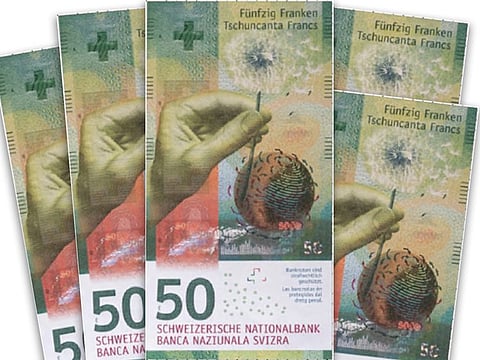
In 2005, the SNB (Swiss National Bank) launched a major competition with the objective of creating a ninth se-ries of new Swiss franc banknotes. It had been 20 years since the last issue, and Roland Tornare, in charge of notes and coins, admitted the urgent need to combat coun-terfeiting: “Reproduction technology is evolving rap-idly. We think our banknotes will very probably be at risk by 2010.” The jury choice of Manuel Krebs from Zürich provoked an immediate orchestrated polemic sparked by newspaper Le Matin. The new banknotes, which were certainly highly original, included the image of a fotus on the 100-franc note, the most commonly used one, a depiction of the Aids virus on the 200-franc note, and a human skull on the 1,000-franc note. However, the SNB then chose the work of the elegant 26-year-old runner-up Manuela Pfrunder, who studied graphic design at Lucerne. Her design had its roots in a typically Swiss style stemming from Josef Müller-Brockmann in the 1950s. The clear sans serif typeface formed the basis of large, elegant motifs, with f lecks, the cosmos and neural networks on a complicated, abstract background, which echoed the main subject. The de-sign had slightly garish basic colours for each note in keeping with tradition and the specifications: petrol blue for 100 francs, vermillion red for 20 francs and Indian yellow for 10 francs.
A most beautiful banknote
It wasn’t until 2016, more than a decade later, that the new grass-green 50-franc note was issued, followed by the 20-franc one. The complete series will be ready by 2019, in particular, the hotly-debated violet 1,000-franc note, which is alleged to make financial wrongdoing easier. With 15 anti-forgery features on the new notes, the delay was more technical than artistic. Making a mass-produced item impossible to forge is the obvious challenge of banknote production. For a cost of 40 centimes per banknote, ten steps are needed to turn the double layer of cotton and polymer paper into actual Swiss money. The paper is printed using offset lithography and intaglio, and then numbered and coated. Even more impressive, it is screen-printed using a magnetic field to direct the pigments, which are micro-perforated using powerful lasers, and then checked at a speed of 40 notes per second. No doubt this was a technological high point. The Inter-national Bank Note Society called the 50-franc note “the best and most beautiful banknote of 2016,” but in purely aesthetic terms, the end result was sadly a long way from the initial proposal.
Visual chaos and poorly rendered drawings
The security aspect is linked to the design on the 20-franc note, with Planet Earth appearing to turn on its axis from one note to the next, meant to rep-resent the opening of Switzerland to the world. The globe, which is impossible to copy, turns green or gold depending on the viewing angle. The previous design, with what looked like an extremely abstract representation of a butterfly wing, has been replaced after 11 years by four much more anecdotal butterflies. These are supposedly in the guise of artistic creation on a white background representing the screen of the Locarno International Film Festival. The other side of the note features a supposedly distinctive Swiss character, with the focus on a drawing of a “universal” hand. These poorly drawn hands are a sad sight to behold, like diagrams from a bad anatomy course. The 50-franc note depicts a dandelion with its seeds flying around, supposedly a typical Swiss symbol: the wind. The visual chaos of the new notes is the result of endless brainstorming sessions to reach a compromise between political issues, demagogy and technological hubris. In a po-etic sense, examining the detail of these banknotes under a magnifying glass, Pfrunder retains her freedom: the back-ground is filled with tiny skilfully drawn abstract compositions that were an essential part of her initial project.


