China chip claim rattles Samsung and SK Hynix: What is the 4F² breakthrough?
Samsung drops 7.4%, SK Hynix 10% after CXMT touts denser DRAM design with no yield data
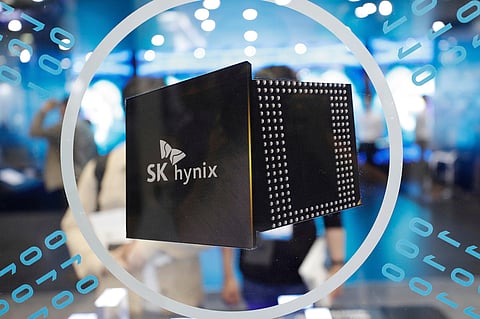
Dubai: Samsung Electronics and SK Hynix shares tumbled on October 13 after China’s CXMT Corp claimed a memory chip breakthrough. SK Hynix fell 10% and Samsung lost 7.4%. The selloff dragged down the broader Kospi index.
Over the weekend, CXMT President Cao Kanyu speaking at a conference in Shanghai said that CXMT will launch a data center server chip with a 4F² design before the end of the year. A company spokesperson confirmed his comments. He gave no further details, and the claim remains unsubstantiated.
What is a 4F² DDR5 server memory?
CXMT claims that its product is a 4F² DDR5 server memory, meaning its DRAM is built for servers rather than phones or laptops. The “4F²” describes how much surface area one memory cell takes up, measured against F, the minimum line-width of the chip. Today’s standard is 6F². The 4F² design shrinks the cell footprint from 3F × 2F to 2F × 2F, which could raise density by roughly 30% to 50% on the same chip area. More capacity per chip means more memory per server, at lower cost per bit.
But this has more to do with physics. To fit cells that tightly, the transistor must stand upright, with the channel running vertically and the gate wrapped around it. Leakage and manufacturing complexity have made it difficult to put together for years.
SK Hynix holds a patent for a vertical-channel DRAM cell reduced to a 4F² structure. The patent noted that the manufacturing process was complicated. Samsung launched a public 3D DRAM development project in 2021, then formed a team in May 2023 to develop mass production of 4F² cells.
In June 2025, reports suggested that both companies aimed to validate working 4F² prototypes by the end of that year. Samsung is not expected to produce 4F² products until 2028, and none of the established leaders has reached large-scale commercialization.
Developments put CXMT two years ahead
The timing rattled investors. If the claim holds, CXMT reached the threshold before its Korean rivals, despite US sanctions that bar it from tools such as ASML’s top-end machines. Micron had already closed 4% lower in New York overnight, setting the tone for Seoul.
The timing has rattled investors. If the claim holds, CXMT reached the threshold before its Korean rivals, despite US sanctions that bar it from tools such as ASML’s top-end machines. The longer-term pressure is in the wider DRAM market.
Counterpoint Research data shows CXMT’s share reached 10% in the second quarter, up from 4% a year earlier. The company is also on track to make the latest LPDDR6 smartphone memory on roughly the same timeline as its Korean rivals. A summer IPO briefly made CXMT China’s most valuable company. Its claim of a launch by December is what has rattled Seoul, as it would put the Chinese firm roughly two years ahead of its rivals, giving it a huge leg up.


![Environmental advocates warn that expanded commercial shipping along the Northern Sea Route could threaten the fragile Arctic ecosystem. [Illustrative image]](http://media.assettype.com/gulfnews%2F2026-08-22%2Ftpq7r8g0%2Farctic.jpg?w=320&auto=format%2Ccompress&fit=max)

