Showdown inside the Philippines Senate: Bigger questions loom
Dela Rosa’s return triggers clash over immunity, ICC and Senate authority
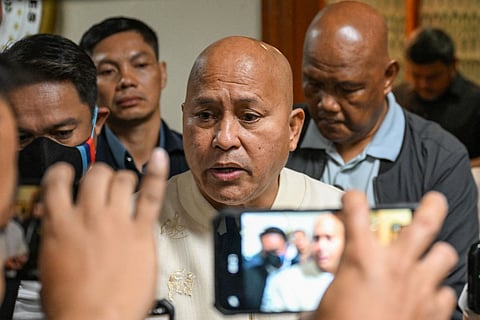
Manila: What unfolded on May 11 inside the Senate complex in Pasay quickly escalated from routine plenary into a constitutional and political spectacle.
At the centre: Ronald "Bato" dela Rosa, who reappeared in the chamber after a six-month absence just as law enforcement officers attempted to serve processes related to allegations tied to the Duterte-era drug war.
Minutes after his arrival, National Bureau of Investigation (NBI) personnel entered the premises with Antonio Trillanes IV, who showed reporters what he said was a copy of an arrest warrant issued by the International Criminal Court (ICC).
Tensions
Tension spilled into the corridors.
Later, the Senate released CCTV footage showing dela Rosa moving briskly through hallways as NBI agents followed.
In the session hall, he objected to the presence of Trillanes and the NBI, asking that they be removed from the chamber.
ICC warrant and domestic subpoenas collide
On the same day, the ICC confirmed that Pre-Trial Chamber I had found reasonable grounds to believe dela Rosa may bear responsibility for crimes against humanity — specifically murder — allegedly committed during the anti-drug campaign when he served as Davao City police chief and later as Philippine National Police (PNP) director general.
Subpoena orders dela Rosa
Separately, the Police Criminal Investigation and Detection Group (CIDG) had issued a subpoena ordering dela Rosa to appear on May 14 in connection with investigations into alleged extrajudicial killings.
The rare convergence of an ICC action and domestic investigative steps, both surfacing on the same day a senator returned to the chamber, set the stage for an institutional standoff over jurisdiction, custody, and parliamentary privilege.
A sudden motion, a leadership reset
Amid the commotion, Joel Villanueva moved to declare all Senate leadership posts vacant.
A roll-call vote followed. Thirteen senators voted in favour.
The move effectively unseated Tito Sotto and installed Alan Peter Cayetano as the new Senate President after a second vote, 13–9.
Those who voted to reset the leadership included:
Alan Peter Cayetano
Pia Cayetano
Ronald dela Rosa
Francis "Chiz" Escudero
Imee Marcos
Rodante Marcoleta
Joel Villanueva
Bong Go
Robin Padilla
Jinggoy Estrada
Mark Villar
Camille Villar and
Loren Legarda.
Abstentions
JV Ejercito and Migz Zubiri abstained.
For critics, the timing was impossible to ignore: the vote relied on dela Rosa’s presence at a moment he was facing legal pressure.
'Selective justice' debate resurfaces
Opposition voices and civil society figures revived comparisons with past incidents inside the Senate building: the arrest of Leila de Lima on drug charges during the Duterte administration (she was later cleared of all charges), and the earlier arrest of Trillanes while the Senate was in session.
They argued that the chamber’s decision to place NBI personnel in contempt and order them into Senate custody — while placing dela Rosa under Senate “protective custody” and locking down the premises — created the appearance of unequal treatment.
Allies countered that the Senate was asserting institutional independence and protecting a sitting senator from what they described as harassment and foreign interference.
Newly-installed Senate President Alan Cayetano said on Tuesday that warrant of arrest against Senator Ronald “Bato” Dela Rosa must be issued by a local court before the Senate will "allow" its enforcement.
Celebrities, broadcasters, and influencers react
Public reaction spilled onto social media, where entertainers and journalists framed the day as either a defense of sovereignty or a troubling spectacle.
Bianca Gonzalez-Intal questioned what it would take for governance to translate into better daily life and public service.
Romnick Sarmenta blasted what he called a shameless power game.
Gabbi Garcia called it “a day for the Philippines,” punctuated with a clown emoji.
Bela Padilla questioned dela Rosa’s long absence and accountability to the public.
Bea Binene posted a brief prayer for the country.
Julie Anne San Jose tweeted clown emojis.
Broadcaster Doris Bigornia wrote a single, somber “PILIPINAS.”
On the other side, Duterte allies rallied:
Mocha Uson cheered, “LABAN BATO!” and thanked the Senate for “protecting” him.
Former presidential spokesperson Harry Roque called the leadership change “good news.”
Bigger questions now confronting Philippine institutions
Beyond personalities and drama, the episode highlights deeper, unresolved questions about law, power, and public trust:
Where do parliamentary privilege and law enforcement authority meet — and stop? Can the Senate lawfully prevent agents from serving processes on a sitting senator within its premises? What are the exact limits of “protective custody” by a legislative body when domestic investigators seek access?
How should Philippine institutions respond to actions by the ICC?
What is the government’s obligation, if any, when the International Criminal Court issues a warrant tied to alleged crimes during a prior administration? How do sovereignty arguments square with international commitments and victims’ rights?
Did the leadership overhaul pass the test of propriety as well as procedure?
Even if the votes were valid on paper, does a leadership reset timed amid an attempted arrest undermine confidence in the Senate’s motives? Should there be norms about major institutional changes during active legal confrontations?
Is there a consistent standard for arrests and accountability inside the chamber?
Observers recall the arrests of Leila de Lima and Antonio Trillanes IV during past sessions. Why did this moment look different? What standard should apply regardless of who is involved?
What powers does the Sergeant-at-Arms truly have?
When the Senate cited NBI officers in contempt and placed them under Senate custody, what legal doctrine justified it? Has this power been tested before in comparable situations?
Can a senator’s prolonged absence affect legitimacy or internal rules?
What are the chamber’s rules on attendance, accountability, and sanctions for long absences—and were they applied here?
Are institutions protecting independence — or people?
At what point does defending institutional independence blur into shielding an individual officeholder? How should the line be drawn and communicated to the public?
What precedent does this set for future clashes?
If another senator faces arrest or legal action, should Filipinos expect the same response? Or was this an exceptional case?
How does this affect public trust in the rule of law?
When legal processes appear to stall at the doors of power, what happens to citizens’ belief that laws apply equally?
A test of boundaries
What began as a senator’s return turned into a test of constitutional boundaries, international law, and political loyalty — playing out live before a public already weary of spectacle and hungry for governance, and tackling legislation that would improve the lives of the common people.
For many Filipinos watching the unfolding scenes, the images from the Senate corridors felt less like statesmanship and more like a primetime drama — except the stakes were national institutions, accountability, and the rule of law.


