Diff 2016: Georges Hachem reveals his trade secrets
Lebanese director discusses the role of a director in a film, ahead of the release of his Muhr feature ‘Still Burning’
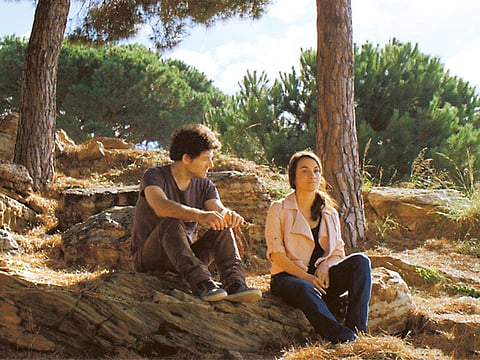
Georges Hachem
The director’s role is not always seen as the most glamorous in the film industry, and its importance is often forgotten. This is not to say that directors do not receive their due credit.
During the Dubai International Film Festival, Lebanese filmmaker Georges Hachem discussed the role of a director and his Muhr feature film, Still Burning.
Was film something you always wanted to go into?
From the beginning it’s the field I wanted to go into and it’s telling stories that’s the origin of this vocation. So, all the work I did for theatres and all my background and seeing movies was structuring this desire.
You used to be an actor so why did you switch to directing?
Yes, in fact it’s because of the kind of — it’s not the right word but — manipulation, incursion.
Control maybe?
Not the control... scanning human beings and this process which makes people bring out themselves and telling stories with their psychological items. It’s a little complex and quite thrilling. Maybe [it’s] this position of ‘demiurge’ [being responsible for the creation of the universe] which is at the same time a challenging position... because it’s having the power and the ethical responsibility to not abuse that power. You have to make power beneficial for the others but still maintain a sort of control.
What is the central theme behind Still Burning?
Still Burning is about the evocation of memories, so when we are a human being in any average field of life, when you recall the past it’s a sort of emotional trip or nostalgia.
You wrote the script for the film. Talk about that process.
When you are writing a script, when you’re involved in writing stories or making films, you are haunted by your experiences, and many other things along the way. The moment you try to structure the story, all your baggage, your background, your past, your feelings [come out]. You start by making a schema [diagram]. For Still Burning I decided it would be a spiral. Not a linear story.
Does the film have an intended effect or do you want to leave that up to audience?
No, it’s more of a game with audience... any story, it’s a game, a serious game, a profound game. I trust the audience but at the same time [with] this movie the audience are a little bit son une pris du court [they are taken by surprise]. I wanted to contribute in a small way in this kind of feeling or narrative. Is it about love? I believe that a movie shouldn’t move things too fast forward but a little, shed a little light on a basic essential aspect in human life.
You seem to like writing about the human condition.
Yes, crossed with my personal experience. In life, you have two or three fields you explore, three or four moments that impress you. I prefer to talk about these three or four moments or three of four fields from the moment I didn’t consider making movies and making products. It’s about surmonce [surmise]... about evoking or giving my baggage my surmonce, my life. It’s a good and honest deal.
— The Young Journalist Award (YJA) at Diff is a training programme for high school and university students who are aspiring writers and reporters. Eight students are competing at the festival this year. One winner will secure a monthlong internship with Gulf News.
