BRDG House and the power of partnership
Wissam Breidy, Paula Gambrell combine disciplines to rethink real estate project approach
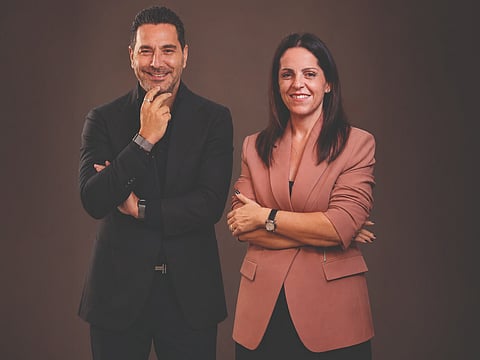
A development’s success is often determined long before it reaches the market . By the time it launches, the decisions that shapes it value, from the product and pricing to its positioning and intended buyer, have already been made. When those decisions are misaligned with the market, even the strongest marketing cannot compensate the gap.
That belief sits at the heart of BRDG House, the strategic development partner founded by Wissam Breidy and Paula Gambrell. The two arrived at this shared conviction through very different careers. Wissam spent more than 25 years working in communication and the public eye, learning how people form opinions and, more importantly, whom they trust. Paula brings more than two decades of experience across the UAE and Saudi Arabia, with a focus on development, product and commercial strategy. Their partnership these perspectives together to shape stronger developments and create lasting value.

WISSAM BREIDY: EARNING THE MARKET’S TRUST
“Paula and I came from different professional journeys, and that is precisely why the partnership made sense,” says Wissam. “She sees a development from the inside out - the product, feasibility, pricing and execution. I see the market from the outside in - how people understand value, how trust is built and what makes brokers and buyers choose one proposition over another.”
He did not start his career in property. For more than two decades, his work involved understanding what earns people’s attention, what moves them and what makes them believe someone. Those lessons, he says, are just as relevant when someone is choosing a home or committing money to an investment.
“More than 25 years in communication taught me that attention can be created quickly, but belief cannot. Real estate works the same way. A beautiful render or a major launch can attract attention, but if the product does not answer a real need, the market will eventually expose the gap.”
After moving to Dubai and becoming more involved in investment and development, Wissam began noticing the same disconnect across projects. A developer might have land, financing and a clear ambition, but product planning, brand, sales strategy and broker relationships were often handled separately. By the time the project reached buyers, the story did not always add up.
“I did not want to build another consultancy, marketing agency or brokerage. I wanted to create the bridge between vision and validation, between the product and the people expected to believe in it.”
“Marketing, relationships and visibility can bring people to the table, but they cannot make a weak product survive serious scrutiny. We should not compete only for the client; we should help the product compete for the client’s trust.”
BRDG House’s model follows that thinking through. Wissam focuses on perception, communication, relationships and market activation, while Paula brings the development and commercial discipline that helps shape the proposition in the first place. Rather than stepping in at launch, they intend to stay involved from the early decisions through to distribution and sales.
Spending much of his career in public view taught him the difference between being recognised and being trusted. Moving to Dubai meant building credibility again, without assuming that achievements elsewhere would speak for themselves.
“Leadership therefore means being willing to say that a product is not ready, a price is not justified or a strategy needs to change. At BRDG House, we will choose the difficult truth over comfortable approval.”
For Wissam, success is not a question of how quickly the company becomes bigger. It is whether people can rely on its judgement. “I will never compromise reputation for revenue,” he says.
He wants developers to accept scrutiny, brokers to trust what they are offering and buyers to find that the finished product lives up to the “Paula and I came from different professional journeys, and that is precisely why the partnership made sense,” says Wissam. “She sees a development from the inside out - the product, feasibility, pricing and execution. I see the market from the outside in - how people understand value, how trust is built and what makes brokers and buyers choose one proposition over another.”
He did not start his career in property. For more than two decades, his work involved understanding what earns people's attention, what moves them and what makes them believe someone. Those lessons, he says, are just as relevant when someone is choosing a home or committing money to an investment.
“More than 25 years in communication taught me that attention can be created quickly, but belief cannot. Real estate works the same way. A beautiful render or a major launch can attract attention, but if the product does not answer a real need, the market will eventually expose the gap.”
After moving to Dubai and becoming more involved in investment and development, Wissam began noticing the same disconnect across projects. A developer might have land, financing and a clear ambition, but product planning, brand, sales strategy and broker relationships were often handled separately. By the time the project reached buyers, the story did not always add up.
He saw an opportunity to bring those conversations together rather than simply promote the end result. “I did not want to build another consultancy, marketing agency or brokerage. I wanted to create the bridge between vision and validation, between the product and the people expected to believe in it.”
That distinction matters to him. His concern is not only whether a project can attract interest, but whether the product can justify it. Buyers have access to more information and can question claims about pricing, location or value. A launch may capture their attention; it cannot answer every difficult question for them.
“Marketing, relationships and visibility can bring people to the table, but they cannot make a weak product survive serious scrutiny. We should not compete only for the client; we should help the product compete for the client's trust.”
BRDG House's model follows that thinking through. Wissam focuses on perception, communication, relationships and market activation, while Paula brings the development and commercial discipline that helps shape the proposition in the first place. Rather than stepping in at launch, they intend to stay involved from the early decisions through to distribution and sales.
“Our advantage is not one isolated service; it is the continuity between all of them,” he says.
His views on leadership are shaped by an equally personal lesson. Spending much of his career in public view taught him the difference between being recognised and being trusted. Moving to Dubai meant building credibility again, without assuming that achievements elsewhere would speak for themselves. He brings that sense of responsibility into business decisions, including decisions that may be uncomfortable for a client to hear.
“Leadership therefore means being willing to say that a product is not ready, a price is not justified or a strategy needs to change. At BRDG House, we will choose the difficult truth over comfortable approval.”
For Wissam, success is not a question of how quickly the company becomes bigger. It is whether people can rely on its judgement. “I will never compromise reputation for revenue,” he says. He wants developers to accept scrutiny, brokers to trust what they are offering and buyers to find that the finished product lives up to the promise.
When he talks about the years ahead, he returns to the principle that brought him into the partnership: “Do not build first and explain later. Understand people, shape the right product and earn the market's trust before asking for its money.”

PAULA GAMBRELL: GETTING THE EARLY DECISIONS RIGHT
Paula approaches the same problem from the development side. “Real estate value is not created at the point of sale, or even when construction begins,” she says. “It is decided much earlier, by the quality of the decisions that define a development: what the market needs, what the product should be, how it is positioned and whether the commercial logic can carry the ambition.”
Across more than 20 years in the UAE and Saudi Arabia, including work on recognised branded residence launches, she saw how frequently those decisions were taken in separate rooms. Feasibility would be considered in one conversation, design in another, with sales and marketing involved only after the product was effectively fixed. Too often, she was brought in once a project was already defined, when there was little opportunity to revisit the decisions that could have made it stronger.
“It was a point of clarity rather than a single event,” she says of the decision to start BRDG House. “I could see where a project could have been stronger, but by then the decisions that mattered had been made. I wanted to be involved at that earlier stage, when the questions are still open and strategic thinking can still change the outcome.”
BRDG House gave her the opportunity to put that conviction into practice. She wanted to move beyond simply delivering against a brief and instead question the assumptions behind it, bring different disciplines together and remain involved in shaping the outcome.
“Individually, each of us could advise on part of the picture. Together, we could offer something rarer: a strategic development partner with the range to question the brief, connect the moving parts and stay accountable for how that thinking performs in the market.”
One assumption she frequently challenges is that a strong location automatically guarantees demand for any product built there. It is a tempting shortcut, but it misses the more important question. “What should we build, for whom, and why will it matter to them?”
Answering it properly can change the unit mix, design priorities, positioning and pricing. Paula wants those choices tested against the market rather than defended after launch. BRDG House therefore remains involved through sales, so that its advice is measured against what buyers actually do.
The way she judges those decisions owes something to the beginning of her career, on the product side at HSBC, including mortgages. She still thinks about the person who will finance the property, own it and live with the consequences of choices made long before handover. She has also learned that a decision affecting design rarely ends at there; it has implications for pricing, operations and the resident's experience.
“It has also taught me that conviction should not be confused with certainty. Good judgement means asking difficult questions, listening to people with different expertise and being willing to revisit an assumption when the evidence changes.”
That willingness to challenge is central to her view of partnership. She values straightforward advice and consistency, especially when a project faces difficulties. “The moment our advice stops being independent, we stop being a strategic partner and become a supplier.”
Paula defines success in terms that extend beyond the sale: a development that continues to work for its residents and investors, clients who make better decisions, and a team that grows through its work. Growth matters, she says, but it should follow the creation of value rather than substitute for it.
Her longer-term ambition is for BRDG House to leave a standard of thinking behind, not simply a list of completed projects. The company's philosophy, “We Build Value Before We Build Projects,” is intended as a commitment to how decisions are made. “Ultimately, I want BRDG House to prove that better outcomes are not accidental. They are built deliberately, strategically and long before construction begins.”
For the two founders, the test of the partnership will be found in the projects themselves: whether the early decisions stand up to scrutiny, and whether buyers ultimately receive what they were promised. Ultimately, a development’s value is shaped not by its launch, but by the decisions that make its promise worth believing in.


