Rats with wings: Dubai's pigeon problem
The Romans considered pigeons harbingers of peace, but in Dubai, they are increasingly seen as a nuisance.
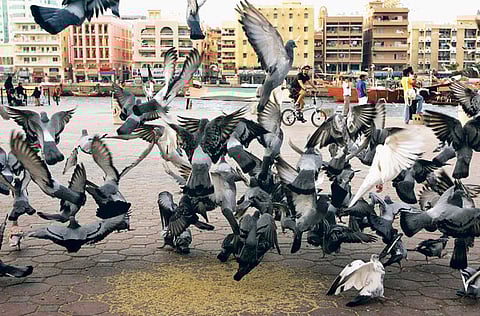
Dubai: Pigeons have become a nuisance in the city, leaving many residents exasperated.
These birds which have been breeding uncontrollably are messing up property with their droppings.
Building owners are having to hire pest-control firms to ward off these fast-breeding birds.
Dr Elmahi El Tilib Gubran, pest control studies officer at Dubai Municipality's Public Health Department, while describing pigeons as a "serious" problem, said it's hard to put a figure to their numbers in Dubai, where it is illegal to cull pigeons.
Serious problems
"They cause serious problems on structures and are a real nuisance to get rid of," said Dr Gubran, who added that the municipality traps them and gives them to a falcon hospital as feed.
With a plentiful supply of food, water and nesting perches, the city's pigeon population has exploded in recent years. The problem prevails across the emirate, right from the residential districts of Karama, Bur Dubai and Deira, to the five-star hotels and industrial buildings in Jebel Ali and Jumeirah.
To deal with the problem, pest-control films have introduced a number of measures - from installing anti-roosting spikes on building tops, to the use of PVC (poly-vinyl chloride) netting and flying falcons to scare them away.
Pigeon droppings have been known to carry disease causing germs (see box on left). The droppings are acidic and can eat away at tar-based roofing, damage machinery, air conditioning systems and car paint work.
XPRESS went out with a team from Trap Pest Control, which uses nets and spikes for clients in the industrial areas of Jebel Ali as well as palaces.
Amin Jarrar, who runs the company, said: "We get calls from companies all the time asking to use our service. We don't kill the pigeons because that is illegal, so all we do is move them on."
One reason pigeons are widespread in places like Deira, Bur Dubai and Karama is that landlords are unwilling to invest in preventive measures, he said. "In Dubai, many tenants as well as property owners are coming and going all the time, so to invest in something like this is not appealing for them."
Netting costs Dh75 per square metre and a metre of spikes costs Dh75. With spikes, the protruding pins make it impossible for pigeons to land, encouraging them to go elsewhere without them getting hurt.
Other pest-control companies treat problem areas with anti-pigeon spray that wards off the birds without harming them or other animals for up to a year after treatment.
While fake hawks and falcons are used in some UK cities to scare off pigeons, a Dubai company is using real falcons to do the job.
Al Hurr Falconry, based in Nad Al Sheba, uses 21 peregrine falcons - of which 14 constantly patrol the air in places like Jumeirah, while seven are used for breeding.
Battle in the air
David Stead, managing director of Al Hurr, describes the "battle" with pigeons as a "war of attrition". Since his company was set up seven years ago, business has never been busier. "We get calls from people running five-star hotels to deal with pigeon droppings on their property," said Stead.
"Pigeons are also one of the fastest birds in the air, and one of the few birds of prey that can catch them are falcons," he said. "When pigeons see falcons, they go ballistic and scatter all over the place as they think they are going to be eaten. I've seen them almost fall to the ground in a desperate attempt to pick up speed and escape."
Peregrine falcons can catch birds in the air and urban peregrines eat a lot of pigeons. Stead's peregrine falcons, however, are trained to hover in the air for around a few minutes before returning to their handlers.
For their work to have a lasting effect, Stead and his team maintain a presence at the client's buildings up to five days a week.
"It's not a case of flying once and then leaving it," he explained. "You have got to maintain an almost permanent presence around the building. You've got to make the pigeons think that the falcon lives in the area. That is the only way to get them to go away. "
"Other countries have tried things like shooting the pigeons with air guns, but they alway return," said Stead.
Methods to deal with them
- Draping a PVC net across overhanging areas to prevent the birds from flying to a specific location.
- Installing spikes on ledges or positions of walls and buildings to prevent pigeons from having a comfortable spot to rest on.
- Setting up brown coloured balls on a piece of string to fool the pigeons into thinking it is a falcon. (no photo)
How other nations dealt with the issue:
Switzerland:
Had experimented with a pigeon contraceptive pill, but it was found to be ineffective in trials
and often was also eaten by fertile birds from other species, making it difficult to specifically target pigeons.
United Kingdom:
Although pigeons are tolerated at Trafalgar Square, in London, as a tourist attraction elsewhere companies have hired snipers to shoot the birds off buildings with airguns. Specially licensed pest controllers can also use narcotic-laced drugs to "knock out" the birds before the pigeon's necks are dislocated.
United States:
Use of plastic models of birds of prey is popular but the effect of scaring off pigeons has been found to work only for a short period of time.
Birds of a feather
- Pigeons are scared of peregrine falcons, who primarily eat birds they catch in the air.
- Between the 16th and 18th centuries pigeon droppings were a highly prized fertiliser and considered far more potent than farmyard manure - so guards had to be stationed near pigeon houses to stop thieves from stealing it. In 16th century England, it was the only known source of saltpetre, an ingredient of gunpowder. In Iran pigeon houses were set up and used simply as a source of fertiliser for melon crops and in France and Italy it was used to fertilise vineyards and hemp crops.
- Pigeons are gregarious and tend to be found in flocks of around twenty to thirty birds. Seeds and grains make up their diet.
- A pigeon nest is usually constructed with small twigs and located on covered building ledges, well-hidden from view. The male brings the nesting material to his mate, one piece at a time.
- Pigeons reproduce throughout the year and can raise four or five broods annually.
- Pigeons can hear sounds at much lower frequencies than humans, such as distant thunderstorms and even far-away volcanoes, which may explain why pigeons sometimes fly away for no apparent reason.
- Pigeons can fly up to 40 or 50 miles per hour and may travel as far as 600 miles a day. They can detect the Earth's magnetic fields, which, along with the ability to tell direction by sun, seems to help them find their way home.
Sign up for the Daily Briefing
Get the latest news and updates straight to your inbox


