Encouraging a new generation of collectors
Art auctions are becoming a regular affair in Dubai. With works from across the price range going under the hammer, they are no longer an obsession of just the rich
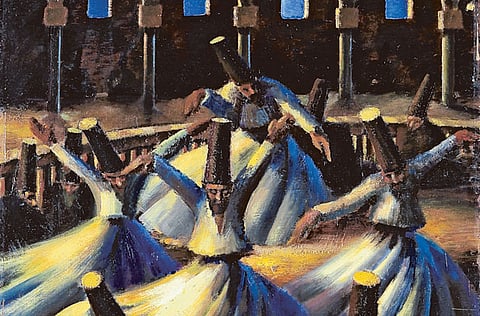
The first Christie’s auction of International Modern and Contemporary Art in the Middle East, held in May 2006 in Dubai, was a significant indicator of the growing importance of the UAE and the region in the global art market. Since then Christie’s has made sales of over $200 million (Dh734 million) through its Dubai auctions, with prices for works by established and emerging artists from the region setting new international records. The auctions attract not only regional buyers but also collectors from around the world. But perhaps the strongest sign of the increasing awareness about art in this region and the growing maturity of the art scene is that a new generation of art lovers is getting interested in collecting art. Recognising this trend, last year Christie’s introduced in Dubai the Part I and Part II sales format followed by their international sales rooms. In this format, the sales are spread over two consecutive days, with higher-value pieces going under the hammer on the first day and the second day reserved for more affordable art by younger artists.
Christie’s upcoming sale of Modern and Contemporary Arab, Iranian and Turkish Art, to be held on October 23 and October 24 at Jumeirah Emirates Towers, will once again follow this format. Part I of the sale, (on Tuesday October 23), is a tightly curated auction of 30 important works by some of the most famous artists from the region. It is led by two masterpieces by Egyptian master Mahmoud Said. Both works have been consigned for sale from a prestigious private collection in Egypt closely associated with the artist’s family and have never appeared at auction before. “El Zar” has never been exhibited to the public while “Pecheurs a Rosette” was last displayed in public in 1964, the year of the artist’s death. Other highlights include works by Farhad Moshiri, Paul Guiragossian and contemporary Turkish artists such Ramazan Bayrakoglu, Irfan Onurmen, Murat Germen and Ahmet Elhan.
Part II of the sale (on Wednesday October 24) will feature more than 100 lots, spanning the work of great modern painters and cutting-edge art by young artists. Sixteen of these artworks will be sold without a reserve price. Highlights include a monumental composition by Egyptian artist Omar Al Nagdi and works by Fateh Moudarres, Louay Kayyali, Safwan Dahoul and other established and emerging artists from the region. This part of the auction also features seven paintings to be sold for the benefit of The Prince’s School of Traditional Arts, London, set up by HRH The Prince of Wales, and six works whose proceeds will be used to benefit the Caspian Arts Foundation.
Although art auctions in Dubai are attracting new buyers, many art lovers are still hesitant to enter this nascent market. The reasons range from lack of confidence about their assessment of the market, feeling intimidated by the procedure involved in participating in an auction and the perception that collecting art is only for the very rich. Weekend Review spoke to Hala Khayat, specialist for Modern and Contemporary Middle Eastern and Iranian Art at Christie’s, about getting the most out of the Part II auctions. Excerpts:
What is the concept of the Part II sales?
While the Part I sales offer modern works and the higher-value contemporary lots, the Part II sales offer a wider range of artists and concentrate on contemporary art from the region with lower price points, starting from $2,000. They also include new sections devoted to photography and prints. This enables us to introduce more variety to the sales and encourages a new generation to buy at auction. Of the 57 artists whose works were represented in the inaugural Part II sale in October 2011, 39 were under 35 years old and this was reflected in the ages of those participating in the saleroom.
Who should attend the Part II sale? And do you have a programme for guiding first-timers?
Our sales are open to all, and we would encourage anyone who is interested in art, even if they do not wish to buy, to come to the pre-sale exhibition and the auction to see what we are offering. It is a great way to see a huge variety of what we believe is the very best art from the region, featuring artists from different countries and different generations, in one space and for free. The starting point to guide people is the catalogue which can either be bought or viewed online, and is also available at the exhibition. Then, once they arrive at the exhibition, our specialists are available to tell them every detail about the artworks. And if they decide to bid in the auction, our staff will take them through the buying process. Our experts are happy to offer all the guidance they need.
Will experienced buyers not use the opportunity to buy cheaper artworks by outbidding new collectors, who might bid less aggressively?
The joy of an auction is that the market dictates the prices. We provide estimates based on prices fetched by similar works by the same artist. We find that most of our collectors, whether young or old, buying at the top end or starting small, have a passion for what they are buying. We try to include a variety of works across both sales so that there is something for everyone.
Can you list the top five artists and artworks to look out for in this auction?
Everybody’s top five will be different and it would be wrong for us to make predictions — it is the buyers who dictate the market and value of works, not us.
Michael Jeha, managing director, Christie’s Middle East, lays out his top tips on starting an art collection.
Auctions are great fun. The excitement of the auction itself coupled with the unique nature of the works offered combine to make the process fun. Auctions are not only a surprisingly easy way to start a collection but also a practical and sensible way to buy unique objects for your home that will retain their value over the long term.
Fall in love with the art work: A key piece of advice we always give is that you must absolutely love what you buy. In the present environment of stock market instability, works of art and antiques can be a good place to invest with the potential, over the long term, of a good return, but we always encourage potential clients to ask if the art work moves them in some way. First follow your heart and then buy with your head.
Use the power of the internet: Buying art can seem daunting for the beginner but there is no need for it to be because more help is available now than ever before in an increasingly transparent international market. The internet has made the art market more accessible than ever before and is a particularly useful tool for beginners. Christie’s has an online search engine called LotFinder that allows you to browse catalogues from its sales around the world, which are packed with photographs, background research and previous sales history. Additionally, Christie’s LIVE offers the ability to buy online in real time, via live streaming — this is a particularly useful tool for buyers from abroad and those who would like to bid from the convenience of their own homes.
Acquire “the eye”: New collectors often worry that they could make a serious mistake such as paying too much or buying a fake. However, the best way to acquire real knowledge — or acquire “the eye” is to go and look at works of art. Auction houses hold free public exhibitions before sales giving everybody unrivalled access to all the artworks that will be auctioned.
You don’t have to be a millionaire to start a collection: Art is never just for the elite. Collectors can cut their teeth by buying artworks for a few hundred dollars at auctions, dealers’ exhibitions or art fairs and then, if finances permit, move up the scale as their knowledge and confidence increase. Christie’s now offers a Part II sale that is aimed at younger collections and includes artworks starting at $2,000.
Stay calm, stick to your limit and enjoy the process: Once you have browsed the auction catalogues and identified the lots you are interested in, look carefully at the price estimates published in the catalogues and fix your upper limit to avoid getting carried away. There are four ways to bid — in person, live online, leaving a written bid or on the telephone. If you are bidding in person then pre-register providing a bank reference at least 48 hours before the sale, and on the day leave yourself time to present your ID, sign the registration form and receive your bidding paddle. Remember that you will always pay a buyer’s premium — which varies depending on the price of the lot — on top of your winning bid. The auction process can be exhilarating for all involved, especially during particularly popular and coveted lots.
What: Christie’s auction of Modern and Contemporary Arab, Iranian and Turkish Art
Where: Jumeirah Emirates Towers Hotel
When: Part I sale on Tuesday, October 23, and Part II sale on Wednesday, October 24
Public viewing at the Godolphin Ballroom, Jumeirah Emirates Towers Hotel:
October 21 and 22 — 2pm to 10pm
October 23 — 10am to 10pm (selected lots)
October 24 — 10am to noon (selected lots)
For catalogues and further information, call 04-425 5647
Box:
Auction records set in Dubai:
Since 2006, Christie’s Dubai has set over 360 records for prices fetched by artists from the region. The auction house holds the world auction record for almost every leading modern and contemporary Middle Eastern artist. This includes Parviz Tanavoli’s “Oh Persepolis”, sold for the highest price ever for any Middle Eastern artist at an auction; and Mahmoud Said’s “Whirling Dervishes”, which fetched the highest auction price for any Arab artist. Christie’s Dubai also recorded the highest price for a collection sold in the Middle East with the “Farsi Collection”, which fetched $15.4 million.
Top five world records set at Christie’s Dubai auctions:
• “Oh Persepolis” by Iranian artist Parviz Tanavoli — $2,841,000 (Dh 10,426,470)
• “Whirling Dervishes” by Egyptian master Mahmoud Said — $2,546,500 (Dh9,350,748)
• “Les Chadoufs” by Mahmoud Said — $2,434,500 (Dh8,939,484)
• “Tchaar Bagh” by Iranian artist Charles Hossein Zanderoudi – Dh1,609,000 (Dh4,260, 870)
• “He is the Merciful” by Iranian artist Mohammad Ehsai — $1,161,000 (4,260, 870)
Other art auctions this week:
A strong indication of the UAE’s robust art market is that the city is hosting three art auctions this week, with one dedicated to young collectors.
The Young Collector’s Auction: October 22, 7pm
The Ayyam Art Centre in Alserkal Avenue, Al Quoz, was the first commercial art space in the region to conduct art auctions, and it has been holding auctions of Middle Eastern art for young collectors since 2009. The 14th edition of the Young Collector’s Auction offers Middle Eastern contemporary art at entry-level prices in a fun and relaxed atmosphere. It features 66 lots of painting, sculpture, photography, video and installation works from prominent and budding artists throughout the region, including Safwan Dahoul, Mustafa Ali, Nadim Karam, Hassan Hajjaj, Lara Zankoul, Pouran Jinchi and Shurooq Ameen. With many lots offered in the $2,000-5,000 range and majority of estimates under $10,000, this is a good setting for a foray into the world of collecting. The catalogue is available online and at Ayyam Gallery’s spaces in DIFC and Al Quoz. The artworks are on public display at the Ayyam Art Centre until October 21, from 10am to 8pm. Hesham Samawi, managing director, Ayyam Gallery, says, “Our aim is to make the auction experience and the appreciation of art accessible and enjoyable to all. We welcome the public to a week of viewings before the auction and our specialists are available to answer all their questions. With the flexibility to bid in person or register for telephone and absentee bids, Ayyam Auctions allows even those abroad to participate in the auction.”
Opera Gallery Auction: October 22, 7pm
The Opera Gallery Group, which operates 11 galleries around the world, has recently announced the launch of Opera Gallery Auction and will hold its first sale in the Middle East in collaboration with Opera Gallery Dubai. The International, Modern and Contemporary Art auction, to be held at The Ritz-Carlton, DIFC, will feature 140 lots — works by Renoir, Picasso, Dali, Anish Kapoor and Damien Hirst, along with pieces by Farhad Moshiri, Reza Derakshani, Mohammad Ehsai and Lita Cabellut. Marking an innovative new approach to auctions in the region, the auction will be broadcast live at Millon & Associés in Paris. Mariam Thani Hodge, general manager of Opera Gallery Dubai, says, “We feel that the strengthening art market in the region makes this an ideal moment to introduce a new sale in the Dubai calendar with a breadth of works that will sit well alongside more niche auction events. I hope our buyers will appreciate this opportunity to widen their collections.”
Jyoti Kalsi is an arts enthusiast based in Dubai.


