Electronic strains of harmony
Matthew Barley is deemed 'one of the world's most adventurous cellists'
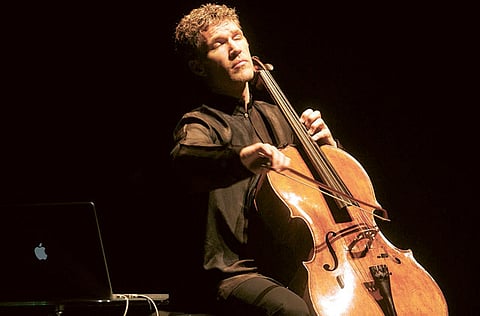
Technology is perhaps not something that is usually associated with classical music. But this isn't the case with musician Matthew Barley, who has been described as "one of the world's most adventurous cellists".
Barley takes classical music to an extreme, bringing it to life with the use of modern techniques. The musician uses electronic technology, including a pedalboard (similar to those used by guitarists to create different sound effects). However, it is not just modern electronics that he considers technology.
"The cello is a highly developed piece of technology. Mine was built in Rome in the late 18th century by one of the great masters of Italy, and I think that's incredibly high-tech," he told Weekend Review from his Abu Dhabi hotel.
"A synthesizer keyboard or a foot pedalboard is just another piece of technology, and all that these do — whether cellos or computers or pedalboards — is enable a human being to bring their inner imaginative world to life. I think it's that simple, really," he said.
Barley visited the UAE in February, during which time he performed as a guest of the Dubai Concert Committee, at Ductac in Mall of the Emirates.
There are some things that he would love to say musically, he said, but can't with the cello, whereas it can be said with electronics — "which just broadens the scope, I think, as a musician".
Barley was trained at the Guildhall School of Music and Drama and The Moscow Conservatoire, which has given him a basis to form his eclectic career comprising performance, improvisation, cross-disciplinary projects, composition and community programmes.
His involvement with technology was perhaps nowhere more evident than a recital at Kings Place, London. The cellist was required to plan and perform ten 45-minute concerts over four or five days, with each showcasing a different facet of his skills.
By the time he had programmed the eighth, he was starting to run out of ideas.
Then he was put in touch with the motion-capture artists from Pinewood Studios who worked on projects such as The Lord of the Rings and the Harry Potter films.
Barley wore a motion-capture suit for the concert and his movements were mapped on a computer.
Images created by artists were "hung" on the computer-generated images mapped by the motion-capture suit, in the same way that actor Andy Serkis played the character of Gollum in The Lord of the Rings. "That was fun! The artists and animators had devised six cartoon cellists, from a blue Matisse-like figure to a multicoloured string figure, and these figures would play the cello exactly when and how I would play the instrument on stage," he recalled.
A VJ then helped manipulate the images projected by the suit and the graphics, multiplying them and turning them upside down to create different effects during the performance.
Backstage, about 12 people were involved with the technology needed to complete the effects for the performance.
It has been said that Barley's musical world has "virtually no geographical, social or stylistic boundaries".
His 2006 UK tour "On the Road" took the cellist to 20 recitals and 17 workshops in a month, with the artiste playing in venues from a school for terminally ill children and a vegan café to a prison.
While he had given workshops in a prison before, this was the first time he had taken his cello in on his own to perform.
"It was terrifying at first," he said of the performance to 60 inmates.
Ending with some solo Bach pieces, he noticed a man at the back of the room with tears rolling down his cheeks.
The inmate told Barley that he had no idea that such beautiful music existed and that he had never seen a cello before in his life.
"Those moments, I think, make all the adventuring worthwhile, because it's really where you contact people through the music. It was wonderful, very, very touching," he said of the experience.
The musician said he was very well looked after during the hectic tour and that constantly meeting new people was stimulating. But while it was a tough month — having to deliver every single day — "I'm doing what I absolutely love", he said.
A musical priority for Barley is improvisation, an element that he says should be encouraged. However, a blend of the written-down and the improvised works well for the musician.
"I find that in a concert, there are things I can say with improvisation that I can't with written music, and vice versa. You do get a particular atmosphere in a concert hall when you're making up music and the audience is aware of it, there's a ‘seat of your pants' atmosphere which is really exciting," he said.
"But you know there's stuff that you can say with composed music that you can't with improvised music, because you can develop forms when you sit down with a piece of paper and think about music in a way that's pretty much impossible to do when you're improvising. They're very different worlds."
Sign up for the Daily Briefing
Get the latest news and updates straight to your inbox


