Cap it all in Abu Dhabi
Futuristic design meets ancient architecture in the city which is as laid-back as it is fast-paced
Leading me to my breakfast table one morning, the waiter said: "This is the best place to sit. From here, you can see all the crashes at the 90-degree turn." I was at the Yas Hotel, surely one of the most curious and exciting hotels in the world.
Futuristic in design and protected from the intense Arabian heat by an LED-illuminated grid shell, the hotel is 20 minutes from the city centre on Yas Island.
Its claim to fame is not just the marina surrounding it — but the 5.5-kilometre Formula 1 racetrack that dips and winds around and beneath the hotel like a giant Scalextric. Thrill-seekers who've paid $252 (Dh925) for 30 minutes' tuition in one of the racing school's Aston Martin GT4s were having a wonderful time.
Right on track
And soon, the stakes will be raised and the circuit animated by the V8 engines of the second Abu Dhabi Grand Prix. Guests at the hotel will overlook the track; those gliding into the marina on superyachts can watch from the foredeck while others will have to make do with the grandstands. For good measure, Ferrari World will soon open on the island. The largest indoor theme park in the world, its attractions will include the fastest rollercoaster.
Abu Dhabi, the capital of the UAE, doesn't do things by halves. It's limbering up to take the lead as the cultural capital in the district, with the world's top architects contracted to create public buildings.
One of the emirate's 200-odd islands, Saadiyat, is laying foundations for the local outpost of the Louvre designed, with a lace-like floating dome by Jean Nouvel, due to open in 2013.
Frank Gehry's space-age, angular Guggenheim Museum follows in 2014 and Zaha Hadid is to design a performing arts centre.
Best of the first
Everywhere, cranes are at work. Land is being reclaimed, public beaches (with separate zones for men and women) extended and the first residents have moved into the four-square-kilometre Masdar district, the world's first zero-carbon, waste-free city.
Extraordinary to think that a mere 35 years ago, this Brave New World was just a small fishing village at the edge of the desert.
For all that, Abu Dhabi is a curious sprawling place, seemingly peopled by European management and an immigrant Asian workforce. Downtown, along the Corniche, the high-rises lack the imaginative glitz of Dubai or Qatar and there's glamour in the vast opulence of the Emirates Palace Hotel — built at a cost of $3 billion (Dh11 billion).
Seeking something more authentic, I headed for the Gold Souk, housed in an uninspiring concrete box. But inside, all that glitters is indeed gold.
Two women, dressed in black abayas, headscarves and burqas were bulk-buying diamond-studded gold bibs. The men, in flowing white dishdashas, were on their way to prayer, summoned to the Shaikh Zayed Mosque by the muezzin.
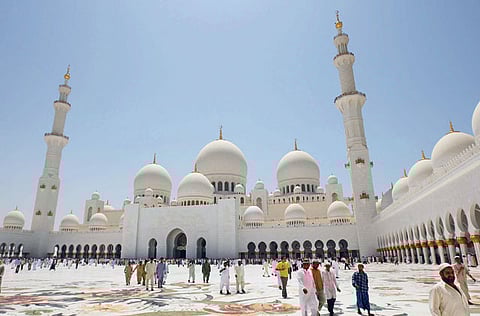
This elegant white marble wonder in the capital is a must-see. With more than 1,000 delicate pillars and 82 domes drawing on architectural elements of mosques from Granada to Damascus, it houses a riot of superlatives.
It was well worth donning black from head-to-toe to marvel at the world's largest carpet, handmade in Iran — all 35 tonnes of it.
But the most striking feature is the floor of the 18,000-square-metre courtyard, inlaid with huge flowers of coloured marble and semiprecious stones, the creation of British artist Kevin Dean.
Desert drive
A mere two hours' drive south of Abu Dhabi city and I was transported to rolling sand and camels. Here, in one of the world's largest deserts, where dunes reach almost 1,000 feet in height, the Qasr Al Sarab Desert Resort comes into view: a luxurious mirage in the shape of a fort. Ali, who lives in the nearby village of Hameem, is something of an ambassador for the hotel. "The desert," he said, "is about tradition and honour."
At dawn, we watched the sun rise over the unspoilt dunes, the air fragrant with desert primrose.
In a 4x4, we drove along salt-encrusted valleys. As the sun climbed, the dunes turned to the colour of apricot ice-cream. We ventured out again at dusk, after a lazy day and heavenly pummelling in the Anantara Spa.
Transported in time
This time, transport was of the traditional variety. As our small caravan of camels loped into the wilderness, the eerie silence of the Empty Quarter, the fabled Rub Al Khali, worked its hypnotic charm.
We dismounted to climb a high dune — two steps forward, one step backwards, as the sand cascaded beneath us.
I found a vantage point and watched a herd of gazelles prance into the distance, as the sun sank into the Arabian night.
My camel waited patiently, in no hurry to return, while a mere 193 kilometres away, life in the fast lane sped on.


