
What posture correctors can actually do
Slouching at your desk? Here’s what a posture corrector can do
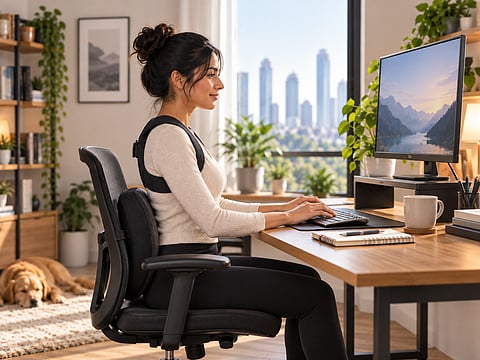
A posture corrector looks as though it should physically teach the body to sit straight. The more useful way to understand it is as a cue. Its straps resist the familiar movement of the shoulders rolling forward, making a slouch easier to notice. That distinction matters because occupational ergonomics does not revolve around holding one ideal position for eight hours. OSHA advises workers to change position frequently, even when their working posture is otherwise good. A brace can remind you how you are sitting, but the desk, screen position, chair support and time spent moving remain part of the equation.
What a posture corrector is, and who it is for
Most wearable correctors sit across the upper back with straps around the shoulders. When you round forward, the straps create gentle resistance. For a desk worker, that feedback can make habitual slouching more noticeable without requiring constant conscious checking.
It should not be confused with treatment. Research on braces and workplace ergonomics does not support the idea that simply wearing a support prevents back problems.
For UAE office and home workers, the practical question is therefore broader: does your setup make a comfortable position easy to maintain?
What to look for
With a wearable corrector, prioritise adjustability and a fit that provides a noticeable cue without forcing the shoulders aggressively backwards.
For the desk, geometry matters more. OSHA recommends supporting the lower back and positioning the monitor directly ahead, with its top at or slightly below eye level. It also recommends regular changes of position rather than remaining static all day.
Recommended products
Sifoz Posture Corrector Belt
The Sifoz is the most direct way to try the reminder approach. The manufacturer describes it as a universal size, adjustable design with lightweight, breathable construction, intended to draw the shoulders back when they start to round forward. The useful feature here is adjustability, since a corrector should provide feedback rather than hold the torso rigidly. Made from lightweight, breathable neoprene with no latex, this posture corrector feels soft and comfortable for extended daily wear while providing firm support around the back and waist. Treat it as a temporary posture cue alongside a better workstation and regular movement, rather than something that retrains the body automatically.
Ergonomic Lumbar Support Backrest
A lumbar cushion tackles a different part of desk posture. Instead of pulling at the shoulders, it fills the space between the chair and the inward curve of the lower back. OSHA's workstation guidance recommends appropriate lumbar support when sitting upright or leaning back slightly. This model is designed as an add on backrest for an existing chair, making it relevant when the chair itself offers limited adjustment. This ergonomic curved design provides lumbar support while sitting or driving, helping ease tension and discomfort across the upper, middle and lower back while encouraging better posture. Position matters, so the cushion should support the lower back curve rather than simply adding padding behind the middle of the back.
Mnixy Premium Acrylic Monitor Stand
A monitor riser can address the workstation rather than the person. OSHA recommends placing the monitor directly ahead, generally 50 to 100cm from the eyes, with the top of the screen at or slightly below eye level. The Mnixy is a fixed acrylic platform that raises a monitor while leaving usable desk space underneath. The AMT Acrylic Monitor Stand features smooth edges and a clear, minimalist design that complements any desk setup. Its practical height raises your screen comfortably, while the wide platform provides space to store a keyboard underneath and makes cleaning easier. A riser is useful only when your existing screen is too low. Raising an already well positioned monitor can simply move it beyond the recommended viewing position.
Alllvocles Resistance Band
A resistance band belongs here because posture is also about what happens away from the chair. A compact band provides resistance for general strength and mobility exercises without pretending to mechanically set posture. Versatile and suitable for a wide range of exercises, these resistance bands support calorie burning, muscle building and fat loss workouts targeting the arms, shoulders, chest, glutes, legs and more. Exercise selection should suit your ability and goals. Persistent pain, weakness, numbness or other symptoms are reasons to consult a doctor or qualified healthcare professional rather than self treat with accessories.
Verdict
A posture corrector makes most sense as feedback, not as a permanent external frame. For someone who repeatedly rounds the shoulders at a desk, the Sifoz Posture Corrector Belt is the most direct option here, provided its fit is comfortable and expectations stay realistic. The stronger desk upgrade may be the less conspicuous one: correct the monitor height, support the lower back and keep changing position during the day.
Gulf News earns a commission on purchases made through links in this article, at no extra cost to you. Our editorial team selects products independently.


