Atherton enjoying second innings
‘Watching england's transition from an ordinary side has been interesting'
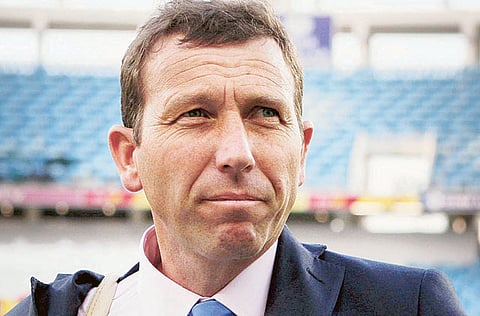
Dubai: It's been exactly over a decade since Michael Atherton switched over to his second innings of an expert columnist and commentator — and an exceptionally successful one at that. Former England captains, more so the articulate ones, have taken to the Fourth Estate like a fish to water though ‘Athers' has been a standout performer among them.
"It's been an interesting 10 years. Writing and commentating has helped me stay in touch with the game, while I have also had the privilege of watching England's transition from a pretty ordinary team to a wonderful side over the last two to three years," said Atherton on the sidelines of the first Test against Pakistan at the Dubai Sports City.
Objective
Much like his commentary, which is clipped but often laced with a wry sense of humour, the former England opener is objective in his opinions.
Speaking to Gulf News as the English wickets continued to tumble on a dramatic third day, Atherton was in no mood to join in bashing them, and tried to put things in perspective. "Yes, they haven't been able to get their act together in this (first Test) match and the next few months are going to pose a big challenge to their new-found status of No 1 Test team," he observed.
While Strauss & Co now trying to pick up the pieces after their humiliating defeat in Dubai, they have a long Asian sojourn ahead of them — two more Tests against a charged-up Pakistan team with a slew of one-dayers and T-20 fixtures here will be followed by tours of Sri Lanka and India.
Resurgence
Asked what would be his prescription for the England team to remove their tag of poor travellers in sub-continental conditions, Atherton said: "The team has to really stretch itself — that's what coach Andy Flower said at the start of the tour as they are up against a very well-drilled Pakistan team."
Asked what are the factors behind the resurgence of England over the last two years, Atherton felt it was a culmination of a number of qualities. "The outstanding leadership from Strauss as well as contributions from coach Flower and Gooch (batting), both of whom earned the respect from the players. There is more money now for the board, and they are covering all the bases. Finally, quality of the players is a must and there are one or two outstanding players like Pietersen and Swann who developed in the last few years...," Atherton reasoned.
The man known for his often stodgy, but match-saving efforts feels there is no reason for undue panic about the future of Test matches — provided there are wickets available which make for an even contest between the bat and ball.
"We have seen some terrific Test matches over the last six months — Australia vs South Africa, Sri Lanka vs South Africa, etc. The two ingredients, according to me, for a good Test match are pitches that allow bowlers a chance to pick up 20 wickets as well maintain a balance between bat and ball, and the game will continue to thrive.
More dynamic
"One talks about sporting wickets but it shouldn't be such that run-making becomes difficult, while you don't want dull draws either with scores of a 900 as against 500. If a batting team makes 300-350 as we have seen here (Dubai International Cricket Stadium), then you should have a good Test match.
How has Atherton seen the game change since a recurrent back injury somewhat cut short his international career in 2001? "There's a lot more one-dayers played these days along the emergence of Twenty-20. But fundamentally for me, the game hasn't changed as it still remains a battle between the bat and ball, though the game has become more dynamic, cricketers are fitter while the batsmen have become more inventive ..."
For him, the more dynamic aspect has been the arrival of technology (read: Decision Review System) over the last few years.
"It will certainly have a positive impact, though most of us would like to see it standardised. It has brought spinners back into the game, as batsmen can no longer afford to play with their pads," said Atherton, making a case for sound technique as the criterion for survival in any form of the game.


