Dubai's history through the lens
Japanese photographer held on to negatives and dug them out after decades
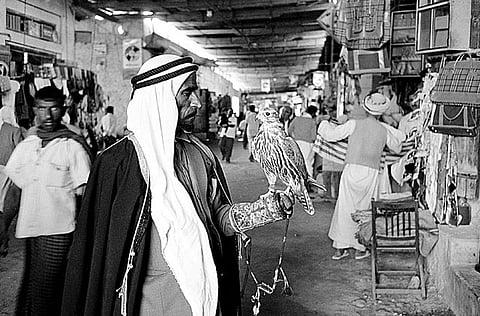
Dubai: For some reason, Yoshio Kawashima didn't hand over the photographic negatives of his 1962 press trip to Dubai to his Japanese newspaper Sankei Shimbun as is usually the norm.
If he had, they would have been destroyed after five years of storage. For some reason, Kawashima felt they were valuable even all those years ago and decided to hold on to them.
As Dubai grew into a modern city, Kawashima and his colleague Hiroshi Kato heard about the emirate from time to time and often reminisced about their trip. Finally, the photographer, now 80, dug out the photographs and decided to show them to the world.
Almost 50 years after they were shot, the fascinating black and white photographs of Dubai's heritage have been permanently preserved in a picture book, launched recently by Motivate Publishing.
Origins
Kawashima, wanting to show the photographs in the UAE, visited the Dubai Department of Tourism and Commerce Marketing office in Tokyo a couple of years ago, where Kimi Makishima Akai was working as marketing manager.
"The moment I saw the photographs I thought anyone who's lived here [Dubai] would appreciate them and think "oh my goodness these are great"," Akai told Gulf News at the launch.
"Kawashima said to me ‘No-one got so excited about these pictures as much as you did, just take them', and he just put the prints in my face," she said. "It was almost an accident that these photos came to me."
Akai wrote the text for the picture book and has also written a book about the emirate entitled Cool Dubai in Japanese. She lived in Dubai in the 1980s and moved back to the emirate with her husband in 2006. She has organised a number of cultural and media projects with the aim of building bridges between her native Japan and her home of Dubai.
The photographs were showcased at an exhibition last year, held in Ductac, Mall of the Emirates. While the veteran photographer attended the exhibition, he was unable to travel to the book launch due to ill-health. He did, however, send a detailed letter in traditional Japanese style to the launch.
Kawashima and Kato first visited Dubai in 1962 having landed in Sharjah at the British Royal Air Force air station — the then Trucial States were a British protectorate.
A three-hour Land Rover journey over rough terrain followed before they reached Dubai. The road was not paved until 1966. The visitors departed after five days, flying out of Dubai Airport, constructed two years earlier with runways of compacted sand.
During their visit they were guests of Shaikh Rashid Bin Saeed Al Maktoum, former Ruler of Dubai, in his majlis. Several informal pictures of Shaikh Rashid are included in the book and were presented to Shaikh Ahmad Bin Saeed Al Maktoum, President of Dubai Civil Aviation and Chairman and Chief Executive of Emirates airline and Group, who officially invited the two Japanese visitors back to Dubai on two occasions.
One section of the book is dedicated to the Dubai Creek. Impressed by its vibrancy, Kawashima writes that he could not help but capture the energy of the people and the colourful scenes of the vessels dotting the creek.
He recalls that his first glimpse of Dubai reminded him of Japan in the late 19th century at the threshold of the modernisation process.
There was a similar air of hope, expectation and belief in a better future in Dubai in the early 1960s.
The launch of the book, held at Bookworld by Kinokuniya, was attended by the Japanese Consul General Takashi Ashiki and Ebrahim Al Janahi, Chief Commercial Officer, Jebel Ali Freezone, which sponsored the book.


