An artist for all seasons
Zia Mohyeddin is a man of impeccable taste who possesses a sublime talent
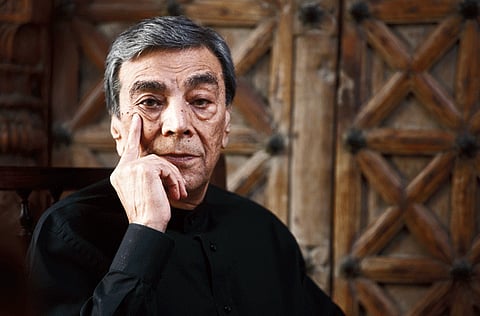
You are almost reluctant to take a breath lest its soft sibilance rupture the spell that is being cast by Zia Mohyeddin. For this man is gifted with a voice so mesmerising, he could read to you the nutritional information on a box of cereal and make it sound like poetry. As I sat in the 400-strong audience at the Ductac Theatre listening to him recite from Shakespeare, Mirza Ghalib, Kishan Chander and other geniuses from the West and the East, it was hard to not ride the alternating waves of thunderous applause and spell-binding recitation of literary works and land on the shores of an extraordinary mindspace. Moving between literary genres with matchless ease and mastery, Mohyeddin, the legendary raconteur, orator, theatre and film personality proved once again why it is a rare privilege to be a part of an audience when he is on stage.
One of the towering figures to emerge from Pakistan in the world of art, Mohyeddin, 77, was in Dubai recently at the invitation of Salaam Pakistan, reprising his brand of magic that today is considered an artistic benchmark. A magic that was unleashed at the age of 11 and which since then has only ripened and matured to acquire a cache reserved for the exclusive experiences in life.
It is difficult to pigeon-hole Mohyeddin's talent. One moment he has you in stitches as he recites humourous passages of Ibne Insha (an eminent Pakistani Leftist Urdu poet, humorist, travelogue writer and columnist) and in the next he is giving you goose bumps as he recites the legendary Urdu poet Sir Mohammad Iqbal's verses. Even as you are pulling together your disparate reactions, he changes trajectory and powers away on King Lear's grand lament. The thoughts of the inimitable Dr Aziz from EM Forester's Passage to India boom out next, a role Mohyeddin has performed to perfection both at West End and Broadway many times, as do the heart-rending feelings of the unfortunate Tafas in Lawrence of Arabia. Be it radio plays, television plays, theatre or films, Mohyeddin has done them all. From Chekhov to Shakespeare to Ben Johnson, Mohyeddin gets under the skin of the characters created by these literary masters with an ease that is a priceless gift.
A regular on London's West End, Mohyeddin lived in this city for nearly 50 years before he returned to his home country Pakistan in 2005 to head the National Academy for Performing Arts (NAPA) in Karachi.
He initiated the Reader's Theatre in Pakistan - to promote poetry and prose recitation - even as he continues to grapple with the administrative function of running his country's apex cultural body. His efforts of the last five years, he hopes, will lead to the arts and culture in Pakistan gaining the status they deserve. "I hope to set the standards for professional ethics and aesthetics among our students. Some, if not all, will carry the torch, I hope," he says.
A man of measured words and wry humour, he quotes from the works of Mirza Ghalib, the legendary Urdu poet, to express the spirit in which he meets some of the challenges in life: Bas Hujoom-e-na'umeedi' Khak mein miljaygee; Yeh jo ik lazzat hamari Saaee-e-lah-haasil mein hai. ("My intense frustration in seeking that which cannot be sought is going to be ground to dust. If you really seek something with such passion and insistence, then you will probably achieve it.") The couplet could well be the guiding principle of his life.
I, ME, MYSELF
I am sentimental about nothing. I don't like to live in the past. But sometimes I am moved to tears by simple discoveries. For instance, two months ago I had to perform in the Aman Ki Asha (Hope for Peace) - a cross-border cultural initiative by the Mumbai-based Times Foundation in India. In the middle of my busy schedule, I received a note from someone saying that he is the son of one of my father's contemporaries. He asked if I could meet with him. I have very fond memories of my father as an English lecturer at Lyallpur university and I did remember this man's father. We met for lunch and reminisced about our childhood. It was a truly heartwarming experience.
I realised I wanted to be an actor while in Australia where I had gone to study radio plays. I was there on a fellowship to observe broadcasting methods and had given up my Masters in psychology to study radio drama. While there, I learnt that to become an actor, I would have to enrol in an acting academy. So I applied to the Royal Academy of Dramatic Arts (RADA) in London and was lucky to be selected. After completing the two-year course, I got a chance to work for various companies, including the West End. To make ends meet as a student, I would do radio plays for the BBC and was paid a princely sum of five guineas (the equivalent of £5.50) which helped me to get by.
I am fond of cooking. I always had gourmet tastes and to satisfy them I've acquired fairly good cooking skills.
I don't live in the past. I don't like to dwell on things that have been. Life is not fair and you have to have your own methods of coping with it. Mine is withdrawal.
I am a workaholic. At NAPA I work until 8:30pm. At home, I head straight for my library and get lost in a book. Dinner time is usually late. Sleep often eludes me and I read a little more. Sometimes it's early morning when I doze off.
I am nostalgic about things that cannot be reclaimed. Nostalgia is a very dangerous game. Once you become nostalgic, you tend to romanticise and fantasise. I am nostalgic about quite a few things such as the flavour of French bread which I tasted for the first time in Paris. I am nostalgic about the first Tandoori roti with shorba (curry) that I tasted when my father took me out for dinner at the Delhi-Muslim restaurant in Lahore. I am nostalgic about the tinda gosht (apple gourd cooked with meat and gravy) an aunt treated us to at our ancestral village in Usool in Pakistan. I can never forget that taste and nothing can replace it.
I believe being a perfectionist is a curse. I am never quite happy with what I do or have done. I have acted in numerous radio and theatre plays and only a few stand out in my mind as they fall the closest to my idea of what great plays should be. I feel there is a huge gap between my intention and my execution. When I see a role in my mind's eye, I see the manner in which it needs to be performed; however, when I review my own performance, I see it way down on the rating scale. There have been moments when the gap between my intention and execution has been bridged as an actor, director or a raconteur. My most memorable role was as Shylock in Peter Dews' production of The Merchant of Venice. I am a great believer in understatement so I would say it was not the world's worst performance!
I dream in a variety of languages. Usually when people dream they are preoccupied by colours. In my case, I listen to the language, which is sometimes English, sometimes Urdu... Sometimes I dream in a language that I simply do not understand.
I consider an actor to be a curious combination of extreme ego and extreme humility. He dares to take up a role that others have done before him because his ego prompts him to do so. At the same time he invites critical appreciation for the role. Acting involves curious chemistry. You can feel it in your bones when the audience is with you. It is palpable.
I, ME, MYSELF
Me and my identity
I am a Pakistani. However, at the same time, I belong to a minority group of people who do not belong to any one place. I am perfectly happy to work in an environment where jingoism and chauvinism are not welcome.
Me and my repertoire
This is extensive. Radio plays, theatre, films... I also wrote a novel once, which wasn't published because when I went over it I found it to be too immature. It was called Unreal City and was inspired by London, which was my home for many years. It was misplaced along with a few other precious things while moving homes.
I'd like to think that I understood King Lear 40 years ago. I'd like to think I understand Hamlet. But there are a lot of things that I did - and do - not understand. I like to think I am truly in control when I am directing Chekhov although I have only read the English versions.
I do renderings from a lot of Urdu poets ranging from Mir Taqi Mir, Nazir Akbarabadi, Momin, Ghalib to modern poets such as Josh Malihabadi, Firaaq and Faiz Ahmed Faiz; there are some difficult poets such as Noon Meem Rashid whose poetry is difficult to understand. But it is wonderful to read and stirs the minds of the audience. I feel that if I have been able to arouse such emotions, I have done my job.
Me and cinema and televisionIn
In 1960 when I played Dr Aziz in Shanta Rama Rau's stage adaptation of EM Forster's Passage to India, the production was widely appreciated in London and it went to Broadway where it turned out to be an even greater success. That's when the phone began to ring and my roles in films like Lawrence of Arabia, Khartoum, Behold a Pale Horse and Sammy Going South happened. That opened doors for my career in television as well. Later television series and plays such as Cyrano De Bergerac, The Jewel in the Crown, Death of a Princess, Z-cars and so on happened. During my first sabbatical in Pakistan, (1969 to 1970), I conducted a 26-episode talk show. I marvel at the fact that people still remember it. To my mind it was a poor man's version of The David Frost Show. I wanted to prove that pure conversations can be entertaining and energising.
Me and the Reader's Theatre
My inspiration for the Reader's Theatre was the great Shakespearean actor John Gieglud. His performance in Ages of Man was a perfect example of what the Reader's Theatre is all about. One moment you are on the sea coast of Illyria, the next in the deserts of Syracuse. And whatever the place, the characters emerged as large as life.
I thought I could do this in Urdu. The Reader's Theatre is a style of theatre featuring minimal movement and scenery and relying instead on the vocal expressiveness of the actor to create a sense of place, character and action. You have to do it all with your voice. The way I recite, there has to be perfect coordination between eye, voice and the ear.
Me and stage fright
I think when you go on stage, you are tongue-tied, your mouth dries up and you have butterflies in your stomach. With experience this feeling has become less but it never goes away altogether. I think that if you lack nerves, your concentration or focus won't be as good.
I feel that the most difficult acting is that which takes place in the theatre. When you are acting there is [very little] between the audience and you. I love theatre and would love to do a few roles even today. Over the years I have come to love King Lear, but now I have no stamina left to hold Cordelia in my arms!
Me and the great men who influenced me
One man who had the deepest impact on me was EM Forster. He was the quintessence of gentlemanliness and he taught me the most important etiquette - of listening. He was in his seventies when I met him and he would patiently listen to me as though I was coming out with great chunks of profundity. It was he who insisted with the American Producers that they had to cast me as Dr Aziz in the Broadway version. It was only when the Broadway show turned out to be such a thumping success, that I learnt about this.
Theatre personality Frank Hauser was one of the finest directors I had the pleasure to work with. He was great as a friend but as a director, he would keep pulling me up and never let me rest until I gave my best.
Me and my philosophy of life
I do not have any. Only people who claim to be ambitious and pretentious about life want to correct and create a new society and have the gall to talk about a new philosophy. Aren't there enough philosophies in the world? There is Plato, Leibniz, Spinoza...
Me and my love for music
I am passionate about music. I recall as a child when at about 8pm, my father, Khadim Moheyddin, would gently lift the satin-embroidered cover, so laboriously created by my mother, off the radio. Only he had the permission to do so. For the next hour, we would hear the classical luminaries of the time - Gangubai Hangal, Laxmibai Jadhav, Kesarbai Kerkar, Vinayak Rao Patwardhan, Narayan Rao Vyas... I would sit and listen to the music that made no sense to me then.
However, it was embedded in my subconscious. Today my reactions to classical music stem from the deepest recesses of my heart. However, I detest attending classical shows where the audiences kill the pure experience by over-applauding and renting the air with wah wahs (a term of appreciation in the subcontinent). I feel 90 per cent of the audience that attends such shows has not been initiated into any form of classical music. When musicians indulge in pyrotechnics and gymnastics, the essence of music is lost. Our music is very serene and that is how it should be heard.
Me and my love of words
Language means a lot to me. Is it because I am an actor? I feel good speech comes with clarity of thought. I can be moved to tears if I come across a beautiful verse. Words reside in my heart.
I, ME, MYSELF
Running a cultural academy must be tough. What made you accept the challenge?
I accepted the job as director of NAPA in 2005 because I felt it was high time we had an organisation like this to conserve our culture and heritage. I was concerned with the performing arts - dance, drama and music.
We set up the organisation in Karachi because I felt it was a more contemporary city. I wanted to be allowed to find and hire the right teachers and create autonomy for the organisation. It's our sixth year and we have about 175 students. People are now aware of it. Sometimes I feel I will not be able to complete what I set out to achieve. I willingly accepted a challenge because I love the energy it calls for.
How would you describe yourself?
I have found solace in each of my roles, whether they be in Urdu or in English. To elaborate on who I am, I would like to quote the renowned Urdu humorist Patras Bokhari who said: ‘Main doghala nahin hoon, main dohra hoon'. There is such a world of difference between the two words. Doghala means someone who is two-faced and dohara means someone who is two-layered.
I encompass it all. I can appreciate Joyce, Shakespeare and Eliot and be equally moved by Ghalib, Rumi and Mir Taki Meer. I do not have to make too many adjustments to fit into the East or West.
I must admit that while my heart was touched by the poets of the East such as Ghalib and Firaaq for a long time, I didn't understand what Shakespeare really meant until I saw Richard Burton perform Hamlet at the Old Vic. It shook me completely. To be a good actor you have to be like an oak tree - seasoned, strong and grand.
Do you have any regrets?
If anything, I'd like to be remembered for my love for the language, culture and heritage of my country. For some bizarre reason, we are losing touch with our heritage and culture. What I would like as an epitaph is: ‘Here lies a man who tried to inculcate a taste for everything.' I believe that the biggest bane of our lives is mediocrity.


