1-2-1 with adventurer Adrian Hayes
He tells us about helping a charity team prepare for a climb up Europe's highest mountain
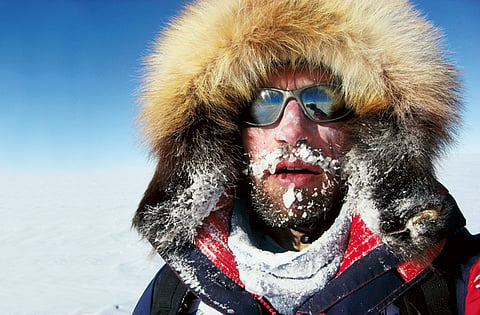
Adrian Hayes is walking to the top of the main slope in Ski Dubai, clad in just a T-shirt and shorts when all around him are buttressed from the biting cold by padded jackets and gloves, when he is stopped by a shocked staff member and asked why he isn't wearing the mandatory coat and boots. "It's OK, I'm used to it," he says to the bemused guy, telling him that he's prepared to wear the requisite coat if someone would be kind enough to bring it to him.
"Used to it" is some understatement. Not only is Adrian is a Guinness World record holder for reaching the Earth's "3 Poles" (the North Pole, South Pole and Mount Everest) in the shortest period of time in history, he's also an Ironman event competitor and a former British Army Gurkha officer. It's fair to say he is au fait with extreme temperatures.
Under canvas in the snow
He's here in Ski Dubai to offer his advice and expertise to members of the Climb for Cancer team who are about to embark on a mission to climb Mount Elbrus in Russia.
The six-strong team, led by Dubai-based Lebanese national Nizar Fakhoury, spent two consecutive nights camped out in Ski Dubai last month ahead of their assault on Europe's highest mountain, on August 31. Sleeping in freezing temperatures is a tough enough task without having to resist the temptations of the several (warm) restaurants and coffee shops that are a mere five-minute walk away. I ask Adrian how useful these two nights will be in the group's preparations for climbing a 5,600-metre peak in the mighty Caucasus Mountain range.
"For physical training it's too short," he admits. "You really need to be climbing big mountains. Unfortunately at this time of year it's impossible. What this exercise does do is allow you to test your systems, which may be fine in your living room at 22 degrees Celsius but you find that at minus three or four degrees, it doesn't work quite as well. So your sleeping bag for instance - is it warm or is it cold? Your sleeping mat, your stove. Get it right in practice and then when you do the actual climb it makes life a lot easier."
He says the greatest test the group may face is altitude sickness. "Altitude is a great leveller. It is no respecter of age, experience or fitness. People get it or they don't get it. But there are ways you can mitigate getting it. The body is a remarkable thing so you take things slowly, and drink copious amounts of water."
Let's hear it for altitude
As a passionate advocate of economic, social and environmental sustainability and a renowned speaker on the topic, it is hardly surprising that Adrian can also see the benefits of altitude. We should be grateful, he says, for the way it prevents humans from spoiling some of the few intact locations left in the world.
"I think it's fantastic that altitude exists," he adds. "If it didn't affect anyone we would have motorways and big hotels and cars in all these beautiful places, so [high-altitude locations] are where the Earth can stay in its pristine beauty, untouched and unsoiled. And long may that continue, which it will because we cannot live at altitude. The maximum altitude at which anyone has ever lived is around 5,000 feet (1,524m), in a city called La Rinconada in Peru."
Asked whether the Climb For Cancer charity is one that is close to his heart, he says that it is, "because cancer is something that everybody is familiar with, because everyone knows someone who has been affected by it".
"I'm passionate about the reasons for [the climb] and these guys ultimately help the cancer patients," he says. "Our world is being poisoned by the food we eat, with pesticides and chemical hormones and I'm really passionate about getting back to a place where we can eat, live and drink without being affected by this toxin, this blight on humanity."
I ask Adrian why, as someone who has lived and worked in nine countries and visited over 100, he decided to settle in Dubai with his family.
"I've been here a long time but the main reason is the sporting facilities are excellent," he says. "The training for getting fit is brilliant. The heat between May and October means we've got a bit of a problem, but the rest of the year is superb and my work takes me around the world so it's a good central location. I love it here."
1-2-1
- Name: Adrian Hayes
- Age: 48
- Nationality: British
- Claim to fame: Holds record for reaching the world's "Three Poles" - the North Pole, South Pole and Mount Everest - in the fastest time.
- Lives in: Dubai
- Occupation: Motivational life coach


