Range Rover Sport: Car with a metrosexual appeal
Wheels gets behind the steering of the new Range Rover Sport and tries to figure out why it turns civilised men into monsters
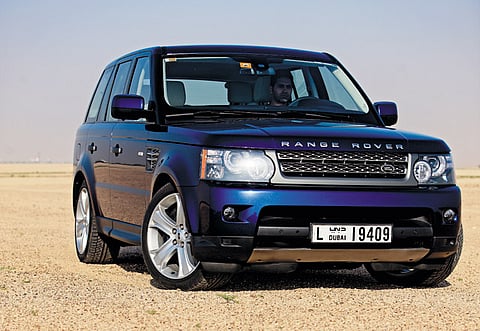
I have always despised them. I absolutely loathe all those who drive around in tall, fat cars with scant regard for others; as if they inherited the roads, and the fast lane was their birthright. And I've tried to imagine what evil power overcomes them so that they shed all traces of civility and bully others, tailgate lesser metals, or cut across six or seven lanes in haste only to stop at the next fast food joint and honk incessantly till they get their bucketful. But I've never found a convincing answer. That is until last week, when I found myself very close to doing all the above.
I was the same person, driving down the same route, so what could have possibly made me want to act in a way that I detested so much? Why did I get the feeling that the road, especially the fast lane, belonged to me and me alone?
Could it be the Range Rover Sport that I was driving? It can't be... It's too civilised and dignified a vehicle for that. Although it's true that it leaves 510 raging horses at your disposal and seats you in a position that makes you think you rule the road. And it's possible that serving this heady mix of brutal power and lofty ride to someone not level-headed enough to handle it could unleash a beast with menacing potential.
And all this while, I had considered myself a level-headed driver.
Metrosexual appeal
Long gone are the days when Land Rovers were bought for their off-road capabilities, with companies like Toyota and Nissan offering much cheaper, yet capable four-wheel drives. So, it's only natural that most of the changes for the 2010 Range Rover Sport Supercharged are aimed at the affluent city driver than the daring explorer.
The design changes are more a nip here and a tuck there. Up front, the 2010 model gets LED headlights, a revised bumper, redesigned front wings and a new two-bar grille. New LED side indicators, redesigned side vents, body-coloured side mirrors and new light clusters at the rear pretty much round off the exterior updates, and these, together with a lower stance, make the Sport look even more athletic than before.
Open the vault-like door, slide into the snug leather seats with electrically adjustable side bolsters and look out from the commanding position; it already makes you feel important. Land Rover hasn't tried anything outrageously different with the cockpit design, and has stuck to the traditional Range Rover styling cues here. Loads of leather and wood, beautifully blended with high quality soft touch materials, superb
detailing and improved switchgear contribute to the overall premium feel inside. In fact, the centre console looks much cleaner than in the previous model as the number of buttons and switches has been halved. There's a circular one close to the steering column that says Start/Stop; press it, and sit back in amazement as the suave, sophisticated barge transforms into a roaring beast.
More power
Under the chiselled bonnet lurks a supercharged 5.0-litre V8, jointly developed by Land Rover and Jaguar, which is good for a whopping 510bhp and 625Nm, bringing it almost on par with the Porsche Cayenne Turbo and the BMW X5M. Although the X5 will decimate it in a drag race, the Sport Supercharged is a seriously quick machine. Land Rover claims it will sprint to 100kph from standstill in 6.2 seconds, but I saw that mark on the speedo before the sixth click of the seconds needle a couple of times. The superb six-speed automatic transmission enables a smooth, refined progression up to a top speed of 225kph. Additionally, the new model has paddle shifters, which, however, are most likely to remain an ornament in this market.
The steering is communicative and you can feel every cobblestone and lane marking in the palm of your hand. The brakes are good too. Uprated 380mm ventilated Brembo discs up front and 365mm ones at the rear are employed to bring the more than two-and-a-half tonne hulk to a halt.
The suspension has also been revamped, with conventional dampers being replaced by new units, which adjust in accordance with driving patterns and terrain. One great feature is the surround camera system which makes parking and manoeuvring in tight spaces a piece of cake. This will also come in handy when negotiating craggy hills or dangerous steeps.
Take on the dunes
Although it's extremely unlikely that a Range Rover owner will take his car deep into the desert or up a mountain, Land Rover has done minor upgrades to its terrain response and hill descent control systems. The new sand launch control feature limits initial wheel slip, reducing the chance of the wheels digging into desert sand.
And the gradient release control introduced in this model is claimed to inhibit the rate of acceleration when the brakes are released at extreme angles, making it more controllable when descending steep inclines.
Verdict
Agreed, you don't need a Range Rover to go off-roading. You can make do with a Toyota Land Cruiser or a Nissan Patrol. And if it's road-ripping speed that you're looking for in your SUV, then there's the BMW X5M. But it's hard to find another car out there that makes the driver feel so important as a Range Rover does.
So the next time you have someone tailgating you in a Range Rover Sport, don't be angry, sympathise with him. He's simply not capable of handling this wonderful machine, which is not for the easily intoxicated.
Specs and rating
- Model: Sport Supercharged
- Engine: 5.0-litre V8
- Transmission: Six-speed automatic
- Max power: 510bhp @ 6,500rpm
- Max torque: 625Nm @ 2,500rpm
- Top speed: 225kph
- 0-100kph: 6.2sec
- Price: Dh385,000
- Plus: Powerful, smooth engine, interior, image
- Minus: Not the best off-roader


