For the love of design
Dutch design duo, Miriam Van der Lubbe and Neils Van Eijk, darlings of the design show circuit, prepare to wow the Middle East with one of their trademark designs.
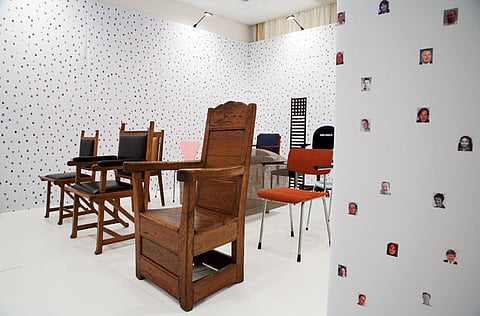
According to the official version, Miriam Van der Lubbe and Neils Van Eijk first bumped into each other at a coffee shop somewhere in their native Holland. A few sips of coffee into our conversation and Van der Lubbe coyly says, "Honestly, we fell in love in design school and that was way before that official cup of coffee."
As in all newsprint-worthy love stories, it was fate that brought these two together. If it weren't for math and physics, Van der Lubbe would have been an architect.
"The whole idea of others populating someone else's creation to give it meaning was fascinating," she recalls. Lack of enthusiasm for those two subjects set her looking for other mediums of design that could bring stories, people and reactions together.
That's when Design Academy Eindhoven happened and Van Eijk came into her life. After graduation, for the sake of their love and their work, they set up studios in different cities. "We would be on the phone daily, critiquing each other's works," chuckles Van Eijk.
"Soon, daily calls turned hourly and living apart started to seem silly." In 1997 they set up shop together.
In 1998, Van Eijk started work on the famous Bobbin Lace lamp. "I was disturbed by the thought that the lamp shade had no connection to the light it was highlighting," he says. Weaving glass fibre into a traditional lace pattern, light would break through every knot in the lace.
Unveiled in 2002, with its light source remaining concealed, the lace became the light. Soon, Abu Dhabi will be home to one of the biggest, most expensive Bobbin Lace lamps in the world. "From difficulty funding the research to being paid to make it bigger and brighter has been quite a journey!" says Van der Lubbe.
In 2006, their love for craftsmanship was tested again when Droog Design & Gallery Friedman, New York, came knocking with a simple request - "Make something super-expensive". "What a silly brief, we thought," laughs Van der Lubbe.
Their clientele in NYC, them from Holland — there was enough room to be ‘touristy' about it. Instead the designer duo sniffed out a small Indonesian village known for its hand carving and the Godogan Table was born.
"The woodworkers carved out this extremely complicated design depicting an Indonesian fairy tale. A whole lot of people were employed for a good period and were paid fair wages," she adds. "We are driven by an urge to explore materials as a means of communication - to research and create for ourselves. Our commercial work is a means to that end!" says Van Eijk.
One such experiment was the 2008 La Divina Commedia, a chaise longue and a lamp, both realised in polypropene enhanced by means of laser beams and manual cut-outs. "We created a design inspired by the artist Gustave Doré's 18th century interpretation of Dante's La Divina Commedia and asked one of those master craftsmen to execute a carving - in plastic!"
The irony is not so much in the design, but in how the designers' initial search for an ‘expensive' piece led to new applications of the indigenous crafts from a far away land.
"Humour is an important tool in communication. We are not after a silly joke that is forgotten after being told once, but a joyous experience that makes people feel," says Van der Lubbe. The adorable Bloom my Buddy vase did just that.
"We wanted to connect a vase with its flowers in a way that could elevate a floral arrangement into an expression of moods and personalities. Designed like a doll with a water reservoir at the base, these fun and fabulous flower vases allow you to design your ‘boy' or ‘girl' in infinite floral dresses to suit your mood!"
"Human experience guides us," says Van Eijk of their design ethos. "While no one can ever predict precise reactions, we strive to make products that will give people a direction to think, feel or do."

