Review: The Man Without a Shadow
In Joyce Carol Oates’s latest, a scientist falls for her test subject, a man with a compromised memory
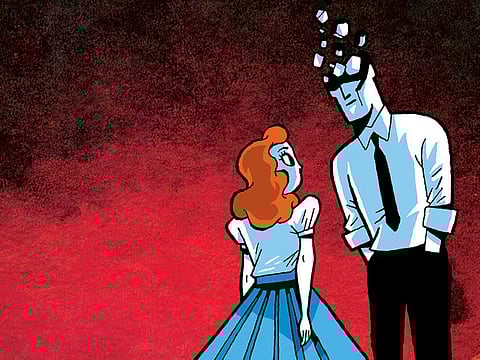
The Man Without a Shadow
By Joyce Carol Oates, Ecco, 384 pages, $28
Joyce Carol Oates’s latest novel makes for uncomfortable reading. Even before the narrative begins, a hint of disquiet creeps in with the epigraph: “The annihilation is not the terror. The journey is the terror.”
Forget the explicit reference to terror; a clammier sort of eeriness settles on the reader who pauses to research the identity of the epigraph’s supposed source, Elihu Hoopes, who turns out to be the “man without a shadow” of the title. To enter these pages is to enter a world of smoke and mirrors, rendered all the more insidious by the realisation that this purports to be a world of objective truth, a world of scientific inquiry.
A peculiar stylistic device adds to the book’s penumbral chill: the omniscient narrator’s penchant for isolating words within a sentence, whether quarantining them inside quotation marks, sequestering them within parentheses, setting them off by dashes or distinguishing them by font. The effect is “distancing” — disorienting — disconcerting. As if certain words were so suspect — sordid — as to require “handling” by tweezers or being pinched between fingertips, the way one might hold a (soiled) tissue.
“The Man Without a Shadow” spans three decades and is set almost entirely within the confines of the University Neurological Institute at Darven Park, Pennsylvania. Its plot focuses on the relationship between Margot Sharpe (she is about to turn 24 when we meet her in 1965, a graduate student and brand-new research assistant in the memory lab) and Elihu Hoopes, or E.H., as he is called in the scientific literature. An infection left him, at 37, suffering from untreatable anterograde amnesia. That is, he remembers most of his life leading up to the illness but is incapable of forming any new memories. Once a successful businessman, he now lives with an elderly aunt and spends his days undergoing tests (sometimes cruel, even sadistic) at the institute.
E.H. is gentlemanly. E.H. “emanates an air of manly charisma”. E.H. is “unexpectedly tall”. His skin “exudes a warm glow”. He is “something of an artist”, the scion of a distinguished old Main Line family, a former seminary student and civil rights activist. To top it off, he is famous in a highly particular way. As Dr Milton Ferris, the principal investigator of Project E.H., says, he “will possibly be one of the most famous amnesiacs in the history of neuroscience”.
In other words, E.H. is the kind of fellow to make an impressionable young neuropsychologist swoon. Or go “dry-mouthed and tremulous”, as Sharpe does, encountering him for the first time. But she’s a practical young woman, and even amid being dazzled by this vision of preppy, tragic masculinity she doesn’t fail to register the boon he might be to her career, or to intuit the impact he will have on her life.
In fact, E.H. becomes her life — or, more accurately, what she chooses in lieu of a life. He serves as the unwitting tabula rasa on which she projects all her hopes and fantasies. If Hoopes is the helpless prisoner of his affliction, Sharpe will spend the better part of her years contorting herself into an amalgam of jailer, saviour and ultimately fellow captive.
At once ferocious and submissive, Sharpe is acutely aware of the caste system she must navigate in order to succeed as a female scientist. She learns to think of herself as the Chaste Daughter to Milton Ferris’s all-powerful paterfamilias. When they enter into a sexual affair, she recasts herself adeptly so as to reap professional benefits while tamping down shame. She turns powerlessness into attainment through an alchemy of the most morally dubious sort.
We are frequently told that she is thin, possibly anorexic, and her self-starvation carries over into her emotional life. Not only does she have very little relationship with her family, she seems oblivious to the meagreness of that relationship. Not only is she virtually friendless, she seems unaware of the impoverishment of her entire existence.
For obvious reasons, E.H. also lacks awareness, but as he ages, memories from his early life increasingly trouble him and his chivalrous demeanour begins to betray alarming cracks. The threat of violence has been telegraphed from the novel’s opening pages, and Sharpe has fantasised about E.H.’s ability to hurt her.
The book devotes much space to a mystery in E.H.’s past. He obsessively draws a drowned, naked girl floating in a stream. We hear repeatedly about a plane crash, knives, a jilted fiancée. We are subjected to many reminders of E.H.’s commitment to civil rights — always in the most generic terms: He “marched with Negroes” and considered Martin Luther King Jr a hero. It’s hinted that his work in “the Movement” might have sparked an appetite for violence.
All these threads are developed excessively and unconvincingly, and when the knots are at last unravelled, the payoff is anticlimactic, perhaps because this whole subplot was never integral to the book’s central concerns.
These concerns involve vital questions: what is the nature of the self, and what is the relation of memory to the self? What kind of personal identity is possible when we lack the ability to sustain a continuous narrative? What kind of identity is possible when we choose stagnation and delusion over growth and reality? And no less trenchant: what sources of power are available to a woman in a male-dominated field? How does she negotiate the collision of professional ambition, desire and medical ethics? How does a person whose memory is not impaired construct a narrative of the self?
Throughout her career, Oates has demonstrated an uncanny knack for plowing straight into difficult, essential terrain. But why “uncanny”? Why not simply say “a knack”? Because of the fault line that runs between the subjects she rehearses again and again — violence, betrayal and shame, sexual and otherwise — and the sense that although she is drawn to them, she has not discovered much that is new about them.
It’s as if this material mesmerises her so utterly that it impedes the full range of her power to interrogate it, as if she’s examining it not in full daylight or even in the bright glare of the laboratory but only in the bleakest reaches, only in the shadows.
Oates could hardly be accused of writerly timidity. In terms of her output, her unapologetic appetite for working across genres, her incisive intelligence, she’s a paragon of boldness. Yet this novel, much like its protagonist, seems an unstable alloy of ferocity and submission. As I read it, I couldn’t help thinking of Oates’s assertion that when watching a boxing match she tends to identify with “the losing or hurt boxer”, and wondering if this notion of victimhood continues to hold her in thrall. The book poses such large questions, yet restricts itself to such small answers.
Early on, we learn that E.H. has a flattened affect, “as a caricature is a flattened portrait of the complexity of human personality”. In confining her search to the realm of darkness and depravity, Oates has flattened the potential complexity of her own novel.
–New York Times News Service
Leah Hager Cohen’s most recent novel is “No Book but the World”.


