New Delhi art show: Imprints of plight
In a bid to spread awareness about the endangered sloth bears, artists create works from canvases with paw marks
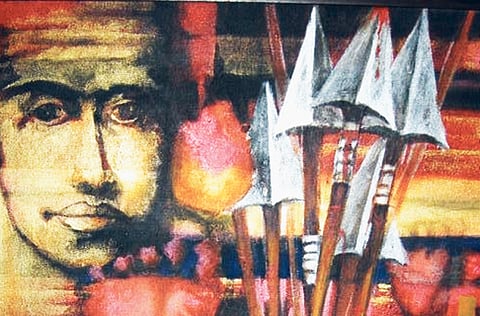
The looming shadow of a poacher and a set of spears hover ominously over a despondent-looking bear; multiple bear pug marks in a jungle whittle down to a few before fading out completely; leaves scatter in a jungle as eddies of wind blow them out, symbolising the extinction of India's bear population.
These and many other paintings were a part of a unique art initiative called One World held in New Delhi recently, to underscore the plight of sloth bears in the Indian subcontinent.
No mundane event this. For the show, rescued and rehabilitated sloth bears from four Indian wildlife sanctuaries were made to walk with colour-dipped paws on empty canvases.
These canvases were then given to eminent Indian artists to create masterpieces around them. The result? A delightful cachet of paintings that conveyed their message with engaging images.
"Basically," explains New Delhi-based artist Anjoo Kaushik, who was a part of the project, "after the bears had left their footprints on the sheets, we worked around them to convey our message. Some canvasses had one pug mark, the others had two while many had multiple imprints."
The exhibition — which took three months to curate — finally showcased works by 30 artists and some of the 600 rescued dancing bears living in the Wildlife SOS Bear Sanctuary. Expectedly, the show, initiated by two NGOs — People for Animals (PFA) and Wildlife SOS — was a sellout. The sales proceeds of the art pieces will now go towards the rehabilitation and treatment of rescued bears at rehab centres across the country.
Kartick Satyanarayan, founder member of Wildlife SOS, says: "Our mission is to help conserve the endangered wildlife. One of our primary species has been the sloth bear. The rescued sloth bears were being used as dancing bears by people in local villages. We have rescued about 600 of them and are looking for proceeds to make them live in peace and happiness."
Ambika Shukla, the director of PFA, opines that the biggest threat to the sloth bear in India is poaching for "bear dancing". Small wonder that the present bear population in the India has plummeted from more than 6,000 a decade ago to about 4,000 now.
Dwindling bear habitat
According to Shukla, the mother bear is often killed while trying to protect her cubs. The adult bears are also poached for their body parts such as the gall bladder, bile, claws and genital organs which are used to meet an exponentially growing demand for traditional medicine in China.
Habitat destruction (illegal quarrying, deforestation and mining, illegal tree felling, etc) is further accelerating the rapid decline of this species.
"Shrinking habitat and encroachment by humans in forest areas is fuelling increasing incidences of man-bear conflicts across swathes of the subcontinent," adds Shukla.
According to the officials of PFA and Wildlife SOS, Qalandars, a nomadic gypsy tribe, date themselves and the origin of bear dancing back to the 13th century and the pre-Mughal dynasty. Qalandars gained prominence as royal entertainers in the courts of Mughal emperors where they also performed magic tricks and staged wrestling bouts. Once the emperors and kingdoms vanished, the bears were used to perform dances in public.
These bear dancers operate on the highway between Delhi, Agra and Jaipur. In India, bear dancing is banned by the Wildlife Protection Act 1972 but a slew of socio-economic and political factors have made the implementation of this law an onerous task.
Qalandars purchase the sloth bear cubs from tribal poachers or traders and then train them to dance and respond to commands by intimidating them. This training begins early — crude iron needles are heated and then driven through the baby bears' muzzle without anaesthesia or antibiotic. Through this, a rough rope is pulled.
This agony of grossly swollen muzzles and torn tissues, together with a fair amount of beating and systematic starvation, force the bear to dance at his master's will. The bears live the rest of their lives at the end of a four-foot long rope and with no stimulation at all, thus causing several mental problems.
Male cubs are also castrated at a very young age to keep their owners safe, again crudely by use of a razor, without anaesthesia or antibiotics. Canine teeth are removed when the bears are one year old by knocking them out with a metal rod.
For the rest of its life, the bear dances in public to earn money for the Qalandar. Often, the bear even falls prey to tuberculosis or rabies while many are blinded due to malnutrition.
For 15 years, Wildlife SOS has been trying to end this horrific tradition. More than 600 dancing bears regained a life of liberty and dignity in their four rescue centres and the Qalandar tribe is being rehabilitated with both financial backing and training, education and health care. The Qalandars are entering mainstream society to better the quality of life for their community.
Organisations to the rescue
"Our organisation has worked for Qalandar rehabilitation to provide alternative livelihoods to the gypsies along with education to their children and economic empowerment to their women," says an official of Wildlife SOS.
Similarly, People for Animals, India's largest animal welfare organisation which runs 26 animal shelters across India, too, has been pitching in towards the cause of bear rescue. It acts as a welfare organisation, a pressure group and policy facilitator for the rescue and rehabilitation of animals across the nation.
For the artists of the exhibition, the bear interface was an enriching one. Anita Trehan, a Delhi-based painter, says: "This exhibition has been a true eye-opener not only for us artists but also for the viewers. As a wildlife lover, you may listen to as many lectures on the topic or read up as much as you like. But when you see an artwork — whose longevity is far more — your connect is emotional and immediate."
Neeta Lal is a journalist based in New Delhi, India.


