Patchwork commentary
The creations of Syrian artist Tammam Azam reveal various facets of life in the city
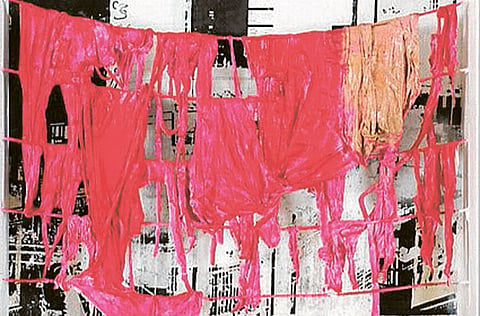
Tammam Azam has a big collection of pieces of fabric that he has found on the streets, in people's homes, in shops and in other places. The Syrian artist uses these fragments in his work, where they appear as laundry hanging on clotheslines strung across his canvases. The tiny pieces of fabric are glued to the canvas or attached to ropes with clothes pegs and painted over to create colourful, mixed-media artworks.
Interestingly, Azam's Laundry Series was inspired by watching his 2-year-old daughter playing with the clothes and pegs on the clothesline to create different arrangements. Over the past five years, the series has evolved from monochrome paintings to colourful installations. In his first solo exhibition in Dubai, titled Dirty Laundry, Azam is showcasing his latest experiments in the Laundry Series. These include paintings, collages and installations that speak about his personal journey from the small village of Sweida to the bustling city of Damascus and comment on the recent upheavals in the region and the present situation in his own country.
"Every piece of fabric in my artworks belongs to somebody and has a story. It represents memories. For those, who, like me, have moved far away from their hometown, these fabrics symbolise their memories of home and the stories they left behind," Azam says.
On a personal level, the glue and pegs that bind the fabrics to the rope in his canvases are a symbolic depiction of how the artist's own memories of home keep him connected to the place and to the people he grew up with. On another level, the pieces strung together on a rope speak about the connections that exist between human beings, the shared destinies that bind people together and their collective power to change their circumstances.
When Azam moved from his village to Damascus, he was overwhelmed by the crowds and the hustle and bustle of the city. He conveys this experience through a multitude of fabrics of different colours crowded together on his canvases. But the splashes of red and the holes he has burnt in some of these canvases change the narrative to speak about the throngs of protesters and the violence he has seen in the city in recent times.
The artist has always used a black-and-white palette because it reflects the volcanic ash, which is a predominant feature of the landscape in his village. But in his latest work, these colours in a set of collages and paintings signify the fading of memories and of life itself. The barely visible fabrics in the collages indicate a zone between presence and absence. But in the paintings, the laundry and clotheslines appear like ghostly patches, mourning the loss of the people, memories and stories that have been destroyed.
The metallic works in this series are a continuation of Azam's exploration of the city. Here, the laundry on his canvases is drenched in silver, gold and other metallic hues. "The city is so different from my village. I began to use metallic shades when I moved to Damascus, because I wanted to recreate the dull lustre of the buildings, the cars and the factories. I wanted to infuse my work with a sense of the industrial environment, the modern architecture and the beauty and anarchy of the crowds, traffic and chaos in the city. My latest work combines the concepts behind my earlier Metallica Series and the Laundry Series, with the folds of the fabrics, the pegs and the ropes imparting a depth and a sense of movement," Azam says.
His box-shaped installations further comment on life in the city, where people lead isolated lives with little interaction with their neighbours. Here, the laundry is hanging from ropes strung across the boxes, with a silk-screen print of a cityscape in the background. "These were inspired by the view of the city from the window of my tiny apartment," the artist says.
Azam has recently moved to Dubai and has added an installation to this show that speaks about this change in his life and conveys the essence of the show's theme. Titled 7kg. News, the piece is a washing machine, stuffed with local newspapers covered with streaks of red paint. The machine is plastered with cuttings from local newspaper reports about the Arab Spring. The soap compartment is also painted red and lies open. This evocative piece speaks about the barrage of news available in Dubai, the power of a free media, the need to clean up the socio-political environment in the region, the violent protests seeking to do so and the lack of closure for those who risked everything for change.
Dirty Laundry will run at Ayyam Gallery, DIFC until January 26.


