Avant-garde World War I writer Jacques Vaché
The works of a forward-thinker who died tragically young more than a century ago
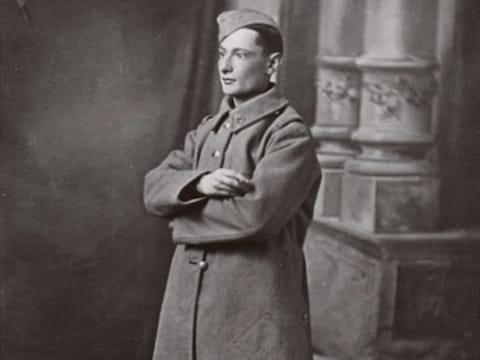
Europe’s dive into the First World War had shown many singularities, raising a new radical avant-gardism. Dada began to take shape in Zurich, Marcel Duchamp and Francis Picabia refined their multifaceted iconoclasm in New York, Erik Satie laid down his art by making music which left out the history of music. These artists, writers, and musicians created the metaphysical summersault towards the unknown faced with the collapse of values in the Western world. However, all were protected from the ravages of war, reformed or having fled to neutral countries. During this time, Jacques Vaché, born in 1895 in Lorient, Brittany, fought in the mud of the trenches and would despite himself be the one and only avant-garde poet of this great war. As the son of an Anglo-French artillery office, in 1913 along with three friends from the group of Sârs known as the Group from Nantes, they published En route mauvaise troupe, a review which caused a scandal due to its anarchism. Called to arms, Jacques Vaché became a dandy of the trenches but was not a soldier. “I had the chance to kill the good Gerry in front of me”, he wrote to his father in August 1915. Marked by the decadent symbolism and by Alfred Jarry, he also cultivated talents as an artist.
His clear and pure lined caricatures captured the characters that he immortalised in just a few lines. Having been injured at his legs in September 1915, he was repatriated towards a hospital in Nantes where he met a nurse, André Breton. The future founder of surrealism was fascinated by the freedom of thought and audacious analogies of Jacques Vaché. The convalescent was one of the rare people of his time to think and believe he was free of romance, literary mannerisms and psychology. Returned to the front as interpreter, his correspondence with Breton allowed him to lay down the foundations for Umour. “I think it is a feeling – I would almost say a SENSE – also – of theatrical uselessness (without joy) of everything.” Stimulated by his new friend, in a telegraphical style he created breaches opening towards poetical spaces which were reminiscent of Lettres du voyant by Rimbaud. From the trenches, he already saw himself as outside of life. “I was successively a famous writer, an artist and a scandalous cubic painter – Now, I am at home and leave others the care of explaining and discussing my personalities after those indicated.”
Continuing in this manner after the way, he was found dead by an overdose of opium in a hotel in Nantes in 1919. He was just 23 years old. Still under his charm, Breton published his Lettres de guerre, which brought together all of the letters written to him by the “Pohète” as well as those sent to Aragon and Théodore Fraenkel. He invented a Vaché who inspired surrealism and certified that he was a real Dada without even knowing Dada. Jacques Vaché became a wandering myth without his own identity, a writer without a body of work offering himself up as an object and subject, and who Guy Debord confirmed he met “at least once a week”. This fleeting hero of the negative, transparent as far as mystery, had seen things as they were: “I have no more ideas, nor sounds, more than ever subconsciously recording many things on the whole.”


