Huawei's smartwatch tech detects diabetes risk
Spotlighted at WHX, Huawei’s technique measures blood flow changes through skin
Diabetes remains one of the most significant public health challenges globally and its impact is particularly acute in the Middle East. According to the 2024 report by the International Diabetes Federation (IDF), 589 million adults (aged 20-79) worldwide are living with diabetes, with 43 per cent of them are undiagnosed. In the Middle East and North Afria, 85 million adults are living with diabetes, a number that is expected to increase by 92 per cent to 163 million by 2050.
The UAE reflects this regional trend. IDF data shows that diabetes prevalence among adults (20-79 years) in the country stands at 20.7 per cent, placing it among the highest globally. With lifestyle-related risk factors on the rise and healthcare systems facing increasing long-term disease burdens, early risk identification and prevention have become strategic priorities for national health agendas.
The case for non-invasive, scalable risk screening
Diabetes is not only a metabolic disorder but a systemic disease that contributes to both macrovascular and microvascular complications, including coronary heart disease, stroke, neuropathy, and kidney failure. Early detection is critical to preventing these outcomes, yet traditional diagnostic tools, such as HbA1c testing, are not always accessible, particularly for asymptomatic individuals.
Healthcare experts increasingly recognise the potential of non-invasive digital biomarkers to bridge this gap. Tools that raise awareness and flag potential risk can help identify individuals who would benefit from confirmatory testing, easing pressure on healthcare systems while improving patient outcomes. Such solutions are especially relevant for populations that may not engage in routine screening.
PPG technology: from vital signs to risk insights
Huawei’s diabetes risk assessment feature is built on Photoplethysmography (PPG), a non-invasive optical technique that measures blood flow changes through the skin. By analysing light reflected from vascular tissue at the wrist, PPG captures detailed cardiovascular signals that have long been used to measure heart rate and blood oxygen saturation.
Recent research has expanded the clinical relevance of PPG. Diabetes affects vascular endothelial function, autonomic regulation, and microcirculation—all of which influence PPG waveforms. Studies have also identified shared genetic pathways between resting heart rate and diabetes, reinforcing the physiological link between cardiovascular signals and metabolic health.
With advances in smartwatch sensor technology, PPG can now be captured continuously in real-world settings, opening new possibilities for large-scale, passive health monitoring.
How Huawei’s diabetes risk feature works
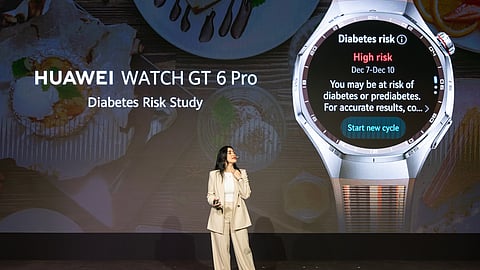
Huawei has integrated advanced PPG sensors and algorithmic analysis into its smartwatches to support diabetes risk awareness. Users are required to wear the device consistently on their wrist for a period of three to fourteen days.
Following the evaluation period, the Diabetes Risk app provides a clear outcome, either low risk, medium risk or at high risk. Users identified as at medium or high risk are advised to seek professional medical consultation for further evaluation and confirmatory diagnostic testing.
From a healthcare perspective, the feature is positioned as a preclinical risk awareness tool rather than a diagnostic solution, which is an important distinction aligned with regulatory expectations.
Clear regulatory and clinical positioning
Huawei emphasises that the diabetes risk function is not a medical device and is not intended to diagnose diabetes or replace clinical testing. Instead, it increases awareness and prevention, encouraging early engagement with healthcare professionals as well as accessibility offering the feature free of charge to users. It is only for civilian use and not intended for clinical or hospital deployment and is safe without any known side effects or contraindications.
In markets such as China, the feature is positioned as a non-medical function, designed to raise awareness and support prevention rather than serve as a clinical tool. Any measurements provided are for reference only and are not intended for diagnosis or treatment, instead offering users an indication of potential diabetes risk levels.
Expert collaboration and scientific validation
At the World Health Expo Dubai 2026, Prof. Jiguang Wang, Director of the Shanghai Institute of Hypertension, highlighted the growing evidence supporting wearable-based PPG as a reliable early risk assessment method. Prof. Wang has collaborated closely with Huawei on wearable health innovations, including the development of the HUAWEI WATCH D and WATCH D2, devices focused on ambulatory blood pressure monitoring.
Huawei’s broader health research efforts are supported by its Health Labs in Dongguan, China, and Helsinki, Finland, where multidisciplinary teams conduct research in cardiovascular health, exercise physiology, and long-term health monitoring.
A strategic shift towards the UAE and global markets
Historically, advanced wearable health features are often launched first in China before reaching international markets. Huawei is now actively shifting this model. Through synchronised global launches and deeper collaboration with local medical institutions, the company aims to ensure that regions such as the UAE gain timely access to its most advanced health technologies.
This strategy aligns with the UAE’s national focus on preventive healthcare, digital health transformation, and early disease intervention. Future deployments from Huawei including areas such as glucose monitoring, cardiovascular health, and women’s health will increasingly involve local medical partnerships to ensure relevance and compliance with regional healthcare frameworks.
Preventive health at scale
Currently available on the HUAWEI WATCH GT 6 Pro via an OTA software update, Huawei’s diabetes risk assessment feature is expected to expand to additional smartwatch models. While not a substitute for clinical diagnosis, it represents a meaningful step towards population-level health awareness driven by consumer technology.
As diabetes prevalence continues to rise in the UAE and across the region, innovations that support early risk identification without adding cost or complexity may play an increasingly important role in national health strategies. Huawei’s approach signals how wearable technology can complement traditional healthcare by shifting the focus from treatment to prevention.
This content comes from Reach by Gulf News, which is the branded content team of GN Media.