Better insurance coverage for Indian workers from August 1
Indian government enhances mandatory insurance scheme for migrant blue-collar workers
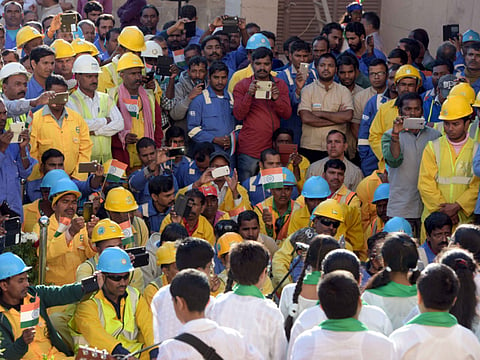
Dubai: From August 1, Indian blue-collar workers in the UAE will have better insurance coverage as the Government of India has revamped a mandatory insurance scheme for them.
The scheme called Pravasi Bharatiya Bima Yojana (PBBY) is aimed at the welfare of Indian workers holding Emigration Clearance Required (ECR) passports for overseas employment in 18 countries, including those in the GCC.
The strengthened scheme (PBBY, 2017) will come into effect from August 1, the Indian Consulate in Dubai said in an announcement posted on its website.
According to the amendments published in the official gazette of India, PBBY 2017 will replace the existing scheme from the same day.
Blue collar workers
About 65 per cent of an estimated 2.8 million Indians in the UAE are blue-collar workers and most of them are in the ECR category.
The new scheme that offers enhanced insurance coverage will benefit these workers and those who will come over to the UAE for employment in future, Indian Consul-General in Dubai Vipul confirmed to Gulf News.
“The enhancement of this scheme is part of the [Indian] External Affairs Minister’s efforts to ensure welfare of the Indian community and workers abroad. The problems that workers used to encounter [with the existing scheme] have been rectified and there is a provision for easily renewing the insurance online. Also, the amount of insurance coverage has gone up in various cases.”
He noted that the revised scheme has given power to Indian missions to certify health conditions and labour cases of blue-collar workers, making the procedures for claims easier for them.
“Earlier, there were some requirements for the workers to get reports and certifications from foreign authorities and employers to make claims in certain issues like death or disability due to accidents and legal proceedings related to labour issues.
"Workers had found such procedures difficult for them. Now, they can just seek the certification from the Indian missions.”
In a report published in March, Gulf News had highlighted such difficulties faced by workers, including a 14-day time frame for the insured to commence the journey for the overseas job for the insurance to be valid. In the amended scheme, there is no such requirement.
“Switching jobs will also not affect the policy if it happens during the same period of policy,” Vipul said.
The policy premium and period remain as nominal as Rs275 and Rs375 for two and three years, respectively. The maximum sum of insurance coverage under the scheme also remains Rs1 million [approximately Dh57,281] in the event of accidental death or permanent disability leading to loss of employment while in employment abroad, irrespective of the change of employer or location of the insured person.
Welcoming the move, K.V. Shamsudheen, who has been engaged in financial education of Indian workers, said the government must find mechanisms to spread awareness about the scheme and assist less educated workers in doing the online processing of the insurance policy.
“It would be ideal if the criterion was changed to all Indian expatriates whose salary is below US$300 [Dh1,101] instead of ECR passport holders because presently many workers in that category are getting more salary than the several other categories of workers,” said Shamsudheen, who is also the director of Barjeel Geojit Securities.
Highlights of the new scheme
- No 14-day time frame for commencing journey for employment to validate the insurance.
- Online provision for renewal of policy.
- No need for certification of documents from foreign entities and employers.
- The certification of accidental death or permanent disability by Indian missions will be accepted.
- The medical insurance cover for hospitalisation due to injuries, sickness, ailment and diseases has been raised from Rs75,000 to Rs10,0000 (up to Rs50,000 per hospitalisation).
- The legal expenses on litigations related to emigrant’s overseas employment enhanced from Rs30,000 to Rs45,000, provided such litigations are certified by the Indian missions.
- Repatriation cover for medically unfit/premature termination of employment: One way economy class air fare to the nearest international airport in India.
- Maternity benefit to women emigrants increased from Rs25,000 to Rs35,000 (in case of normal delivery) and to Rs50,000 (in case of caesarean section delivery).
- Family’s hospitalisation in India in case of death or permanent disability of the insured is up to Rs50,000 per annum during the policy period.
- In case of emigrant’s accidental death or permanent disability, there are provisions for one-way economy class air fare for repatriation and two-way fare for an attendant.
- The insured are also eligible for one-way air ticket when he or she faces the following problems on arrival at their workplace or destination abroad: if the emigrant workers are not received by the employer, or if there is any substantive change in the job/employment contract/agreement to the disadvantage of the insured person, or if the employment is prematurely terminated within the period of employment for no fault of the emigrant.
- However, the grounds for repatriation need to be certified by the Indian mission and the air tickets need to be submitted in original.


