World events that may swing US election
More people are concerned with domestic policy. But every politician lives in fear of that 3am phone call
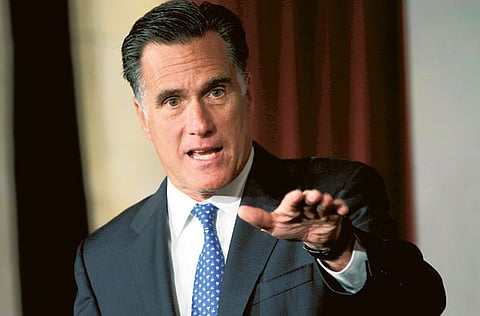
The prevailing political wisdom is that the economy — not foreign policy — will determine who becomes the next president of the United States. In a recent Washington Post-ABC News poll on what the single most important issue was for them in choosing a president, 52 per cent said jobs and the economy (and they’re evenly split on whether Barack Obama or Mitt Romney would do a better job on the latter).
To put that figure in perspective, the second most-cited issue was “Health care/repealing Obamacare” at a mere 7 per cent, while foreign-policy issues such as terrorism and the war in Afghanistan each mustered a measly 1 per cent of responses.
But every politician lives in fear of that 3am phone call that can upend the best-laid campaign plans. Here are five global events that could send the US election careening along a very different path than the one it’s travelling down today.
- A showdown with Iran: World powers are currently wrapping up a second round of contentious nuclear talks with Tehran, and the European Union is preparing to roll out an oil embargo on Iran in July. But if this diplomatic tack fails to wring meaningful concessions from Iran, there’s an outside chance that Israel — or, in a less likely scenario, the United States and its allies — will conclude before November that military action is the only way to halt Iran’s nuclear advances. Americans see Iran as the country that represents the greatest threat to the United States, and a recent Pew Research Centre poll found that 63 per cent of Americans are willing to go to war if necessary to prevent Iran from developing nuclear weapons — a measure that Romney has promoted more aggressively than Obama.
Some market analysts estimate that a military conflict with Iran could push petrol prices in the United States to between $5 (Dh18.35) and $6 per gallon, alienating voters and jeopardising the country’s fitful economic recovery. And there’s a reason why the National Journal’s Charlie Cook has dubbed Iran the “wild card” this campaign season: The last five times petrol prices have spiked during a US presidential campaign, the incumbent party has lost the election.
n A European nosedive: The prospect of a Greek anti-austerity party winning new elections in June has sparked widespread fear that Greece will default on its debt and exit the eurozone, which could spread contagion in southern Europe and plunge the global economy back into recession. But there’s a debate about the extent to which the European debt crisis will influence the US election.
If a Greek exit precipitates the collapse of the Eurozone, Brookings Institution scholar William Galston argues in the New Republic, it will be disastrous for Europe and the United States. But he adds that US GDP growth would probably slow and the unemployment rate would likely stagnate even if the European monetary union remains intact after Greece’s departure.
“These developments would make it harder for Obama to argue that we’re heading in the right direction, and … I suspect that economic growth at these depressed levels would mean victory for Mitt Romney,” he writes.
- A Chinese economic slowdown: China’s slowing economic growth has prompted Chinese leaders to pledge new measures to stimulate domestic demand and commentators to warn of an impending economic crisis in the country. But when Beijing sneezes, does Washington catch a cold? China’s sluggish growth poses a “substantial risk” to the United States as the general election approaches, Campbell Harvey, a professor at Duke University, told CNN. “You don’t need a lot to knock us out of recovery.”
- A domestic terrorist attack: The United States has not suffered a major terrorist attack during Obama’s presidency, and the administration has foiled several plots. The president has taken out several high-profile terrorists through drone strikes and touted the killing of Osama Bin Laden as one of his signal achievements — much to Mitt Romney’s chagrin.
But an attack on American soil could instantly shatter the armour Obama has built up on national security, reverse the public’s declining concern about terrorism, and transform the campaign. And such a scenario isn’t out of the question..
n The unknown unknown: There’s a reason we call the “October surprise” what we do — sometimes (though admittedly not often) we simply don’t know what will tilt the results of a race until Election Day is upon us. The term “October surprise” dates to 1972, when National Security Adviser Henry Kissinger declared less than two weeks before the presidential election that peace was “at hand” in Vietnam — comments that were credited with helping President Richard Nixon resoundingly defeat George McGovern (though in truth, Nixon didn’t need much help).
We have a way to go until November, and anything from security in Afghanistan to violence in Syria to elections in Venezuela (ominously scheduled for October) could emerge as a potential game-changer. When the 2008 presidential election got under way, everyone assumed that foreign policy — specifically the war in Iraq — would be the dominant issue in the campaign. And then the global financial crisis hit, propelling the economy to the top of the agenda. It’s too early to rule out the reverse happening in 2012.
— Washington Post
Uri Friedman is an associate editor at Foreign Policy.


