US trapped in WikiLeaks web
We cannot but marvel at the greatness of the internet and the impossibility of controlling it even by those who are supposed to be its masters
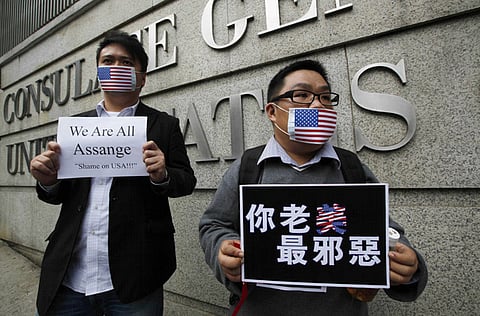
It would have been much better if the website or the journalist who published the cables of the US State Department and divulged its secrets was not a westerner. I wish he was from the so-called northern hemisphere, which usually nags about being overpowered by the south. Had this happened, it would have been a great victory for globalisation. It is definitely difficult for third world media to do what Julian Assange of WikiLeaks did, but it is not at all impossible in the age of the Global Village, as globalisation is supposed to be a multi-way process thanks to the new media.
There is no doubt about the fact that the western world, represented mainly by the US, has on several occasions shown itself to be totally anti-globalisation, as it clearly wants the flow of information to be one way.
In other words, the western world is ready only to influence the rest of the world with its culture and media, but not at all prepared to interact with other cultures, or for that matter, allow others to influence its societies.
Funnily enough, the US alone produces about 75 per cent of world media products, and still it is afraid of foreign influence. But the funny thing this time is the US has not been shaken by foreigners or their media, but by what is regarded to be an innately western invention, that is cyberspace.
It is true that the world wide web was invented by British scientist Tim Berners Lee, but it has since become a great US stronghold thanks to the Americans being the masters of the information revolution.
As we all know, most of the giant cyberspace companies are mainly American. Add to that of course the fact that most internet servers, super computers, protocols and data banks are all located in the US.
Others also argue that even the internet switch is in American hands, being aboard one of the aircraft carriers. And so the US can easily cut off foreign internet services as it did recently with Cuba, Syria, North Korea and others. But still, America with all its humongous cyber power stood powerless before WikiLeaks. It can hardly do anything except moan and groan against a journalist called Julian Assange and his website, which managed to shake the US and the rest of the world with a very low-budget site.
Assange together with a couple of colleagues managed to obtain over a quarter million secret documents from the US State Department and thanks to cyberspace power they made them public for millions of people to read the world over, which hugely embarrassed and even greatly harmed US interests all over the globe.
Assange's leaks have been the talk of the world for the past couple of weeks. All media outlets have republished WikiLeaks with great relish.
In other words, the supposedly most cherished American imperialist media weapon, i.e., the internet, has all of a sudden become an arch enemy. The magic has adversely turned against the magician, as cyberspace has become for the Americans more a nightmare than a great media arsenal.
There is no doubting the fact that the internet is an offshoot of globalisation. It has been promoted to an economic arm for the dominant powers, and globalisation itself is merely a soft synonym for imperialism, which aims to colonise the world with new means, and subject it to its strategies. But there seems to be something more powerful and resourceful than all empires put together. Whoever thought that the internet, which is America's most effective media outlet, would be others' most adequate means to harm US interests and expose its manoeuvring?
Did the gods of cyberspace expect the WikiLeaks tremor? Definitely not. There are of course those who argue from a conspiracy theory point of view that the leaks were let out on purpose by the US itself for certain purposes. But if we leave the conspiracy theory aside, we cannot but marvel at the greatness of the internet and the impossibility of controlling it even by those who are supposed to be its controllers, no matter what they do.
Security apparatuses
We all know that the US establishment represented mainly by the Pentagon and other security apparatuses plus the State Department, has done its utmost to lessen the damage incurred by WikiLeaks on its country, but to no avail.
Funnily enough, some US security apparatuses have exerted a hell of a lot of pressure on US hosting and server companies to drive WikiLeaks out of their servers, which they speedily did.
Some time ago, former US vice-president Al Gore bragged about the internet being a "super highway", but now it is the Americans and nobody else who are putting spokes in the wheels of the cyber revolution. Time magazine did well when it published on its front cover a photo of Assange being gagged by the US flag.
The US predicament with the internet reminds one of Georg Hegel's famous theories, that is "the subtlety of history". According to Hegel, history is sometimes ruled by chance and blind destiny, which no power can ever control.
At last I very much hope I am right in my point of view that WikiLeaks is a great victory for cyberspace over the mighty, and not yet another great deception produced by the US and presented by WikiLeaks and company.
Dr Faisal Al Qasim is a Syrian journalist based in Doha.


