US may believe it's time to attack Iran
Washington has long been interested in a regime change in Tehran, and the stars seem to be aligning
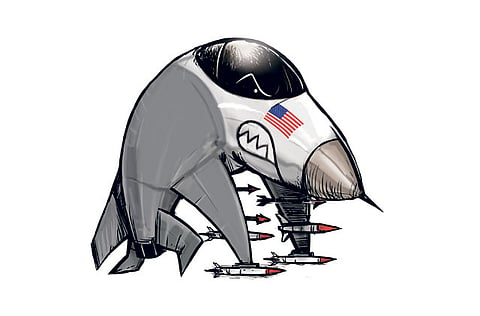
US-Iranian relations are becoming increasingly tense. Most analysts believe that confrontation between the two countries might have become unavoidable. The Obama administration will most likely capitalise on its "success" in reviving peace talks between Israel and the Palestinians by garnering regional support for a possible strike against Iran. The withdrawal of US combat forces from Iraq could also act as a catalyst. Some Washington-based think tanks are no longer debating whether the US should attack Iran, but when. Prominent right-wing analysts have been arguing that any strike that falls short of toppling the regime would be a failure.
If the Obama administration considers regime change in Tehran, it won't be the first to contemplate this policy. In fact, for over half a century, US-Iranian relations have centred on the question of who should rule Iran. Since the Iranian Revolution, most US administrations have considered regime change.
In 1979 the US tried to save the shah's regime. When it failed, it opted instead to save Iran as a key regional ally. The Carter administration decided hence to establish contacts with Ayatollah Ruhollah Khomeini. It conveyed to the Iranian leader that it had accepted the revolution and was prepared to continue an arms-supply relationship with the new government. Washington was disappointed by its initial reading of the revolution, when the US embassy was stormed by Iranian students and its diplomats were taken hostages. The Carter administration contemplated another military intervention — this time to rescue the hostages, rather than overthrow the revolutionary regime. The rescue operation failed too and, as a result, Carter lost his bid for a second term in office.
President Ronald Reagan had his own Iran-related problems. The Iran-Contra scandal haunted his administration for several years. He approved the sale of arms to Iran in exchange for the release of seven American hostages held in Lebanon in 1984. Indeed, three hostages were released, but only to be replaced by three others. When the affair became public in 1986, the administration was found guilty by a Congressional committee of violating the US-imposed embargo on arms sales to Iran.
Dual Containment
The end of the Cold War allowed the US to adopt a tougher approach. The Clinton administration tried to isolate Iran through its Dual Containment policy. It exerted huge international pressure to prevent foreign investment in Iran's hydrocarbon sector and blocked attempts to export advanced technologies to Iran. Despite this approach, the US policy did not aim at changing the Iranian government but at inducing Iran to change its policies. Its success was very limited, however.
The ascendance of President Mohammad Khatami marked a shift in US-Iranian relations. Barely a year after taking office, Khatami addressed the American people via CNN. He expressed respect for US culture and his hope for a new chapter in relations between the two countries. Yet Washington's response was mild and as a result the Clinton presidency ended without much improvement in the relationship between the two countries.
During the war on Afghanistan, the Bush administration sought Iran's support to overthrow the Taliban. Iran contributed significantly, but was stunned when the Bush administration lumped it with Iraq and North Korea as part of an "axis of evil". When the US began contemplating the invasion of Iraq, it turned to Iran once more. After the Iraqi regime was removed, Iran again came under fire. It was accused of trying to destabilise Iraq, undermining the Middle East peace process, developing nuclear weapons and sheltering Al Qaida fugitives.
Having withdrawn most of its combat forces from Iraq and to some extent revived the peace process, it is feared the Obama administration may now be tempted to attack Iran.
Israeli Prime Minister Benjamin Netanyahu believes that he has met his part of the bargain by agreeing to resume peace talks. In return, he expects US President Barack Obama to do his bit by attacking Iran.
Dr Marwan Al Kabalan is a member of the Centre for Strategic Studies and Research at Damascus University in Syria.


