Roots of American rage over Park 51
The rhetoric and policies shaping the war on terror have increasingly developed the notion of a Muslim enemy within
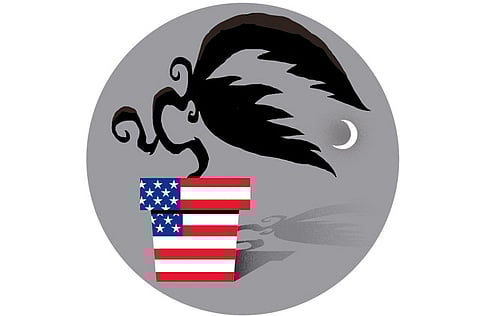
It is increasingly noted that the outpouring of anger among Americans staunchly opposed to the construction of the so-called "ground-zero mosque" at Park 51 is informed by a general distrust of Muslims. To practice Islam, their thinking goes, is to be at odds with genuine American values. Somewhat less focused upon, has been the emerging pattern of vocal opposition, and in some cases vandalism, against proposed Islamic sites in other states. Townships in California, Georgia, Wisconsin, Ohio, Kentucky and Tennessee have seen residents mobilise against plans by Muslim Americans to develop mosques and community centres. Still less noted is the possibility that this backlash is more than either a flash fire of identity politics being cynically stoked by Conservatives gearing up for election season, or even an expression of discontent caused largely by a time of economic decline. It is this possibility that deserves more attention.
This backlash may actually reflect an ongoing shift in many Americans' understanding of their national identity, whereby they increasingly view ‘being American' in terms of ‘defending freedoms' from a threat emanating out of a generic ‘Muslim world'.
In the flurry of sensational rhetoric surrounding the Park 51 project, we often see its opponents pushing the envelope of acceptable opinion regarding Muslims and Islam. Whether it is the ‘expert' opinion that the site will be a "command centre for terrorism", or the reiteration of Pat Robertson's message that Islam is not a religion at all but a "political ideology", one thing is clear: the notion that Muslims and Islam are exceptional to American society is increasingly harder to dismiss as fringe opinion. As early as 2004, a poll by Cornell University indicated that nearly half of all Americans believed that their government should limit the civil liberties of their fellow Muslim Americans to some extent. Another released just last month by the non-partisan Pew Research Centre indicates a continuing rise of unfavourable views among Americans towards Islam. The fact that so few politicians have publicly defended the constitutional right of Park 51 developers or called for restraint in places where tensions have flared suggests an acute awareness of these sentiments on their part.
Yet these trends in public opinion cannot be reduced to the event of 9/11 alone, or even the current military campaigns in Iraq and Afghanistan. For an increasingly widespread suspicion of a specific category of people to both take hold and persist, there is a need for officially sanctioned rhetoric and policies continually targeting them. Facilitating precisely this was the revival of the "clash of civilisations" paradigm immediately following 9/11. A reoccurring theme in American news media since then has been that the dilemma facing America is "Islamic consciousness" itself as it is inherently "prone to extremism". Muslims emerge in these commentaries as uniform in thought and potentially incapable of integration into American society. In sum, the popularisation of this rhetoric has lent itself to legitimising suspicion of Muslim Americans.
This bias, though strengthened since 9/11, is not new in American media. Academics have often traced it back to the 1979 Iranian revolution, and the taking of 52 American hostages which it involved. Until then, Communism was represented as America's only grand political competitor. The emergence of a new Iranian government explicitly identifying itself as both Islamic and anti-American led to Islam being increasingly represented in monolithic terms as yet another grand competitor. Nor did these themes remain limited to news coverage. Jack Shaheen's painstaking review of more than 900 Hollywood films, much of which were also on screen before 9/11, demonstrated a clear stereotype of ‘the Arab' in American popular culture. Spurred by religious zeal and locked in combat with American protagonists, this archetype has worked to advance not only the misconception that all Arabs are Muslims (and vice-versa) but that membership in either of these categories necessarily precludes membership in America.
Since 9/11, however, misconceptions have increasingly been translated into mistreatment. Although George W. Bush initially made efforts to stress Muslims in general were not to blame, the policies of his administration reinforced this generalisation. Soon after the Patriot Act of October 2001, a nation-wide programme of "voluntary interviews" targeted 5,000 Muslims living in America, while the Immigration and Naturalisation Service was instructed by John Ashcroft (then attorney general) to round up only the "young Arab men" from its list of people who had ignored their deportation orders. In fact, Ashcroft went on to underline that immigration laws were being amended to serve the "war on terror" — most of the 20 or so legal changes and executive orders affecting immigrants and visitors to the US have targeted Arabs. All the while, Bush's neoconservative advisors such as David Frum and Richard Perle even began to publicly advocate the surveillance of mosques and American Muslims by their neighbours.
Whether negative public opinion in America towards Muslims will grow or subside in the near future is unclear. What is clear is that the rhetoric and policies shaping the "war on terror" have increasingly developed the notion of America's "enemy within" — an enemy almost exclusively Muslim. We can only hope that civil liberties won't succumb to this sort of politics, and that American attitudes towards the Park 51 project won't morph from "anywhere but there" to "anywhere but here".
Behzad Sarmadi is a visiting scholar at the Dubai School of Government.


