Pakistan at point of no return
Islamabad has been forced to take some tough decisions with regard to US after Nato air strikes
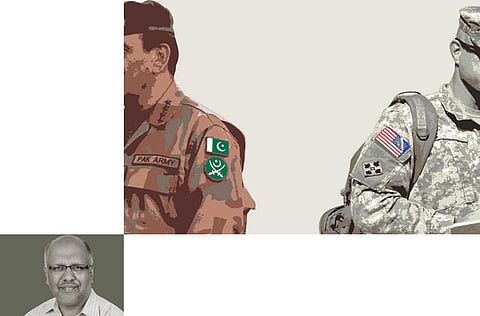
A significant hardening of Pakistan's position towards the United States in the past week carries at least a half familiar ring but with some key differences. In the days after Nato's attack helicopters targeted two of Pakistan's army posts near the Afghan border and killed 24 Pakistani soldiers, the country has reacted angrily in ways including some unpredictable ones.
Beyond ordering a halt to trucks carrying supplies via Pakistan for Nato's troops based in Afghanistan, Pakistan has ordered the return of the Shamsi airbase in the south-western Balochistan province, given earlier to the US. Additionally, in order to make a dent in the world of global diplomacy comes a decision to boycott an international conference on Afghanistan in the German city of Bonn, due to take place tomorrow.
While the reaction as an expression of anger is indeed along the lines of what was expected, it would be a mistake for anyone to assume that Pakistan will this time round back away as easily. In previous instances such as the aftermath of the arrest of Raymond Davis, a CIA operative, nabbed after he killed two Pakistani nationals, the country's authorities eventually relented from their initial hardline position and facilitated his release.
Then came the May 2 discovery and killing of Osama Bin Laden in an attack carried out by US Navy SEALs, targeting a location in Pakistan's northern city of Abbottabad. As if the discovery of the world's most wanted terrorist in their backyard was not enough of an embarrassment for Pakistani authorities, it was also revealed after the raid that the operation came without the US showing Islamabad the courtesy of providing advance warning.
Both of those instances — the Davis affair and the Bin Laden raid were followed by an eventual scaling down of Pakistan's anger. But this time around, there is a possibility that Pakistan's stiff reaction may be longer lived than before. There are a number of factors which have taken Pakistan to this point where the country's ruling authorities, notably the army, is eager to say ‘enough is enough'.
Part of the anger is indeed fuelled by popular sentiment across Pakistan where many common folk sincerely believe that the so-called friendship with the US has been of little benefit to their lives.
But there are also significant questions that have popped up from key institutions, notably the armed forces, which are supposedly allied to the US forces backing the coalition in Afghanistan. For Pakistani forces, there is an ultimate question tied to the net result of carrying out a cost-benefit analysis of this relationship.
While Pakistan's armed forces have received different types of military hardware from the US, to date there is no example of that supply line bringing a qualitative or quantitative lift for Pakistan's defence potential in comparison to its neighbours.
Afghan stabilisation
On the contrary, Pakistan is still reeling from Washington's decision to withhold up to $800 million (Dh2.94 billion) in military assistance which kicked in when Pakistan ordered US military personnel to leave the country after the Bin Laden raid. So far, there are no indications of the military assistance reversal beginning to be restored.
Perhaps last but not the least is what appears to Pakistan as evidence of Washington's failure to help the country elevate itself strategically in relation to its surrounding region as a quid pro quo for Pakistan's support to US-led efforts for stabilising Afghanistan. For months, Pakistan's quiet and occasional public lobbying for being given a role in the strategic stabilisation of Afghanistan appears to have been ignored.
It has been almost two years since General Ashfaq Kiyani, Pakistan's army chief of staff, offered his army's services for the training of Afghan military personnel. To date, there is no tangible evidence of Afghanistan even beginning to take up Pakistan's offer. On the contrary, Afghanistan chose to step ahead and sign a strategic cooperation pact with India, disregarding Pakistan's sensitivity on this issue.
In this background, it is hardly surprising to not only see the scale of anger emanating from Islamabad after its latest encounter with the US but, more importantly, the hardening of positions in the Pakistani capital.
It would be a mistake for Pakistan's western allies to assume that time and not dealing with Islamabad's issues, will begin to resolve what appears to be a truly complicated tangle.
Farhan Bokhari is a Pakistan-based commentator who writes on political and economic matters.


