No clear winner in Iraq
Coalitions will have to work together to form a government
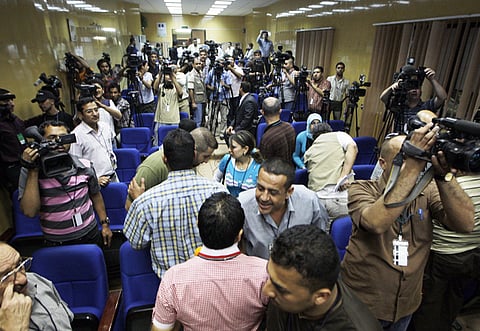
After the voting process ended on March 7, officials began assessing the results of the Iraqi elections.
The political parties that had taken part in the elections waited in anticipation for the news that will lead to new political deals and coalitions.
No doubt the elections will yield a new legislative authority that is superior to the one whose jurisdiction ended on Wednesday.
Iraqi voters removed three speakers and a number of ministers and lawmakers, several of whom were shamefully unable to obtain more than a few hundred votes.
Iraqis have assumed the role of a control body over their representatives, while the lawmakers themselves have failed to a large extent in policing the executive.
Four major political blocs performed well in the Iraqi elections, as shown by the results so far. The State of the Law coalition and Al Iraqiya coalition are competing for first place, ahead of the National Iraqi Alliance in third place and the Kurdish Alliance in fourth. Smaller blocs have disappeared from the new Iraqi political map.
The Iraqi elections also revealed the increasing maturity of voters and efforts to overcome sectarianism.
Iraqi voters no longer support entities that represent a certain sect, religion, ethnic group or region — parties that dominated the political process in the past. The results of the elections also revealed the extent to which the influence of the Iraqi Accord Front has diminished, after many of its members defected to the Al Iraqiya coalition. The Kurdish alliance suffered a similar blow after the Change bloc headed by Noshirwan Mustafa attracted a number of the alliance's former followers.
The elections also restored hope in Iraq's future. Hopes are high that the civil secular movement will have a strong presence that will not be ignored in the parliament.
So how will the new government be formed? No single coalition will be able to form a government. In fact, no two coalitions will be able to do so together. Numerous deals will need to be struck. Negotiations in this respect will be difficult and will take a long time. They will also not be immune from external influence, and may well lead to more violence.
Strong opposition
There will be a strong opposition in parliament, contrary to what we have seen over the past four years. There will be a large political bloc outside government, and this is one of the healthy outcomes of the recent elections.
It is unlikely that the State of the Law coalition will form an alliance with the Al Iraqiya coalition, due to the sharp contrast in their points of view. As a result, the government could be formed by State of law, Iraqi National Alliance (INA) and the Kurdish alliance or Al Iraqiya Alliance, INA and the Kurdish alliance. In either case, two thirds of the parliament's members will have to sanction the alliance's choice of president of the republic, and the approval of a majority of lawmakers will also be required.
The process will be difficult because of the complicated Iraqi political map and regional intervention.
It is worth noting here that the competing alliances were formed for election purposes and thus, may not last much longer. In fact, some alliances will crack apart very soon if subjected to pressures or temptations.
The alliances that are expected to fall apart are Al Iraqiya and the Iraqi National alliance, as both consist of up to 10 parties, while the State of the Law coalition is less likely to be fractured because it mainly comprises the Al Dawa party, as well as a number of politicians from inside and outside the parliament.
Despite the announcements by the major alliances to the contrary, some have major differences with other parties. The Kurdish alliance, for example, had an extremely uncomfortable experience with the Al Dawa ruling party over the past four years.
On the other hand, the Kurdish alliance has long had strong ties with the Islamic Supreme Council of Iraq (ISCI), because the ISCI is more understanding about the Kurds' ambitions. However, the political role of the ISCI has declined over the past few years. Moreover, the influence of the ISCI within the INA has declined, while the Sadrists have gained more power. The Sadrists are known not to be sympathetic to the Kurds.
The Kurdish alliance has differences with some of the political groups inside the Al Iraqiya coalition, such as the Iraqiyoun group led by Osama Al Nujaifi, and the Iraqi Front for National Dialogue led by Salih Al Mutlag.
Hence, the INA which came in third will have a great role to play in forming Iraq's future government. Its alliance with the State of the Law coalition or the Iraqiya will be decisive.
The Sadrist movement inside the INA did not get on well with Nouri Al Maliki's government. However, the INA may be subjected to massive regional pressures to overlook its differences, make a deal and sacrifice some of its leaders. Otherwise, the INA may fall apart.
Dr Mohammad Akef Jamal is an Iraqi writer based in Dubai.


