Mothers dozing away crucial years
They seem to have forgotten their roles of raising children and have dumped them on their housemaids or nannies
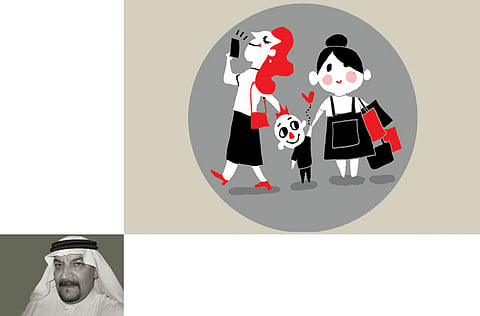
Lin Yutang, a Chinese writer accomplished both in Chinese and English and who lived most of his life in the last century, once said: "Of all the rights of women, the greatest is to be a mother." And almost a century before him, Henry W. Beecher, an American theologian and writer penned, "The mother's heart is the child's schoolroom."
My column on errant and neglectful fathers last week prompted a phone call from a South American reader in one of the kingdom's eastern cities. Lily, a schoolteacher of many years, has been alarmed by a disturbing trend. She wanted to express similar feelings on the breach of parenthood on the part of some of the mothers as well. It seems that during the course of her teachings and time spent at a local private kindergarten in the eastern province, she has observed enough alarming conduct to warrant venting her arguments and observations in this column.
She related to me instances where little children, most with hurriedly washed faces reflecting in their sleepiness and morning grooming were literally dumped at school by their mostly Asian maids or nannies. The poor children, usually woken up at the crack of dawn by their maids, hurried into dressing up for school and with hardly a bite to eat, were dragged and thrust into their cars for the trip to school before their objections became loud enough to wake up their sleeping parents.
On the way, if they had time, the car would stop at a mini-market where a soft drink and a candy bar would be bought for the little ones to serve as a breakfast snack before they were deposited at the school gates. Whilst in the car, the kids could be observed scampering all over seats or stretching out on the nook over the rear window of the automobile. Seat-belts were rarely secured on these young bodies as drivers weaved in the early morning traffic. If the driver and maid happened to be of the same nationality, they would be too engrossed in the topic of the day to be bothered about the security of their charges.
Dining table
As Lily relates it, on more than one occasion, a teacher concerned by the nature of preparations of her little pupils, would attempt to contact the child's mother at home, only to be told by the housemaid that "madam cannot be disturbed as she is asleep". That would even take place late in the day just before school let out. Messages are usually not acknowledged, and phone calls not returned by the end of the school day. Maybe madam is still asleep!
Once home, with madam just waking up for breakfast, these little children would be shepherded by the maid onto the dining table for lunch, after which they would be free to run around like little renegades.
Their luncheon menu would consist of whatever the housemaid put together within the confines of her knowledge and experience. Packaged noodles quick to prepare and loaded with MSG were a favourite and would definitely be in order accompanied by hurriedly prepared fried potatoes, or alternated with rice which is a staple dish in most of Asian countries. The importance of balancing the nutrition values of the different food groups was not put into practice.One does not have to take Lily's word for it. Take a closer look at a playground or the seashore. Or visit one of these ‘fun time play-lands' on any evening and you will be astounded by the magnitude of nannies/housemaids in proportion to the number of little children. And in minority would be found the number of children accompanied by their parents. One does not have to be an astute judge of children's psychology to notice that quite often these children learn foreign words and speak in foreign dialects long before they even begin to utter a single word in their mother tongue. Or that their nature is to draw closer to their nannies for comfort during periods of insecurity.
The oil boom years produced a new phenomenon in the region: the massive recruitment of housemaids or nannies in every household. Whether a household really needed it or not, everybody had to bring one into their home. And it was not long before parental roles fell upon their shoulders unwillingly. There have been reported cases of toddlers and young children suffering emotional traumas upon the final departures of the housemaids. The close and constant proximity of the housemaid during the early and developmental years of childhood helped rear just that. Mothers in slumber seem to have forgotten their designated roles. The seeds of future generations are being germinated today without their active participation. To such ladies I ask: Isn't it time to wake up?
Tariq A. Al Maeena is a Saudi socio-political commentator. He lives in Jeddah, Saudi Arabia.


