Hezbollah is ready for anything
Nasrallah is confident of his troops, but would prefer to avoid another war
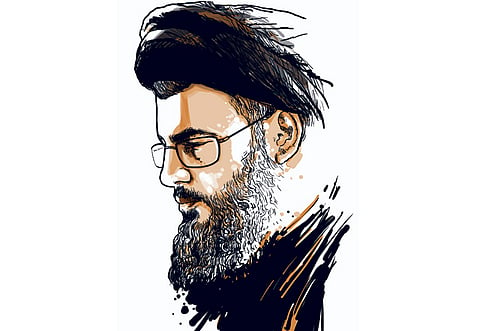
Last week, Iranian President Mahmoud Ahmadinejad spoke with Hezbollah Secretary-General Hassan Nasrallah. Nasrallah reportedly said that if Israel attacks Lebanon next summer, Hezbollah has the will and ability "to close the case once and for all." In a recent speech, he had said that Israel is not in a situation to start a new war, because it had not yet recovered from the 2006 war on Lebanon or the 2008 war on Gaza. "We will bomb your buildings if you bomb ours, your power plants if you bomb ours, your oil refineries if your bombs ours. I announce this challenge and we accept this challenge," said the charismatic chief of Hezbollah.
According to Israeli reports, Hezbollah emerged from the war of 2006 stronger than ever before, with 42,000 rockets and weapons capable of hitting Tel Aviv and the Dimona nuclear reactor in the Negev Desert. Nasrallah's recent threats and Ahmadinejad's show of support comes amidst rising fear of a summer war between Israel and Lebanon. Speaking to reporters last week, Ahmadinejad said, "According to information we have, they [the Israelis] are seeking to start a new war next spring or summer, although their decision is not final yet. But the resistance and regional states will finish them if this fake regime does anything again."
Hezbollah clearly does not want war, but according to Nasrallah it would not shy away if it is inevitable. Lebanon as a whole does not want war, having not yet fully recovered from the war of 2006. A new war would put a damper on the ambitions of Prime Minister Sa'ad Hariri, leaving him in a difficult position. He would have to live up to his Cabinet policy statement, in which he has promised to support Hezbollah's right to armed resistance. This would break the already fragile coalition with Hariri's Christian allies, who are complaining that the prime minister is granting all of Hezbollah's requests.
Syria does not want war either, but top officials have said that they will support Lebanon if it comes to it. The Saudis feel the same way.
Iran, however, would not mind another war in Lebanon. There are certain radicals within Iran who are not pleased about the so-called ‘Lebanonisation' of Hezbollah. The party, they believe, is becoming overly immersed in Lebanese domestic issues, pursing more of a political programme than a military one — a programme very different from the one formulated by Hezbollah's founding charter in 1982. They are itching for another war, to remind the world what Hezbollah is really all about. They are seemingly very convinced that Hezbollah can strike back at Israel, surviving a war just as it did the one in 2006, inflicting maximal damage on Israeli cities and infrastructure. These people believe Hezbollah would do sufficiently well that the international community would think twice before pushing for another confrontation with the organisation or, at a later stage, with Iran itself.
Others, however, are more sceptical, fearing that if Israel lives up to its threats, striking at all of Lebanon and not just the Shiite south, then this would create a very unfavourable environment for Hezbollah within Lebanese society, at least among Sunnis, Maronites and Druze.
In the middle
Nasrallah is caught between these two groups, with analysts trying to gauge whether or not he is in favour of another battle with Israel. Those who know the Hezbollah chief are saying that by making threats, he is actually reducing the chances of war. By stating that Hezbollah is ready, Nasrallah is effectively forcing Israel to think carefully before striking again at Lebanon. He is banking on the wisdom of seasoned Israeli statesmen, who know how costly it would be to inflict so much pain and destruction on Israeli society, regardless of the political or military gains such a war could secure.
As much as they hate the man, Israeli decision-makers believe that Nasrallah is true to his word. They know that if they attack Beirut Airport next summer, he is both willing and able to strike at Ben Gurion Airport. In 2006, Nasrallah vowed never to return two Israeli soldiers held captive by Hezbollah unless they were traded for hundreds of Arab prisoners. He lived up to his word and got Samir Al Qantar, the ‘dean' of Arab prisoners in Israeli jails, in 2008. During the 2006 war, Nasrallah promised to strike at "Haifa and beyond Haifa," and indeed, struck at the port city of Haifa, sending shivers down the spines of Israeli officials.
Nasrallah believes, however, that war is indeed coming — if not in the summer of 2010, then some time in the foreseeable future. He claims that the Israeli army will not settle for the results of 2006. He is, nevertheless, confident of the religious motivation and sophisticated training of his soldiers, along with the backing of states such as Syria and Iran. Nasrallah trusts that his men, who have not been infiltrated by Israel, will lead him to victory, just as they did in 2006.
Sami Moubayed is editor-in-chief of Forward Magazine in Syria.


