Fate of talks depends on Obama
The US president needs to find the backbone to call Netanyahu's bluff
In the wake of last week's peace talks in Washington between the Israeli and Palestinian leaders, will Benjamin Netanyahu now follow the footsteps of Egypt's Anwar Sadat, the Soviet Union's Mikhail Gorbachev or the US' Richard Nixon, who reached out to their adversaries?
Will he travel to Ramallah and pledge peace with the Palestinians, like Sadat when he addressed the Knesset in 1977, like Gorbachev when he accepted the dissolution of the Soviet Union in December 1991 or Nixon, who travelled to China in 1972 and agreed to establish relations with the Communist regime of Mao Zedong? Each of these headline-grabbing events ushered in a new era in international relations.
Master of evasion
It is too early, if not entirely fanciful, to expect such earth-shaking gestures from Netanyahu, a man considered the master of evasion. In turn, the straight-talking Palestinian National Authority President Mahmoud Abbas, whose stance has been well known for decades, will be negotiating on behalf of the all-inclusive Palestine Liberation Organisation, which technically represents all Palestinians and not only the Palestinian National Authority. To his credit, he has pledged to submit any peace agreement with Israel to a public referendum, doubtless a mind-wrenching exercise since Palestinians are scattered throughout the Arab world and beyond.
The upcoming two-day meeting between Netanyahu and Abbas in Egypt's resort town, Sharm Al Shaikh, chaperoned by US Secretary of State Hillary Clinton and special envoy to the Middle East George Mitchell, may be generously described as a positive step. But in reality the issue hanging over all their heads is whether the Israeli prime minister and his ultra-right-wing Cabinet will maintain the freeze, due to expire on September 26, on colony construction. Otherwise, the talks will be scuttled and, as Clinton underlined, the opportunity to end this conflict will vanish.
Cognisant of how everything is hanging in the balance, some Israelis have floated some shoddy ideas about how they could finesse the issue. One suggestion is that Defence Minister Ehud Barak could put a stop to the issuing of building permits in the Occupied Territories, thus curtailing any Israeli expansion by the colonists who nowadays number some 500,000. Barak, himself, has publicly acknowledged, though in vague terms, that the Palestinians should retain their territory in occupied East Jerusalem.
But most Israelis are in denial about how the rest of the world sees their usurpation of Arab land. One contrarian view, now gaining increasing support, has been voiced by Aluf Benn, editor-at-large of Haaretz, a liberal Israeli paper. He wrote in The Washington Post that Netanyahu's Israel "is ever more isolated from an international community that increasingly rejects Israel's occupation of the Palestinian territories, its [colonies] and its excessive use of force". Moreover, he continued, the prime minister "sees Israel's sheer existence, not its controversial policies, as the matter at stake".
To date, Netanyahu has managed to remain vague about his negotiating objectives and does not want any publicity about the progress of the talks until the final agreement. He further wants his negotiating team to be composed of trusted aides, for fear that any public knowledge of any concessions he may offer will torpedo his coalition government. This is reminiscent of Barak's stance during the Camp David talks, when all offers and counter offers were ignored once the meeting ended without any endorsement of the draft accord, a consequence that backfired on all participants.
This time around, a well-argued view for a one-state solution has been published in The Washington Post — a position speedily gaining ground even among some Israelis. George Bisharat, professor at the University of California Hastings' College of Law, wrote that "a de facto one-state reality has emerged, with Israel effectively ruling virtually all of the former Palestine". But for progress to be made, he argued, the two parties need "to formalise their de facto one-state reality ... on principles of equal rights rather than ethnic privilege" as well as "a secular, bilingual government elected on the basis of one person, one vote as well as strong constitutional guarantees of equality and protection of minorities, bolstered by international guarantees".
Question of commitment
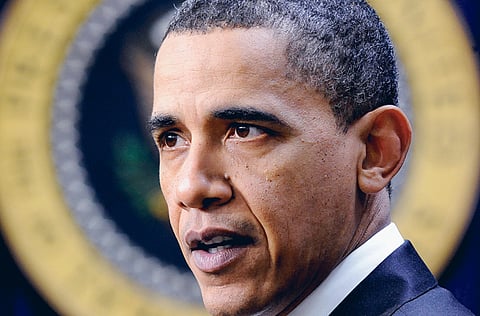
Whether all this will materialise in a year's time may ultimately depend on the seriousness of Barack Obama's commitment to achieving a Palestinian-Israeli settlement, especially given that there is extensive doubt nowadays about his willingness to resist pro-Israeli pressure during a mid-term election.
Here's what Dana Milbank of the Washington Post had to say in a column during Netanyahu's reconciliation session with Obama in June: "A blue-and-white Israel flag hung from Blair House, [the official guest house]. Across Pennsylvania Avenue, the Stars and Stripes was in its usual place atop the White House. But to capture the real significance of Prime Minister Benjamin's Netanyahu's visit with President Obama, White House officials might have instead flown the white flag of surrender".
Only time will tell whether Obama can call Netanyahu's bluff.
George Hishmeh is a Washington-based columnist. He can be contacted at ghishmeh@gulfnews.com


