Smart money over Iran should be on Obama
US President Barack Obama would be remembered for bringing Iran in from the cold
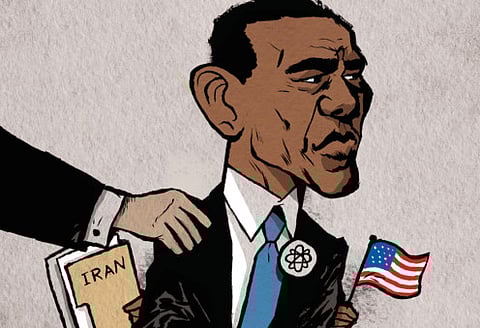
For Richard Nixon it was China and for Reagan it was Reykjavik. Could Lausanne be Barack Obama’s historic moment? It will take years, possibly a decade, to get a clear answer. That is the nature of the Iran agreement. Last Thursday’s deal might even be scuttled before the final deadline in June. Iran could disown what it has agreed when it comes to nailing down the gritty details. The US Congress could pass a bill that would make it easier for Iran to walk away. America’s allies in the Middle East might try to sabotage the talks. Lots of things might happen. But the idea is far from preposterous. For the time being, the smart money should be on Obama.
The reason is simple. Obama heads a strong coalition — the so-called P5 plus one is a formidable group that includes Vladimir Putin’s Russia. It took years, and several false starts, to achieve a deal in Lausanne. It will take years more for the deal to bear fruit. But the range of countries that wants it to succeed outweighs the Israel-Saudi coalition that opposes it. Obama’s critics in the US, including every Republican presidential hopeful, portray him as an isolated naïf chasing a quixotic peace. But the opposite is nearer the truth.
Obama has the backing of Europe, Russia, China, India and others. If a final deal is reached, it would be reckless for an incoming president in 2017 to scrap it. Second, by its own definition, the Iran deal’s success is eminently achievable. Iran must reduce its centrifuges, turn over one of its two uranium enrichment sites to research, close its plutonium facility and submit to intrusive round-the-clock inspections. In return, the nuclear-related sanctions will gradually be lifted. Nothing in the deal requires Iran to stop supporting Hezbollah, Bashar Al Assad’s regime or the Al Houthi rebels in Yemen. In other words, Iran could become a responsible civil nuclear state — at least for the next decade — while remaining a rogue actor in other spheres. By that measure, the deal will still have worked. If Obama’s wildest hopes were realised, the benefits would gradually push Iran to become a force for stability in the Middle East and an increasingly democratic country at home.
But Obama’s real bid for history will be in the demonstration effect of talking to America’s enemies. It is easy to forget that Obama did not just oppose the Iraq war — possibly the key thing that helped him beat Hillary Clinton in 2008. He also promised to give diplomacy a chance. Clinton mocked Obama for vowing to engage the world’s rogue regimes. Last Thursday, Obama returned to a John F. Kennedy quote that he often used in 2008: “Let us never negotiate out of fear but let us never fear to negotiate”.
Political legacy
That stance helped to secure Obama the endorsement of Edward Kennedy and possibly the Democratic nomination. Should the Iran deal stick, it could also become Obama’s big legacy.
Much has been made of Obama’s inability to handle the growing maelstrom in the Middle East. He has made big mistakes. These include a premature withdrawal from Iraq in 2011 — a move that opened a vacuum which was filled by a combination of Iran and Daesh (the self-proclaimed Islamic State of Iraq and the Levant). He also traduced his own “red line” on Syria having said he would bomb the regime then backing out at the last minute. He has alienated close US allies, including Israel and Saudi Arabia. Meanwhile, he backed the ousting of Hosni Mubarak in Egypt but travelled full circle by supporting the Abdul Fattah Al Sissi regime. Just this week Obama announced he would restore the $1.3 billion (Dh4.8 billion) in annual US aid to Egypt’s military regime.
These were the errors of a faltering and inexperienced president. But Obama’s pursuit of an Iran nuclear deal has been dogged and principled. It also involved big risks. If the deal sticks, it will bring Obama outsized rewards. Just as George W. Bush was defined by America’s ill-fated invasion of Iraq, Obama would be remembered for bringing Iran in from the cold. Diplomacy will be back in fashion. If it falls apart, Obama will be mocked as a failed president, who left the US weaker than he found it. It requires gumption to take a gamble like this. It does not come from a place of weakness.
—Financial Times


