Ten gems of New Delhi
Find out how India's diversity comes alive in its capital's many wonders
Ever experienced each glimpse of a city different from the other with still a lot more to unearth? New Delhi does that to you. And now, as it gets ready to host the Commonwealth Games 2010 in October, there's no better time to prepare for an adventure to this capital city.
The diversity of New Delhi attracts visitors to the extent that many decide to make it their home for the rest of their lives. For the more you explore, the more mystical it gets.
Painted in different hues, its colours are more varied than the shades of nature. Shimmering, radiating and forever changing, Delhi is where emperors ruled. This is where history created itself.
Popularly referred to as Dilli, the city is not only known for its cosmopolitan culture, with people from all over the country and the world converging, but also for its warm-hearted inhabitants
Welcome to hamari Dilli (our Delhi).
Lodhi Gardens
Situated on Lodhi Road, the Lodhi Gardens means different things to different people — a historical site, a natural gym, a place for social interaction and a children's park. Hailed as Asia's Best Urban Oasis, it has been named the best garden by Time magazine.
One look at the swanky vehicles lined outside the garden is enough to decipher that it is the most preferred garden by the city's bigwigs. An ideal choice for joggers, strollers and walkers during the morning and the evening, in the afternoons, the garden is a much-sought-after destination for lovebirds or those who like to laze around and get away from the bickering back home.
Semiwilderness in nature, a benign feeling grips visitors on entering the garden, spread over 90 acres. Clean, fresh air, a colourful bloom of flowers and the medieval monuments lend a charm to the huge space that is home to 5,400 trees of 180 species.
Bahai Temple
It is architecturally one of the most splendid temples of India.
This is also referred to as Lotus Temple due to its flower-like shape.
Twenty-seven giant lotus petals of white marble spring from the nine pools and walkways, representing the nine unifying spiritual paths of the Bahai faith. The central hall of the temple is used for meditating.
Often compared to the Sydney Opera House, its exquisitely manicured lawns surround the building, which is visible from the street. Close to Nehru Place, the commercial landmark in South Delhi, the Lotus Temple is a masterpiece of 20th-century architecture and winner of several prestigious awards.
Designed by Fariburz, a Canadian citizen, its construction took six years.
Although beautiful during the day, the temple presents a phenomenal sight at night.
Before planning a dekko, it is importan to check out the visiting hours.
Old Delhi
Referred to as the walled city, Old Delhi is a photographer's delight, having a unique charm that is better seen than read about. Once the capital of the Mogul dynasty, it was chock-a-block with havelis, or mansions, of the nobles. But sadly, all that remains today are remnants of the old grandeur. Some of the havelis exist but the splendour is missing. Though crowded and dilapidated, it remains the heart of Delhi.
Jama Masjid, Red Fort and Chandni Chowk are few of its best-known landmarks. Jama Masjid, one of the largest mosques, can accommodate up to 25,000 people at a time.
Red Fort, also called the Lal Qila because of the red colour of the stone largely used, is laid out along River Yamuna. The Indian national flag is hoisted on the Red Fort every year on August 15, with the Indian prime minister addressing the nation. The tradition has continued since India got independence.
Opposite the monument is the more-than-300-year-old lane called Chandni Chowk. One of the narrowest, busiest and most prosperous trading centres of the city. Several businesses take shape here.
Chandni Chowk is a foodie's haven. You need ample time to relish the numerous mouth-watering vegetarian and non-vegetarian cuisines, if food is your weakness. But it would do well to finish your visit to the historical places of Old Delhi first, followed by Chandni Chowk, because planning a visit the other way round could disturb your (food) plans.
Karim's is a must-visit for its kebabs. Started in 1857, it specialises in Mogul cuisine. It is also famous for phirni — a sweet dish. Though the decor isn't fancy, the aroma that wafts across when you walk in is something that swankier places do not have. Their biryanis and naans are awesome.
Moti Mahal is the first restaurant to introduce tandoori cuisine to the world. Heralding a revolution in taste and transformation of Indian eating habits, Moti Mahal has created a name for itself in the international gourmet map.
As tandoori chicken was followed by the now-famous butter chicken and dal makhani, it has become the destination for Indian and foreign VIPs and dignitaries.
A hub of social and cultural life, there are numerous lanes in Chandni Chowk but Paranthe Wali Gali is the most popular for food. For six generations, families have been serving parathas in this area.
The pure vegetarian meal is without onion and garlic and cooked in desi ghee (clarified butter). The varieties of parathas are stuffed with potato, tomato, cauliflower, paneer (cottage cheese), rabri (sweet dish made of condensed milk), papad (poppadum), peas, radish, carrot, fenugreek, sugar and banana.
They are served on a thali (plate) with subzi (vegetable dishes), achar (pickle) and chutney.
Traffic being a hindrance in Chandni Chowk, the narrow lane is accessible only on a two-wheeler or on foot.
Other major attractions of Chandni Chowk include Ghantewala's jalebi, Natraj's dahi bhalla, Gyani's rabri faluda, Gopal's japani samosa and namkeen and Noori's masale (spices). Gorge on the spicy chaat — it is matchless.
There is more to Chandni Chowk. So take a walk. Set amid sundry shops for clothes and knick-knacks, you can smell your way to a 187-year-old shop with 200 varieties of perfumes. Gulabsingh Johrimal is the oldest shop in the city at Dariba, Chandni Chowk.
Ask anyone for directions and the common refrain is: "Just go straight; you will smell it from a distance!"
India Gate, President's House, North and South Blocks
Once you are done with collecting souvenirs for family and friends, the first leisure outing has to be to India Gate, with its verdant sprawl promising a remarkable change from the city's otherwise cramped surroundings.
Citizens and tourists throng it throughout the day. It is a popular picnic venue too. So don't be surprised to see families enjoying home-made food on the lawns. Never mind weight issues, with vendors around, ice-cream for dessert is a must.
A stroll towards Raisina Hill takes you to the North and the South Blocks. These are Delhi's corridors of power, from where politicians call the shots. The two buildings, on opposite sides of Rajpath, are home to the most important government ministries.
These buildings flank the Rashtrapati Bhavan, the official home of the president of India. Comprising 340 rooms, it is considered the biggest residence of any president in the world.
Akshardham Temple
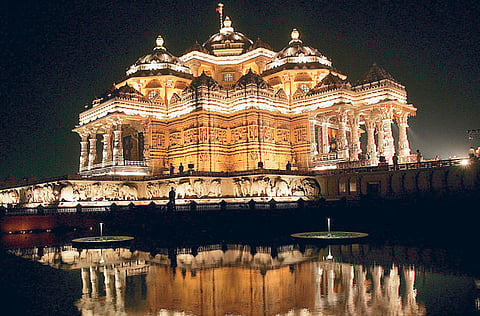
Both the religious-minded and atheists are unanimous in their appraisal for the architectural marvel that is the Akshardham Temple, located adjacent to the Commonwealth Games Village. Its features combine traditional and modern technology, passing on the message that the heavens don't fall if steel isn't used in the construction.
The temple rests on stone carvings of 148 huge elephants. Forty arches, 239 ornately carved pillars and 20,000 statues of Hindu deities complement the 11-foot-high gold-plated idol of Swaminarayan that presides over the structure.
The monumental delight includes exhibition halls and a theatre that features large format films (not Bollywood) on a giant screen. There is an option to capture the sheen of 10,000 years of Indian culture on a boat ride.
Mobile phones and cameras are not allowed. Nor is food from outside. Go for the tasty vegetarian cuisine at the food court inside the complex.
The Metro connects Akshardham to Central Delhi.
Terminal 3
Hong Kong, London and Frankfurt are passé. The buzz around town is New Delhi's swanky Indira Gandhi International Airport.
The recently inaugurated, state-of-the-art integrated terminal called Terminal 3 is a two-tier building, with the Arrival area on the first floor and the Departures area on the top.
With 48 boarding gates, 78 aerobridges, 168 check-in counters, 95 immigration counters, 30 parking bays, 15 X-ray screening areas and duty-free shops, it has the capacity to handle 34 million passengers every year. That makes the airport the world's third largest after Dubai and Beijing. Direct Metro connectivity from Central Delhi is a bonus.
Connaught Place
Delhi has its share of shopping arcades. Barely seven kilometres away from the Commonwealth Games Village and connected by Metro, Connaught Place, popularly called CP, is the place to be. With spacious colonnades and walkways, it is one of the world's few circular markets comprising three circles — outer, middle and inner — that have 16 blocks, lettered A to P. The Central Park is the icing on the cake.
Designed in 1936 and named after the Duke of Connaught, CP has an unmatched character, history and heritage, which beats the showmanship of the glitzy malls. And unlike any other market, from a needle to a swanky car, anything can be purchased here.
It comes with lower profit margins in terms of bargains. Low-budget travellers are advised to keep their options open and look into other affordable markets, else there is always the choice of traversing the same path in this circular zone.
Food
Cuisines from the Kashmir valley to the backwaters of Kerala and from the paddy fields of Bengal to the ghats of Maharashtra, all find a place in Delhi. Tourists do have their Delhi-belly experiences, an after effect, a result of consuming copious amounts of spicy food, but locals seem to be immune to such minor discomfort.
One might find food outlets at every street, but then it is serious business. In fact, some of the best food is found in nondescript corners, which is away from the glitz of hotels and restaurants.
While Wengers is famous for confectionery, Lodhi Hotel's Sagar Ratna is for South Indian food, Andhra Bhavan for thali meals and aloo parathas, Triveni Art Gallery also for aloo parathas and Bengali Market for its chaat, gol gappas and chole bhature. Take your pick.
Khan Market
A popular celebrity hangout next to Sujan Singh Park, Khan Market is the most glamorous shopping area, spilling over with cosy cafés, designer showrooms of national and international brands, bookstores and exotic fruit and vegetable outlets.
Termed India's Fifth Avenue, it ranks high on the global list of main streets. Khan Market's history begins after the partition of India.
The land was given to refugees from Pakistan and the North-West Frontier Province. It was named after the Pathan nationalist and social reformer, Khan Abdul Jabbar Khan, the older brother of Khan Abdul Ghafar Khan, also known as to as the "Frontier Gandhi". The location has always been one of the most coveted because of its proximity to diplomatic missions and many foreign offices.
The market is a big hit among politicians accompanied by their gun-wielding commandos. In what could be construed a win-win proposition for the shoppers, the place is dotted with eating joints of a delectable mix.
Chanakyapuri
The immensely dignified locale oozes charm. With green lawns and clean roads, the areas within the crossways are spread with visually striking embassies.
One of the most expensive expanse in the city, Chanakyapuri is a mix of large and small plots bearing archaic and remodelled constructions along with lush green, well-maintained parks.
Its proximity with the Indian prime minister's official residence at Race Course Road makes Chanakyapuri a high-security zone.
The nearest luxury hotels are Maurya Sheraton and Taj Palace. Others in the vicinity include Diplomat, The Claridges and Ashok.
The National Railway Museum near the Bhutan Embassy is a joyous place. Numerous vintage train engines, carriages and royal saloons are prized possessions at one of the four largest museums in the world. It comes under the Ministry of Railways.
A rail yard has been created here by laying tracks wherein real-time engines are kept. But they do not go to anywhere.
Janpath
The fashion street of Delhi is a must on the tourist itinerary, whether one wants to stock up on souvenirs or just soak in the Delhi feel.
It has also become famous for the 10 Janpath bungalow of prominent Congress leader Sonia Gandhi.
The Janpath market is a haven for budget travellers and shoppers who are keen buyers of curios, artefacts, handicrafts, silverware, garments and junk jewellery, including bangles, trinkets and danglers. Traditional Indian clothes are as popular as the latest trendy dresses.
But don't forget to bargain. The products are generally quoted 20 times more than the actual price.
For food buffs, the whiff of warm aloo tikkis and the typical spicy Indian chaat can be traced metres away from the street stalls. Central Cottage Industries Emporium is highly recommended if the idea is to surround yourself with India.
PalikaBazaar
It is strictly for those who don't mind the crowds, have mastered the art of bargaining or are just interested in window shopping.
More than three decades old, Palika Bazaar was the city's first centrally air-conditioned underground market comprising over 400 shops of varied sizes. Back then, the city had yet to experience the comforts of shopping in malls and it seemed almost all of Delhi shopped here.
Much has changed over the years but what hasn't is quite an irritant. Right from the main entrance gate, hawkers selling pens to precious stones and bangles to bags, descend like vultures trying to attract buyers, however reluctant they may be.
On descending the stairs, it is cacophony all around. Amid the blaring music, it is now the shopkeepers' turn to entice customers with discounts and bargains. They sell all — smuggled electronic goods, video games, pirated DVDs, garments, footwear, jewellery and snacks.
Baba KharakSingh Marg
This is another one for gifts and souvenirs. Containing emporiums of all states of India, including Punjab, Himachal Pradesh and Jammu and Kashmir, the street connects Connaught Place with Gol Dak Khana, the circular, main post office.
Baba Kharak Singh Marg offers the culture of all India in one place and people from the world come here looking for unique arts and crafts. Targeted at the mid-income group, the handicrafts, paintings, jewellery and wooden and brass artefacts available are created by traditional and skilled artisans of the respective states.
The place is also famous for the Hindu deity Hanuman's temple opposite the emporiums. An ideal meeting point for Delhiites is Delhi Tourism's Coffee Home, which provides food at reasonable prices.
The stretch is connected by the Metro and will be a part of Metro's Airport Express line from Connaught Place to Indira Gandhi International Airport.


